
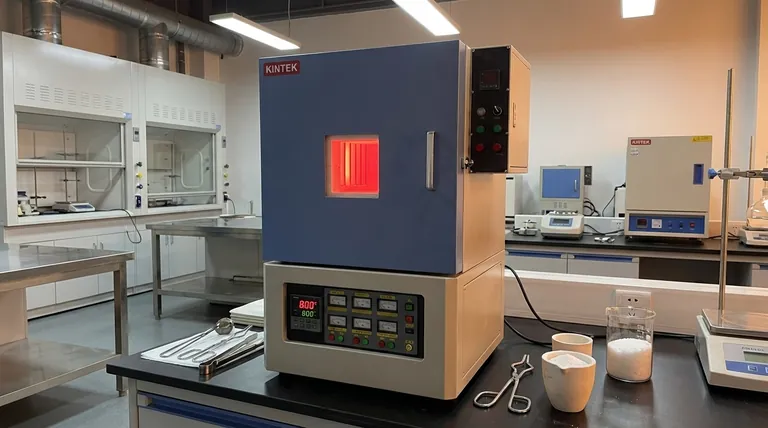
A high-temperature furnace functions as the critical activation chamber for the molten salt synthesis of CoNb2O6-based ceramic powders. By maintaining a precise thermal environment at 800°C, the furnace liquefies the salt medium, creating a solvent that enables rapid diffusion and reaction of the ceramic components at significantly lower temperatures than traditional methods.
The Core Insight While traditional solid-state reactions rely on high heat and long durations to force particles together, the high-temperature furnace in this specific application utilizes a molten salt medium to facilitate "liquid-phase" sintering. This allows for the synthesis of highly uniform, crystalline powders in a shorter timeframe and at reduced temperatures.
The Role of Thermal Precision
Creating the Reaction Environment
The primary function of the furnace is to establish a stable 800°C thermal field. This specific temperature is critical because it ensures the salt medium transitions fully into a molten state without overheating the ceramic precursors.
Once molten, the salt acts as a solvent. This liquid environment allows the reactants to mix and diffuse much faster than they would in a dry, solid-state mixture, which typically requires much higher energy inputs.
Enabling Low-Temperature Sintering
The furnace facilitates what is known as short-term, low-temperature sintering. By maintaining the 800°C setpoint, the equipment allows the synthesis reaction to occur rapidly.
This is a distinct advantage over standard calcination processes, which often require holding materials at constant temperatures for extended periods (often 3 to 5 hours or more) to drive solid-state chemical reactions and eliminate carbonates.
Impact on Material Quality
Enhancing Crystallinity
The controlled thermal environment provided by the furnace directly influences the structural integrity of the final product. The molten salt medium promotes better atomic arrangement during the reaction.
This results in CoNb2O6-based powders with high crystallinity. A precise furnace ensures that the temperature remains uniform throughout the chamber, preventing cold spots that could lead to incomplete crystallization or amorphous phases.
Improving Uniformity
Uniformity is the hallmark of effective ceramic synthesis. The furnace ensures that the thermal energy is distributed evenly across the crucible.
Combined with the fluidity of the molten salt, this thermal uniformity ensures that every particle undergoes the same reaction history. The result is a powder with consistent particle size and phase purity, avoiding the irregularities often found in powders synthesized via uneven heating.
Understanding the Trade-offs
Thermal Stability vs. Reaction Control
While this method is efficient, it is highly sensitive to temperature fluctuations. The furnace must possess tight thermal regulation capabilities.
If the temperature drops below the melting point of the salt, the reaction halts immediately as the medium solidifies. Conversely, excessive temperatures could volatilize the salt or degrade the ceramic phase. Therefore, the equipment's ability to hold a flat 800°C profile is more critical here than in less sensitive solid-state bulk sintering.
Process Complexity
Using a furnace for molten salt synthesis introduces complexity compared to standard air calcination. The presence of a liquid medium implies that subsequent processing steps will be required to remove the salt from the finished ceramic powder, a step not necessary in direct solid-state reactions.
Making the Right Choice for Your Goal
To maximize the effectiveness of your CoNb2O6 synthesis, consider your primary objectives:
- If your primary focus is process efficiency: Leverage the furnace's ability to stabilize at 800°C to drastically reduce reaction times compared to conventional high-heat methods.
- If your primary focus is powder quality: Prioritize the furnace's thermal uniformity to ensure high crystallinity and phase homogeneity across the entire batch.
The high-temperature furnace is not just a heat source; it is the precision instrument that unlocks the kinetic advantages of molten salt synthesis.
Summary Table:
| Feature | Molten Salt Synthesis (at 800°C) | Traditional Solid-State Reaction |
|---|---|---|
| Mechanism | Liquid-phase diffusion in molten salt | Solid-state particle diffusion |
| Temperature | Lower (800°C) | Significantly higher energy inputs |
| Process Time | Short-term sintering | Extended durations (3-5+ hours) |
| Outcome | High crystallinity & phase purity | Risk of uneven particle size |
| Uniformity | Superior due to liquid solvent | Dependent on mechanical mixing |
Optimize Your Ceramic Synthesis with KINTEK
Unlock the full potential of your material research with precision thermal solutions from KINTEK. Backed by expert R&D and world-class manufacturing, we provide the high-stability Muffle, Tube, Rotary, and Vacuum systems necessary for sensitive processes like molten salt synthesis.
Whether you are synthesizing CoNb2O6 or developing next-generation CVD systems, our customizable lab furnaces ensure the tight temperature regulation and thermal uniformity your work demands. Contact us today to discuss your unique needs and let our experts help you achieve superior material quality.
References
- Mustafa İlhan, Kadir Esmer. Structural and dielectric properties of Eu3+,B3+ co-doped CoNb2O6 ceramic. DOI: 10.18596/jotcsa.1397311
This article is also based on technical information from Kintek Furnace Knowledge Base .
Related Products
- 1400℃ High Temperature Laboratory Tube Furnace with Alumina Tube
- 1800℃ High Temperature Muffle Oven Furnace for Laboratory
- 1700℃ High Temperature Laboratory Tube Furnace with Alumina Tube
- 1700℃ High Temperature Muffle Oven Furnace for Laboratory
- 1700℃ Controlled Inert Nitrogen Atmosphere Furnace
People Also Ask
- How does zone-melting in tube furnaces synthesize bismuth micro-wires? Master Single-Crystal Thermoelectric Growth
- How are high-temperature laboratory tube furnaces applied in long-term vacuum homogenization heat treatments for intermetallic samples?
- How are high-temp tube furnaces used to measure diffusion coefficients per Fick's law? Master Precision Annealing
- How do high-temperature laboratory tube furnaces ensure environmental stability? Precision Thermal Reduction Tips
- How are high-temperature tube furnaces applied in testing ceramic-supported alloy membranes? Insights



















