
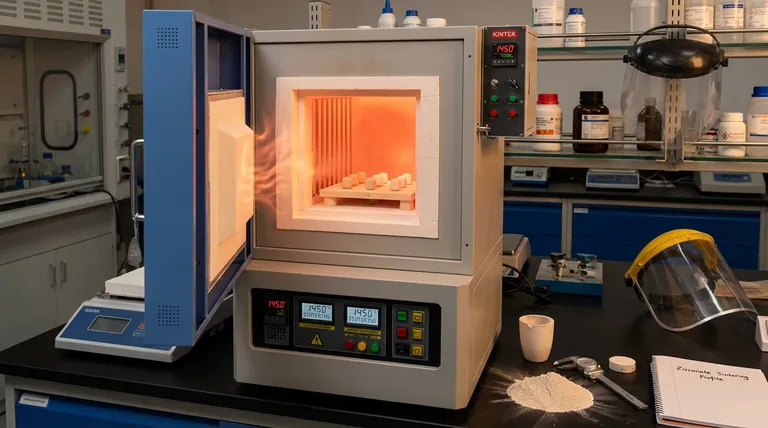
A high-temperature box furnace facilitates the sintering of doped zirconate ceramics by creating a controlled thermal environment specifically between 1300°C and 1500°C. This precise temperature range provides the necessary energy to trigger solid-state reactions and mass transfer, transforming the raw ceramic powder into a dense, cohesive solid.
Core Takeaway The primary role of the box furnace is not merely heating, but orchestrating a phase transformation into a stable perovskite structure. Through controlled heating and cooling rates, the furnace eliminates internal pores to achieve a relative density exceeding 94%, a critical threshold for ensuring the material exhibits high ionic conductivity as an electrolyte.
The Mechanics of Densification
The Thermal Driving Force
To sinter doped zirconate ceramics effectively, the furnace must maintain temperatures strictly between 1300°C and 1500°C.
At these temperatures, the material undergoes solid-state reactions. The heat provides the energy required for atoms to diffuse across particle boundaries, causing the distinct powder particles to merge.
Structural Transformation
Beyond simple bonding, the high-temperature environment enables the ceramic to fully crystallize into a perovskite structure.
This structural arrangement is fundamental to the material's electrical properties. Without achieving this specific crystallographic phase, the ceramic would lack the functional characteristics required for its application.
Pore Elimination and Mass Transfer
As the temperature holds, mass transfer mechanisms accelerate.
Material moves from the particles into the voids between them, effectively filling internal pores. This process is essential for transforming a porous "green body" into a solid, hermetic component.
Critical Process Parameters
Controlled Heating and Cooling Rates
The quality of the final ceramic relies heavily on the furnace's ability to execute specific heating and cooling profiles.
Rapid temperature changes can induce thermal shock or incomplete reactions. By regulating these rates, the furnace ensures the material densifies uniformly without developing cracks or trapping gases.
Achieving Target Density
The ultimate goal of using this specific furnace type is to reach a relative density of over 94 percent.
High density is directly correlated with performance. In the context of electrolytes, a dense material with minimal porosity ensures distinct grain boundaries and optimal pathways for ionic conduction.
Understanding the Trade-offs
Density vs. Pressure-Assisted Methods
While a box furnace achieves excellent density (>94%), it relies solely on thermal energy and atmospheric pressure.
If your application requires near-theoretical density (close to 100%) or minimal grain growth, a method like hot-press sintering—which applies external pressure (e.g., 40 MPa)—might be superior. The box furnace is a balance of efficiency and high performance, but it may not eliminate every microscopic void compared to pressurized techniques.
Uniformity Challenges
In standard box furnaces, achieving perfect temperature uniformity can be challenging but is vital.
Variations in the temperature field can lead to inconsistent microstructures or varying dielectric properties across the ceramic body. High-quality box furnaces mitigate this with precise element placement, but it remains a critical variable to monitor compared to smaller, specialized experimental furnaces.
Making the Right Choice for Your Goal
To maximize the utility of a high-temperature box furnace for doped zirconates, align your process with your specific end-goals:
- If your primary focus is ionic conductivity: Prioritize a schedule that ensures a full soak at 1300°C–1500°C to guarantee the formation of the perovskite structure and density >94%.
- If your primary focus is microstructural consistency: precise control of the heating ramp and cooling rates is essential to prevent defects and ensure uniform grain growth.
Success in sintering zirconates lies in using the furnace not just as a heater, but as a precision tool to manage phase formation and density simultaneously.
Summary Table:
| Feature | Specification/Role in Sintering |
|---|---|
| Temperature Range | 1300°C to 1500°C |
| Target Relative Density | > 94% |
| Key Structural Goal | Formation of stable perovskite structure |
| Mass Transfer Mechanism | Solid-state reaction & atom diffusion |
| Critical Controls | Precise heating/cooling rates to prevent thermal shock |
| Primary Application | Enhancing ionic conductivity for electrolytes |
Elevate Your Material Research with KINTEK
Maximize the performance of your doped zirconate ceramics with KINTEK’s high-precision thermal solutions. Backed by expert R&D and manufacturing, KINTEK offers high-performance Muffle, Tube, Rotary, Vacuum, and CVD systems, all customizable to your specific sintering profiles.
Whether you are aiming for >94% density or complex phase transformations, our lab high-temp furnaces provide the uniform heating and precise control your research demands.
Ready to optimize your sintering process? Contact us today to discuss your custom furnace needs!
References
- Peimiao Zou, Shanwen Tao. A fast ceramic mixed OH−/H+ ionic conductor for low temperature fuel cells. DOI: 10.1038/s41467-024-45060-1
This article is also based on technical information from Kintek Furnace Knowledge Base .
Related Products
- 1700℃ High Temperature Laboratory Tube Furnace with Alumina Tube
- 1400℃ High Temperature Laboratory Tube Furnace with Alumina Tube
- 1700℃ High Temperature Muffle Oven Furnace for Laboratory
- 1800℃ High Temperature Muffle Oven Furnace for Laboratory
- High Temperature Muffle Oven Furnace for Laboratory Debinding and Pre Sintering
People Also Ask
- How does zone-melting in tube furnaces synthesize bismuth micro-wires? Master Single-Crystal Thermoelectric Growth
- How are high-temperature laboratory tube furnaces applied in long-term vacuum homogenization heat treatments for intermetallic samples?
- How do high-temperature laboratory tube furnaces ensure environmental stability? Precision Thermal Reduction Tips
- How are high-temp tube furnaces used to measure diffusion coefficients per Fick's law? Master Precision Annealing
- How are high-temperature tube furnaces applied in testing ceramic-supported alloy membranes? Insights



















