
A bench-top high-temperature furnace guarantees ceramic layer quality by strictly enforcing specific thermal parameters and maintaining a stable oxidizing atmosphere. This equipment ensures the integrity of the Ceramic Conversion Treatment (CCT) on Ti6242 alloy by regulating heating and cooling rates to control oxygen diffusion and crystal growth.
The furnace’s primary role is to synchronize oxygen diffusion with crystal growth through strict temperature management, transforming the surface into a robust ceramic shield without compromising the substrate bond.
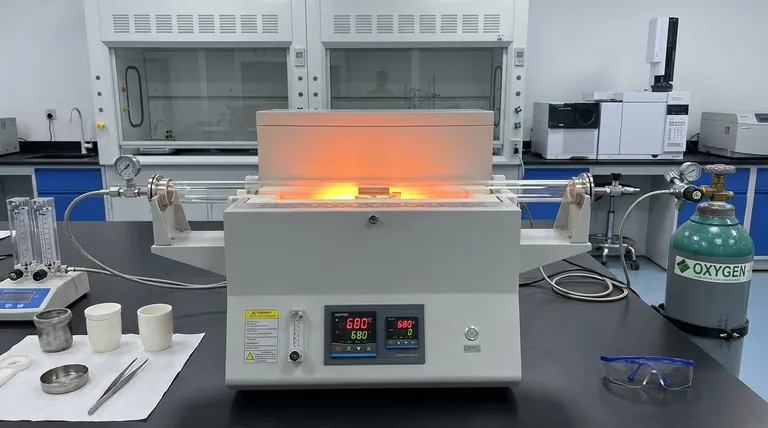
The Mechanics of Thermal Control
To understand how the furnace ensures quality, we must look at how it manages the environment surrounding the Ti6242 alloy.
Precision Temperature Regulation
The furnace maintains a critical temperature window between 640 °C and 700 °C.
Maintaining this range is essential for initiating the chemical conversion process without overheating the substrate.
Stable Oxidizing Atmosphere
Beyond temperature, the furnace provides a consistent supply of oxygen.
This stable atmosphere is required to feed the oxidation reaction necessary to convert the titanium surface into ceramic.
The Critical Role of Ramp Rates
The quality of the ceramic layer is defined by how the material transitions between temperature states. The furnace's programmable logic controls this via specific ramp rates.
Controlled Heating
The furnace applies a heating rate of 8 °C/min.
This controlled ascent prevents thermal shock and establishes the initial conditions for orderly diffusion of oxygen atoms into the alloy lattice.
Regulated Cooling
Perhaps the most critical phase is the cooling process, which the furnace restricts to 2 °C/min.
This slow descent allows for the stable growth of oxide crystals. It prevents the internal stress that often leads to cracking in ceramic materials.
Understanding the Trade-offs
While the high-temperature furnace provides necessary control, it is important to understand the risks if these parameters are not maintained.
The Risk of Rapid Cooling
If the furnace fails to maintain the strict 2 °C/min cooling rate, the ceramic layer may suffer.
Faster cooling can interrupt the crystal growth, leading to a porous structure rather than a dense titanium dioxide layer. It may also cause the coating to detach from the substrate.
The Impact of Temperature fluctuation
If the target temperature (640-700 °C) drifts, the diffusion of oxygen becomes unpredictable.
This results in uneven oxide thickness and a weak bond between the ceramic layer and the Ti6242 alloy.
Ensuring Process Integrity
To maximize the performance of your CCT process, ensure your equipment is calibrated to these specific constraints.
- If your primary focus is Layer Density: Ensure the furnace is programmed for a slow cooling rate of exactly 2 °C/min to promote stable crystal growth.
- If your primary focus is Substrate Adhesion: Verify that the heating rate does not exceed 8 °C/min to allow for the orderly diffusion of oxygen atoms.
Precision control of thermal rates is the difference between a brittle coating and a durable, integrated ceramic surface.
Summary Table:
| Process Parameter | Required Specification | Role in Quality Control |
|---|---|---|
| Temperature Range | 640 °C - 700 °C | Initiates chemical conversion without substrate damage |
| Heating Rate | 8 °C/min | Prevents thermal shock; ensures orderly oxygen diffusion |
| Cooling Rate | 2 °C/min | Promotes stable crystal growth; prevents cracking |
| Atmosphere | Stable Oxidizing | Sustains the reaction to form dense titanium dioxide |
Elevate Your Material Science with KINTEK Precision
Achieving the perfect ceramic conversion requires uncompromising thermal accuracy. Backed by expert R&D and world-class manufacturing, KINTEK provides high-performance Muffle, Tube, Rotary, Vacuum, and CVD systems designed to meet the rigorous demands of lab research and industrial applications. Whether you are treating Ti6242 alloys or developing new ceramic layers, our customizable high-temperature furnaces deliver the stable atmospheres and precise ramp rates essential for your success.
Ready to optimize your heat treatment process? Contact us today to discuss your unique needs with our technical specialists.
References
- Zhenxue Zhang, Hanshan Dong. Tribological Properties of the Fast Ceramic Conversion Treated Ti-6Al-2Sn-4Zr-2Mo Alloy with a Pre-Deposited Gold Layer. DOI: 10.3390/lubricants12040105
This article is also based on technical information from Kintek Furnace Knowledge Base .
Related Products
- 1200℃ Muffle Oven Furnace for Laboratory
- 1700℃ Controlled Inert Nitrogen Atmosphere Furnace
- Laboratory Muffle Oven Furnace with Bottom Lifting
- 1800℃ High Temperature Muffle Oven Furnace for Laboratory
- 1700℃ High Temperature Muffle Oven Furnace for Laboratory
People Also Ask
- What is the primary function of a high-temperature laboratory muffle furnace in chemical synthesis? Achieve Precision.
- How does a high-temperature laboratory muffle furnace affect material properties? Transform Anodic Oxide Films Fast
- How is a laboratory muffle furnace used in 3D-printed PP-CF cross-linking? Achieve Thermal Stability at 150 °C
- What functions does a laboratory muffle furnace perform for AISI 1025 steel post-processing? Precision Thermal Control
- Why is a laboratory high-temperature muffle furnace used for BaTiO3? Achieve Optimal Tetragonal Crystalline Phases



















