
Operating a multi-zone tube furnace is a systematic process centered on control and safety. The core procedure involves powering on the main control panel, programming the distinct temperature settings and heating ramps for each individual zone, and then initiating the automated heating program to achieve your desired thermal gradient.
Successful operation hinges less on the startup sequence and more on meticulous preparation. Proper furnace placement, correct tube installation, and vigilant safety checks are the non-negotiable prerequisites for achieving a stable and accurate thermal profile for your experiment.
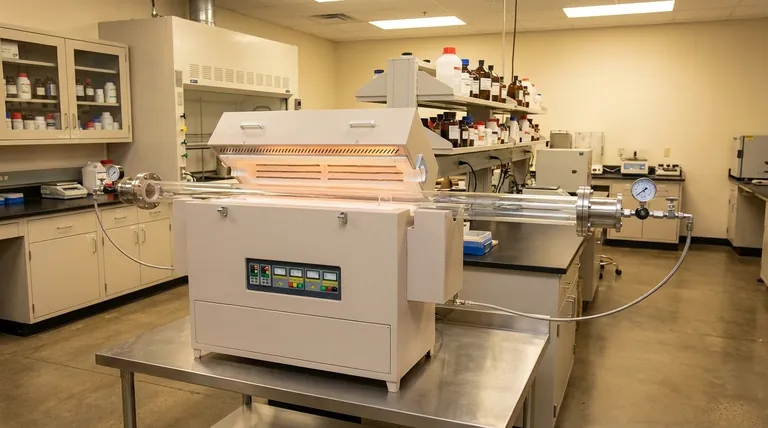
Foundational Setup: The Pre-Operation Checklist
Before applying power, a thorough setup is critical for both safety and experimental accuracy. Rushing this stage is a common source of equipment damage and failed experiments.
Environmental Placement
The furnace must be situated in a stable, controlled environment. This means a location with good air circulation, free from physical vibrations, and clear of any flammable gases, explosive materials, or high concentrations of dust.
Power and Grounding
Confirm that your facility's power supply voltage matches the furnace's requirements. Most importantly, ensure the equipment is effectively grounded. This is a fundamental safety measure to prevent the risk of electric shock.
Furnace Tube Installation
Proper installation of the process tube is vital. The tube must be placed symmetrically, positioned in the horizontal center of the furnace cavity.
Crucially, it must not touch the internal heating elements, as this can cause catastrophic failure of both the tube and the elements.
Sealing the Flanges
Secure the flanges at both ends of the tube in the correct sequence: insert the inner flange sleeve, followed by the sealing ring, the pressure ring, and finally the outer flange sleeve.
Tighten the screws evenly to prevent the flange from skewing, which would compromise the seal. The tube should be positioned with equal lengths extending from both ends of the furnace and should be able to rotate freely before the final tightening.
The Core Operational Workflow
Once the foundational setup is complete, you can proceed with the operational sequence.
Step 1: Power On and System Initialization
Press the main power switch on the control panel. The controller will boot up, typically displaying its model, software version, and the current ambient temperature inside the furnace zones.
Step 2: Programming the Thermal Profile
This is the most critical step for a multi-zone furnace. Set the target temperature and heating program for each zone independently, according to your experimental requirements. This allows you to create a precise thermal gradient along the length of the tube.
Step 3: Initiating and Monitoring the Heating Cycle
With the programs set, turn on the heating system. The controller will begin the automatic program, often indicated by a red heating curve appearing on the display. It is essential to monitor the process to ensure temperatures are tracking as expected.
Step 4: Reaching the Insulation Stage
After reaching the specified target temperatures, the system enters the insulation or "soak" stage. During this phase, the controller actively adjusts the heating power to maintain a stable temperature for the programmed duration.
Step 5: Controlled Cooldown
Once the experiment or insulation time is complete, turn off the heating system. Allow the furnace to cool naturally and gradually to room temperature. Do not attempt to force a rapid cool-down unless your procedure explicitly requires it.
Understanding the Risks and Critical Safety Measures
Operating high-temperature equipment carries inherent risks. Acknowledging and mitigating them is the hallmark of a professional operator.
The Danger of Thermal Shock
Rapid temperature changes can cause ceramic or quartz furnace tubes to crack or shatter. Natural, gradual cooling is the safest procedure to prevent thermal shock and extend the life of your consumables.
Gas Flow and Atmosphere Control
If your process uses a controlled atmosphere, you must constantly monitor gas flow rates and check all connections for leaks. A compromised seal can ruin an experiment and, with certain gases, create a significant safety hazard.
Adhering to Temperature Limits
Never attempt to operate the furnace beyond its maximum rated temperature. Doing so will drastically shorten the lifespan of the heating elements and can cause permanent damage to the furnace insulation.
Personal Protective Equipment (PPE)
Always wear appropriate personal protective equipment. This includes high-temperature-rated gloves and protective clothing to prevent severe burns when handling components near the furnace.
Making the Right Choice for Your Goal
Your specific procedure should be tailored to your experimental objective.
- If your primary focus is material synthesis with a precise gradient: Pay meticulous attention to programming each zone independently to create the exact thermal slope required for your process.
- If your primary focus is annealing or thermal treatment: Prioritize programming a stable, uniform temperature across all relevant zones and a sufficient insulation (soak) time for thermal uniformity.
- If your primary focus is safety and repeatability: Make the pre-operation checklist, especially symmetrical tube installation and proper grounding, a mandatory and documented part of your standard operating procedure.
By treating the operation as a complete process from environmental setup to final cooldown, you ensure the safety, longevity, and accuracy of your equipment.
Summary Table:
| Step | Key Action | Purpose |
|---|---|---|
| 1 | Power on and initialize system | Boot up control panel for operation |
| 2 | Program thermal profile per zone | Set precise temperatures and ramps for gradients |
| 3 | Initiate and monitor heating cycle | Start automated program and track progress |
| 4 | Reach insulation stage | Maintain stable temperature for set duration |
| 5 | Allow controlled cooldown | Prevent thermal shock with gradual cooling |
Need a reliable high-temperature furnace for your lab? KINTEK leverages exceptional R&D and in-house manufacturing to provide advanced solutions like Tube Furnaces, Muffle Furnaces, Rotary Furnaces, Vacuum & Atmosphere Furnaces, and CVD/PECVD Systems. With strong deep customization capabilities, we precisely meet your unique experimental requirements. Contact us today to enhance your lab's efficiency and safety!
Visual Guide

Related Products
- Split Multi Heating Zone Rotary Tube Furnace Rotating Tube Furnace
- Multi Heating Zones CVD Tube Furnace Machine for Chemical Vapor Deposition Equipment
- Multi Zone Laboratory Quartz Tube Furnace Tubular Furnace
- Magnesium Extraction and Purification Condensing Tube Furnace
- Vacuum Sealed Continuous Working Rotary Tube Furnace Rotating Tube Furnace
People Also Ask
- What are the main applications of multi zone tube furnaces in university laboratories? Unlock Precision in Material Science and Energy Research
- How are multi zone tube furnaces used in ceramics, metallurgy and glass research? Unlock Precise Thermal Control for Advanced Materials
- What environmental protection applications utilize multi zone tube furnaces? Unlock Precision in Waste Treatment and Green Tech
- What temperature-related capabilities make multi zone tube furnaces valuable for research? Unlock Precision Thermal Control
- What role do multi zone tube furnaces play in new energy research? Unlock Precise Thermal Control for Innovation



















