
IoT gas sensors and Autoencoders work in tandem to create a high-precision safety system for Chemical Vapor Deposition (CVD) furnace pipelines. The IoT sensors continuously capture massive amounts of environmental data regarding chemical concentrations, while Autoencoders process this stream to identify subtle anomalies. By detecting deviations from standard operating patterns, this combination pinpoints minute corrosion or gas leaks in real-time, preventing catastrophic accidents in high-temperature processing environments.
The core value of this integration is the shift from reactive repair to predictive maintenance. By using Autoencoders to analyze sensor data, operators can identify and address pipeline integrity issues before they escalate into environmental hazards or safety failures.
The Role of Continuous IoT Monitoring
High-Fidelity Data Collection
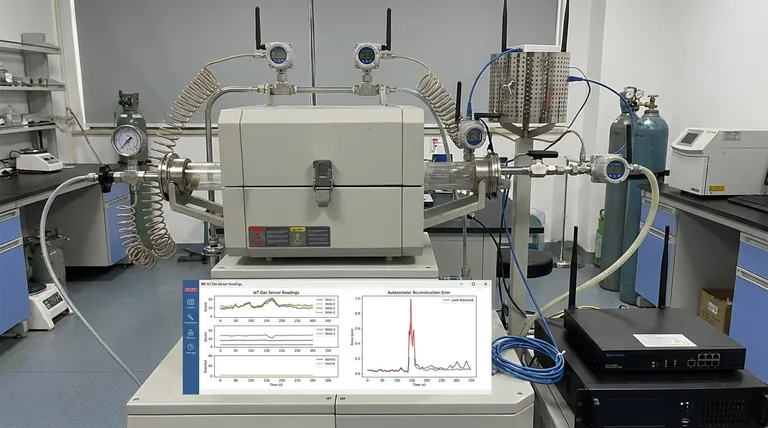
IoT-connected gas sensors are deployed directly around the CVD furnace pipelines. These devices operate continuously, monitoring the immediate environment for specific chemical concentrations.
Operating in Harsh Environments
CVD processes involve high temperatures and volatile chemicals. The sensors provide a persistent set of eyes on the hardware, generating a massive, uninterrupted stream of status data that manual inspection cannot replicate.
Intelligent Analysis with Autoencoders
Compressing and Reconstructing Data
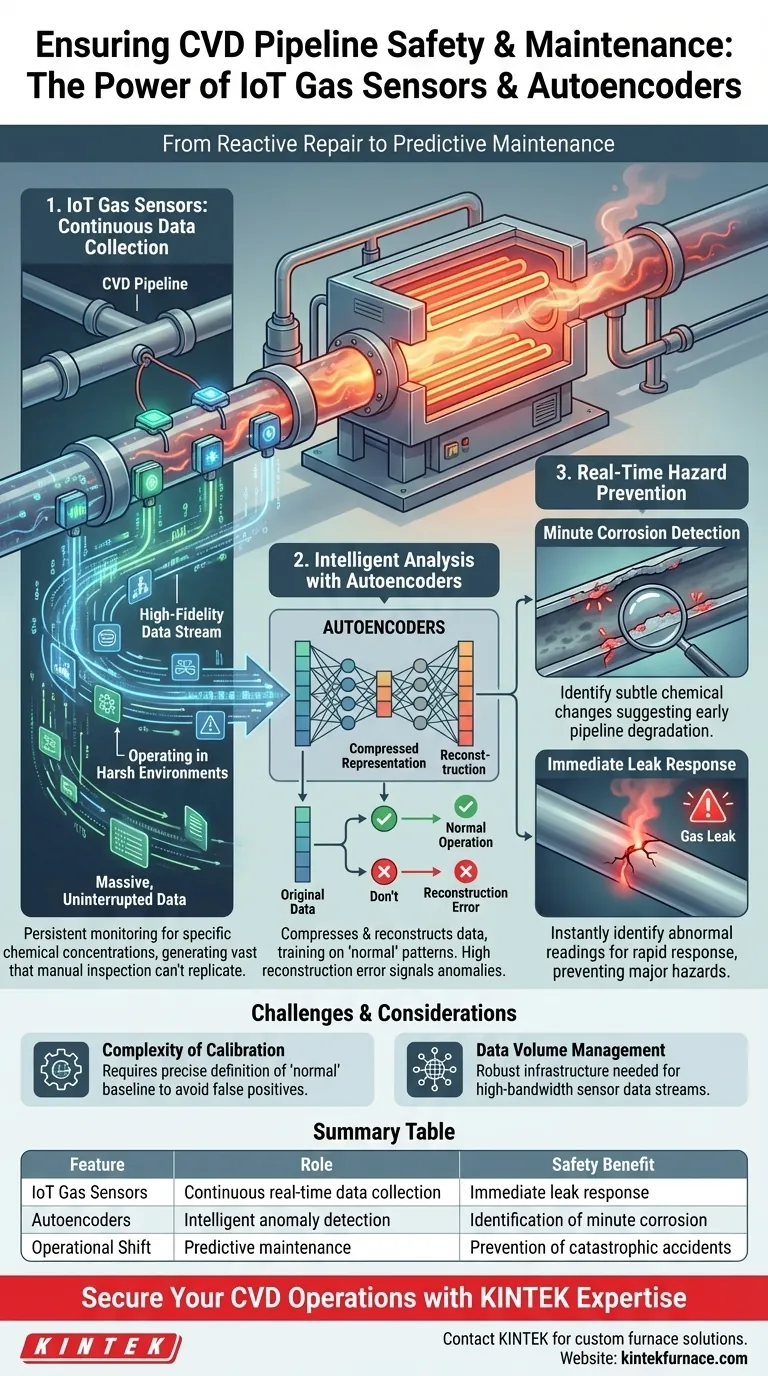
Autoencoders are utilized to manage the massive volume of data generated by the sensors. Their primary function is to compress the input data and then attempt to reconstruct it.
Detecting the "Reconstruction Error"
The system is trained on standard, safe operating patterns. When the Autoencoder processes new data, it attempts to reconstruct it based on what it knows as "normal."
Flagging Anomalies
If the system cannot accurately reconstruct the data, it signals a high "reconstruction error." This error indicates a deviation from the norm, alerting operators to potential issues like gas leaks or structural changes.
Preventing Hazards Through Real-Time Detection
Identifying Minute Corrosion
Corrosion often starts subtly before causing a rupture. The sensitivity of this system allows for the detection of minute changes in chemical presence that suggest early-stage pipeline degradation.
Immediate Leak Response
By identifying abnormal readings the moment they occur, the system enables real-time responses to gas leaks. This capability is critical for preventing major environmental hazards associated with toxic chemical release.
Understanding the Challenges and Trade-offs
Complexity of Calibration
Implementing this solution requires precise calibration of the Autoencoders. If the "normal" baseline is not defined perfectly, the system may produce false positives or miss actual threats.
Data Volume Management
While Autoencoders compress data efficiently, the sheer volume of raw input from IoT sensors requires robust network infrastructure. Organizations must be prepared to handle high-bandwidth data streams reliably.
Making the Right Choice for Your Goal
To effectively implement this safety architecture, consider your specific operational priorities:
- If your primary focus is immediate hazard prevention: Prioritize high-sensitivity IoT sensors that can withstand the specific thermal limits of your CVD furnaces.
- If your primary focus is predictive maintenance: Invest heavily in the training phase of your Autoencoders to ensure they can distinguish between normal operational variance and true corrosion indicators.
The integration of IoT sensing and machine learning converts raw data into a definitive safety shield for your facility.
Summary Table:
| Feature | Role in CVD Safety & Maintenance |
|---|---|
| IoT Gas Sensors | Continuous, real-time data collection of chemical concentrations in harsh environments. |
| Autoencoders | Intelligent data compression and anomaly detection via reconstruction error analysis. |
| Safety Benefit | Immediate response to gas leaks and identification of minute pipeline corrosion. |
| Operational Shift | Transition from reactive repairs to data-driven predictive maintenance. |
| Key Outcome | Prevention of catastrophic accidents and reduction of environmental hazards. |
Secure Your CVD Operations with KINTEK Expertise
Ensure the highest safety standards for your high-temperature processes with KINTEK’s industry-leading technology. Backed by expert R&D and world-class manufacturing, KINTEK offers a comprehensive range of Muffle, Tube, Rotary, Vacuum, and CVD systems, all fully customizable to meet your unique laboratory or industrial needs.
Don't leave your pipeline integrity to chance. Partner with us to leverage cutting-edge equipment designed for reliability and precision. Contact KINTEK today to discuss your custom furnace solution and see how our advanced systems can enhance your research and production safety.
Visual Guide
Related Products
- Custom Made Versatile CVD Tube Furnace Chemical Vapor Deposition CVD Equipment Machine
- Split Chamber CVD Tube Furnace with Vacuum Station CVD Machine
- Multi Heating Zones CVD Tube Furnace Machine for Chemical Vapor Deposition Equipment
- Slide PECVD Tube Furnace with Liquid Gasifier PECVD Machine
- Controlled Inert Nitrogen Hydrogen Atmosphere Furnace
People Also Ask
- Why are CVD tube furnace sintering systems indispensable for 2D material research and production? Unlock Atomic-Scale Precision
- What is a CVD tube furnace and what is its primary function? Discover Precision Thin-Film Deposition
- Which industries and research fields benefit from CVD tube furnace sintering systems for 2D materials? Unlock Next-Gen Tech Innovations
- How does CVD tube furnace sintering enhance graphene growth? Achieve Superior Crystallinity and High Electron Mobility
- What are the practical applications of gate media prepared by CVD tube furnaces? Unlock Advanced Electronics and More



















