
At their core, Chemical Vapor Deposition (CVD) tube-furnace systems are defined by three key operational features: programmable temperature control, precise gas supply regulation via mass flow controllers, and controllable chamber pressure using throttle valves and vacuum pumps. Advanced systems can also incorporate plasma sources for lower temperature processes and rapid heating/cooling mechanisms to precisely manage reaction times.
These features are not independent; they form an integrated system designed to create a highly controlled and reproducible environment. The ability to manipulate temperature, pressure, and gas composition in concert is the fundamental requirement for successfully depositing high-quality thin films and materials via CVD.
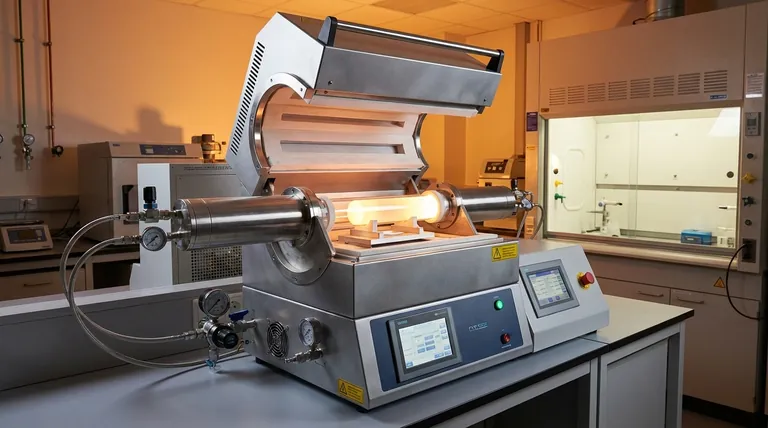
The Pillars of a CVD Environment
A CVD furnace is more than a simple heat source. It is a sophisticated reactor where every variable is meticulously managed to drive a specific chemical reaction on a substrate's surface.
Precise Temperature Control
The foundation of any CVD process is thermal energy. The furnace must provide a stable and uniform temperature to ensure consistent film growth.
Key capabilities include high-temperature performance, often exceeding 1000°C and sometimes reaching over 2000°C in specialized systems.
Uniform heat distribution is critical. Furnaces use high-quality heating elements (like resistive coils) and often feature multiple heating zones (1, 2, 3, or even 5) to create a perfectly flat temperature profile along the length of the process tube.
These systems are temperature programmable, allowing operators to define specific ramps, soaks, and cooling rates, which is crucial for complex material synthesis.
Meticulous Atmosphere Control
The "vapor" in Chemical Vapor Deposition refers to the precursor gases. Controlling this atmosphere is paramount.
Gas delivery is managed by Mass Flow Controllers (MFCs), which regulate the precise volume of each precursor or carrier gas entering the chamber.
Pressure is controlled using a combination of vacuum pumps and throttle valves. This allows the system to operate anywhere from high vacuum to near-atmospheric pressure, tailoring the conditions to the specific CVD chemistry.
This enables operation under various atmospheres, including inert gas (like Argon), reactive gas (like Oxygen), or vacuum, preventing unwanted reactions and contamination.
The Physical Furnace and Chamber
The physical design of the furnace dictates its usability, material compatibility, and safety.
The process chamber is typically a high-purity tube made from materials like quartz (for temperatures up to ~1200°C) or alumina (for higher temperatures), chosen for their thermal resistance and to prevent contamination of the film.
Many systems use a horizontal orientation, which provides a long, uniform hot zone ideal for processing multiple samples or large substrates.
Safety features are built-in, including over-temperature protection to prevent furnace damage and interlocks that ensure safe operating conditions are met.
Advanced Capabilities and Designs
Beyond the core functions, many CVD systems incorporate specialized features to expand their processing capabilities or improve ease of use.
Split-Tube vs. Standard Tube Design
A standard tube furnace is a simple, robust design where the process tube is inserted into a fixed cylindrical heating chamber.
A split-tube furnace, however, is constructed in two halves joined by hinges. This allows the chamber to be opened, providing quick and easy access to the process tube and substrate. This is invaluable for complex experimental setups.
Plasma Enhancement (PECVD)
Some systems can incorporate a plasma source. This enables Plasma-Enhanced CVD (PECVD), a process that uses an electromagnetic field to create plasma.
The plasma energizes the precursor gases, allowing deposition to occur at significantly lower temperatures than in conventional thermal CVD. This is critical for depositing films on temperature-sensitive substrates like polymers.
Rapid Thermal Processing
To gain precise control over reaction start and stop times, some furnaces feature sliding stages or rapid cooling systems.
A sliding furnace can be moved away from the process tube, or forced air cooling can be engaged, to rapidly cool the substrate. This quenches the reaction, preventing unwanted diffusion or phase changes in the deposited material.
Making the Right Choice for Your Goal
Selecting the right features depends entirely on your specific application and research or production goals.
- If your primary focus is fundamental research and versatility: A multi-zone, split-tube design with options for plasma enhancement provides the greatest flexibility for developing new processes and handling complex setups.
- If your primary focus is high-volume, established processes: A simpler, robust single-zone horizontal furnace is often the most reliable and cost-effective solution for consistent production.
- If your primary focus is depositing films on sensitive substrates: A system with plasma enhancement (PECVD) capability is essential to avoid damaging the underlying material with excessive heat.
Understanding how these core features create a controlled reaction environment empowers you to select a system precisely tailored to your material deposition goals.
Summary Table:
| Feature | Description | Key Benefit |
|---|---|---|
| Precise Temperature Control | Programmable ramps, soaks, and cooling with uniform heating zones | Ensures consistent film growth and material synthesis |
| Meticulous Atmosphere Control | Mass flow controllers and vacuum pumps for gas and pressure regulation | Tailors conditions for specific CVD chemistries, preventing contamination |
| Physical Design | High-purity quartz/alumina tubes, horizontal orientation, safety features | Provides material compatibility, ease of use, and operational safety |
| Advanced Capabilities | Plasma enhancement (PECVD), rapid thermal processing, split-tube designs | Enables low-temperature deposition and precise reaction control for sensitive substrates |
Ready to enhance your lab's capabilities with a customized CVD tube-furnace system? At KINTEK, we leverage exceptional R&D and in-house manufacturing to provide advanced high-temperature furnace solutions. Our product line, including Tube Furnaces and CVD/PECVD Systems, is complemented by strong deep customization capabilities to precisely meet your unique experimental requirements. Contact us today to discuss how we can help you achieve superior thin-film deposition and material synthesis!
Visual Guide

Related Products
- Custom Made Versatile CVD Tube Furnace Chemical Vapor Deposition CVD Equipment Machine
- Multi Heating Zones CVD Tube Furnace Machine for Chemical Vapor Deposition Equipment
- Split Chamber CVD Tube Furnace with Vacuum Station CVD Machine
- Slide PECVD Tube Furnace with Liquid Gasifier PECVD Machine
- Inclined Rotary Plasma Enhanced Chemical Deposition PECVD Tube Furnace Machine
People Also Ask
- Why are CVD tube furnace sintering systems indispensable for 2D material research and production? Unlock Atomic-Scale Precision
- What is a CVD tube furnace and what is its primary function? Discover Precision Thin-Film Deposition
- How does CVD tube furnace sintering enhance graphene growth? Achieve Superior Crystallinity and High Electron Mobility
- Which industries and research fields benefit from CVD tube furnace sintering systems for 2D materials? Unlock Next-Gen Tech Innovations
- What are the key application fields of CVD tube furnaces? Unlock Precision in Thin-Film Synthesis



















