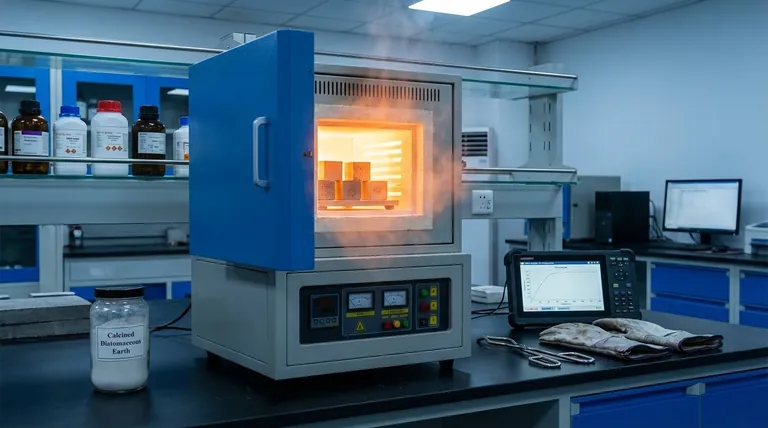
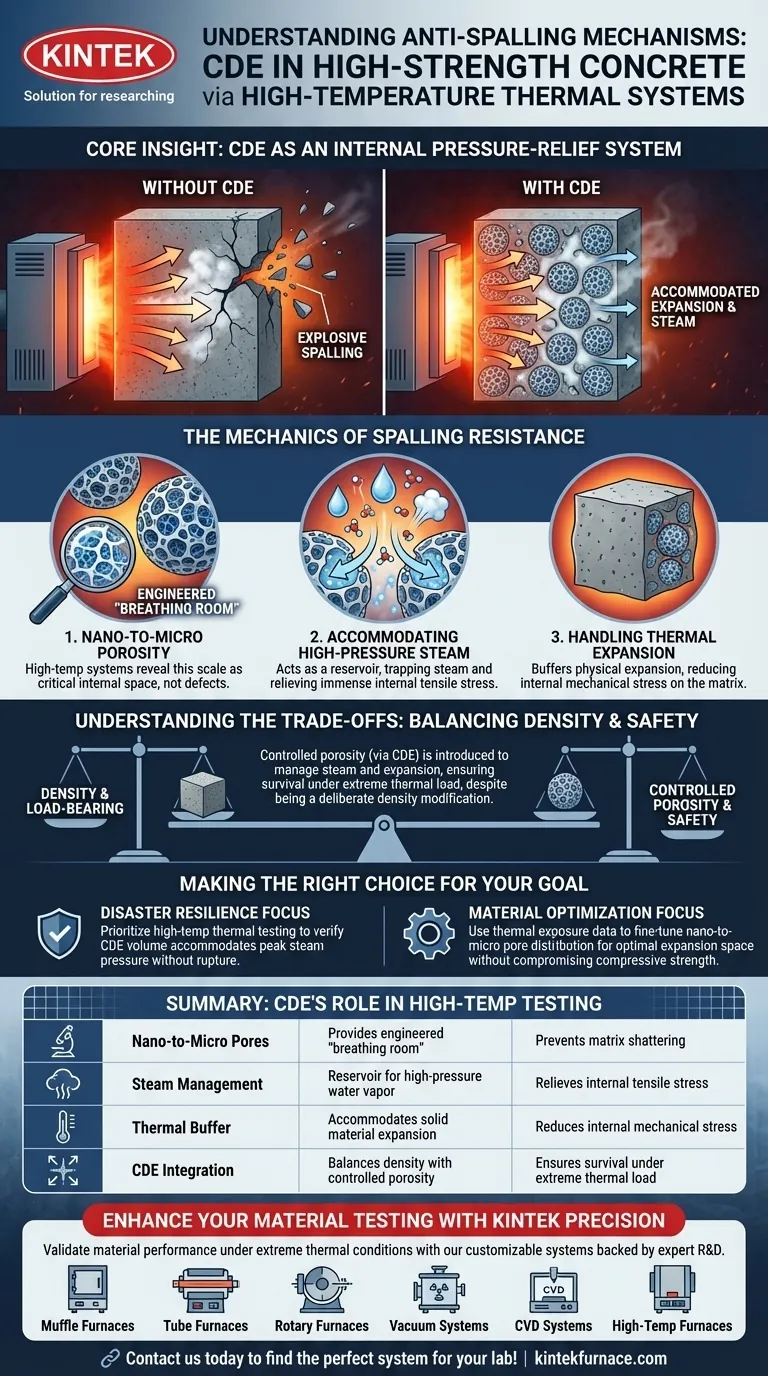
High-temperature thermal systems serve as the critical validation tool for understanding how Calcined Diatomaceous Earth (CDE) acts as a safety mechanism within concrete. By subjecting high-strength concrete samples to intense heat, these systems reveal that the nano-to-micro scale porous architecture of CDE provides essential internal space. This void space accommodates high-pressure steam and thermal expansion, directly preventing the catastrophic failure mode known as explosive spalling.
The core insight is that CDE functions as an internal pressure-relief system. High-temperature thermal testing confirms that its porous structure allows expanding steam and material to occupy internal voids rather than shattering the dense concrete matrix.
The Mechanics of Spalling Resistance
The Function of Nano-to-Micro Porosity
The primary reference highlights that the effectiveness of CDE lies in its specific structural scale. High-temperature systems allow researchers to observe the behavior of nano-to-micro scale pores under stress.
These pores are not structural defects; they are engineered "breathing room" within the material. In high-strength concrete, which is typically very dense, the presence of this specific porosity is the key differentiator during a fire event.
Accommodating High-Pressure Steam
When concrete is exposed to rapid heating, internal moisture vaporizes instantly. In standard high-strength concrete, this vapor creates immense internal pressure because it has nowhere to escape.
Thermal systems demonstrate that CDE provides the necessary internal space. This space acts as a reservoir, trapping and holding the high-pressure steam so it does not exert varying forces that exceed the concrete's tensile strength.
Handling Thermal Expansion
Beyond water vapor, the solid material of the concrete expands when heated. This thermal expansion can induce significant stress in a rigid structure.
The testing confirms that the porous architecture of CDE also accommodates this physical expansion. It effectively acts as a buffer zone, absorbing the volume change and reducing the internal mechanical stress on the concrete matrix.
Understanding the Trade-offs
Balancing Density and Safety
High-strength concrete is prized for its density and load-bearing capacity. However, the very feature that makes it strong—low permeability—makes it susceptible to explosive spalling.
The trade-off revealed by these thermal systems is the necessity of introducing controlled porosity (via CDE) into a material designed to be non-porous. While this architecture prevents spalling by managing steam and expansion, it represents a deliberate modification of the concrete's internal density to ensure survival under extreme thermal load.
Making the Right Choice for Your Goal
To effectively utilize CDE in high-strength concrete applications, consider the following based on your specific objectives:
- If your primary focus is disaster resilience: Prioritize testing with high-temperature thermal systems to verify that the CDE volume is sufficient to accommodate peak steam pressure without rupture.
- If your primary focus is material optimization: Use the data from thermal exposure to fine-tune the nano-to-micro pore distribution, ensuring you permit just enough expansion space without compromising compressive strength.
By using high-temperature systems to validate the porous capacity of CDE, you transform a theoretical material property into a proven safety feature.
Summary Table:
| Mechanism Component | Function in High-Temperature Testing | Benefit to Material Integrity |
|---|---|---|
| Nano-to-Micro Pores | Provides engineered "breathing room" | Prevents matrix shattering |
| Steam Management | Reservoir for high-pressure water vapor | Relieves internal tensile stress |
| Thermal Buffer | Accommodates solid material expansion | Reduces internal mechanical stress |
| CDE Integration | Balances density with controlled porosity | Ensures survival under extreme thermal load |
Enhance Your Material Testing with KINTEK Precision
Are you looking to validate material performance under extreme thermal conditions? Backed by expert R&D and manufacturing, KINTEK offers high-performance Muffle, Tube, Rotary, Vacuum, and CVD systems, as well as other lab high-temperature furnaces—all fully customizable to meet your unique research needs.
Whether you are studying the anti-spalling mechanisms of high-strength concrete or developing the next generation of resilient materials, our thermal solutions provide the precise control and reliability you require. Contact us today to find the perfect system for your lab!
Visual Guide
References
- Muttaqin Hasan, Taufiq Saidi. Properties of High-Strength Concrete Incorporating Calcined Diatomaceous Earth, Polypropylene, and Glass Fibers. DOI: 10.3390/buildings15020225
This article is also based on technical information from Kintek Furnace Knowledge Base .
Related Products
- 1400℃ High Temperature Laboratory Tube Furnace with Alumina Tube
- 1700℃ High Temperature Muffle Oven Furnace for Laboratory
- 1800℃ High Temperature Muffle Oven Furnace for Laboratory
- High Temperature Muffle Oven Furnace for Laboratory Debinding and Pre Sintering
- 2200 ℃ Graphite Vacuum Heat Treat Furnace
People Also Ask
- How does zone-melting in tube furnaces synthesize bismuth micro-wires? Master Single-Crystal Thermoelectric Growth
- How do high-temperature laboratory tube furnaces ensure environmental stability? Precision Thermal Reduction Tips
- How are high-temperature laboratory tube furnaces applied in long-term vacuum homogenization heat treatments for intermetallic samples?
- How are high-temp tube furnaces used to measure diffusion coefficients per Fick's law? Master Precision Annealing
- How are high-temperature tube furnaces applied in testing ceramic-supported alloy membranes? Insights