
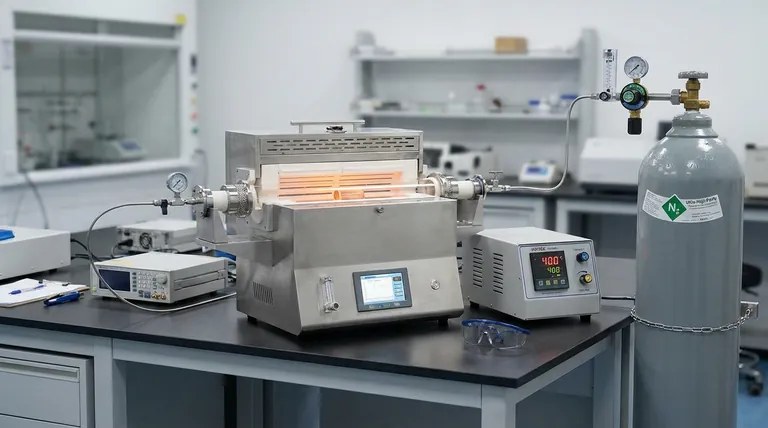
High-precision heating and inert gas protection serve as the dual pillars of reliable in-situ High-Temperature X-ray Diffraction (HTXRD). The heating furnace enables the accurate simulation of thermal aging and the real-time observation of phase transitions, while ultra-high-purity nitrogen creates a protective environment that prevents sample oxidation, ensuring data integrity during extended experiments.
By combining precise thermal regulation with an inert atmosphere, researchers can isolate genuine material phase changes from environmental artifacts. This setup guarantees that observed diffraction peaks reflect the material's intrinsic structural evolution rather than surface contamination.
Simulating Real-World Thermal Conditions
Replicating Aging Processes
The core function of the high-precision furnace is to simulate real-world aging conditions, such as maintaining a steady temperature of 400 °C.
This capability allows the instrument to move beyond static snapshots and collect diffraction data in real-time. Researchers can observe the material as it evolves, rather than just analyzing the final product.
Strict Regulation of Heating Rates
To ensure accuracy, these systems often integrate thermocouple feedback mechanisms.
This technology allows for the strict regulation of heating rates, such as a controlled 5 °C/min, and precise holding times. This level of control is essential for experiments where rapid heating might bypass critical intermediate phases.
Capturing Critical Phase Transitions
By controlling the temperature profile, the system can pinpoint the exact moments when specific transitions occur.
Common examples include monitoring transitions from beta-to-alpha and beta-to-omega phases in alloys. In synthesis experiments, this precision reveals complex pathways, such as the emergence of rock salt or spinel intermediate phases before the final layered phase forms.
Ensuring Data Purity with Inert Gas
Preventing Surface Oxidation
The introduction of ultra-high-purity nitrogen creates a protective atmosphere around the sample.
This is critical because high temperatures naturally accelerate oxidation, which can chemically alter the sample surface. Without this protection, the X-ray beam would interact with a layer of rust or oxide rather than the intended alloy.
Enabling Long-Duration Testing
HTXRD experiments often require extended periods to capture slow phase changes.
The nitrogen atmosphere maintains sample integrity for long-duration tests, effective for periods up to 12 hours. This stability allows for the observation of slow kinetics without the risk of environmental degradation over time.
Validating Diffraction Peaks
The ultimate goal of using nitrogen is to ensure the authenticity of the data.
It ensures that the recorded diffraction peaks correspond strictly to the metallic phases of the alloy. This eliminates the possibility of misinterpreting oxide peaks as structural changes within the material itself.
Understanding the Operational Trade-offs
The Risk of Signal Masking
If the protective atmosphere is compromised or of insufficient purity, the data becomes unreliable.
Oxide layers form quickly at high temperatures, creating "noise" in the diffraction pattern. These oxide peaks can overlap with or completely mask the signals of the relevant metallic phases, rendering the experiment void.
Complexity of Setup
Achieving this level of precision requires a tightly integrated system.
The sample must often be contained within a capillary or a specific chamber to maintain the inert atmosphere while allowing X-ray transmission. This setup demands rigorous calibration of the thermocouple feedback to ensure the temperature inside the capillary matches the setpoint.
Making the Right Choice for Your Goal
To maximize the quality of your HTXRD data, align your experimental setup with your specific research objectives.
- If your primary focus is Phase Identification: Prioritize the high-precision furnace with thermocouple feedback to capture exact transition temperatures for intermediate phases like spinel or rock salt.
- If your primary focus is Material Purity: Ensure the continuous flow of ultra-high-purity nitrogen to prevent oxidation artifacts during long-duration aging studies.
Ultimately, the value of HTXRD lies not just in heating the sample, but in controlling the environment so that the data reflects only the physics of the material.
Summary Table:
| Feature | Function in HTXRD | Experimental Benefit |
|---|---|---|
| High-Precision Furnace | Controlled heating rates (e.g., 5°C/min) | Captures critical intermediate phases like spinel/rock salt |
| Thermocouple Feedback | Real-time thermal regulation | Ensures exact replication of aging processes (e.g., at 400°C) |
| Nitrogen Protection | Creates an inert atmosphere | Prevents surface oxidation and maintains sample integrity |
| Long-Duration Stability | Supports tests up to 12 hours | Enables observation of slow kinetics without data artifacts |
Elevate Your Material Research with KINTEK
Precision and purity are the foundations of successful in-situ analysis. KINTEK provides industry-leading high-temperature solutions tailored for advanced research. Backed by expert R&D and manufacturing, we offer Muffle, Tube, Rotary, Vacuum, and CVD systems, as well as specialized lab high-temp furnaces—all fully customizable to meet your unique HTXRD and material synthesis needs.
Ready to eliminate oxidation and master phase transition control?
Contact our experts today to find your custom furnace solution!
References
- JoAnn Ballor, Carl J. Boehlert. Lattice Parameter Evolution during the β-to-α and β-to-ω Transformations of Iron- and Aluminum-Modified Ti-11Cr(at.%). DOI: 10.3390/cryst14020145
This article is also based on technical information from Kintek Furnace Knowledge Base .
Related Products
- 2200 ℃ Tungsten Vacuum Heat Treat and Sintering Furnace
- 2200 ℃ Graphite Vacuum Heat Treat Furnace
- 1700℃ High Temperature Laboratory Tube Furnace with Alumina Tube
- 1400℃ High Temperature Laboratory Tube Furnace with Alumina Tube
- Laboratory Muffle Oven Furnace with Bottom Lifting
People Also Ask
- How does a tungsten-heated vacuum sintering furnace prepare (TbxY1-x)2O3 ceramics? Achieve 99%+ Density & Purity
- What wear-resistance enhancements are achieved by powder coating? The Role of Vacuum Sintering Furnaces
- How do compaction pressure and vacuum sintering optimize porous ceramics? Maximize Density & Toughness
- What role does a high-temperature vacuum sintering furnace play in the densification of WC-10(Ni, Ni/Co) alloys?
- What core role does a high-temperature vacuum sintering furnace play in Sm:YAG ceramics? Mastering Optical Clarity



















