It's Not the Machine, It's the Environment
A high-temperature vacuum furnace isn't just a box that gets hot. It's a meticulously crafted micro-universe, designed to exclude the chaos of the outside world. But we often forget this. We treat it like any other tool, only paying attention when a loud noise or a failed process forces us to.
This is a failure of perspective.
The goal of maintenance is not to fix what is broken. It is to proactively defend a highly controlled environment against the relentless pressures of atmosphere, thermal drift, and contamination. True reliability is a discipline, a psychological shift from reactive repair to proactive control.
The Three Pillars of Environmental Control
A robust maintenance program isn't a random checklist. It is a systematic defense of the three invisible forces that dictate the success or failure of every single process.
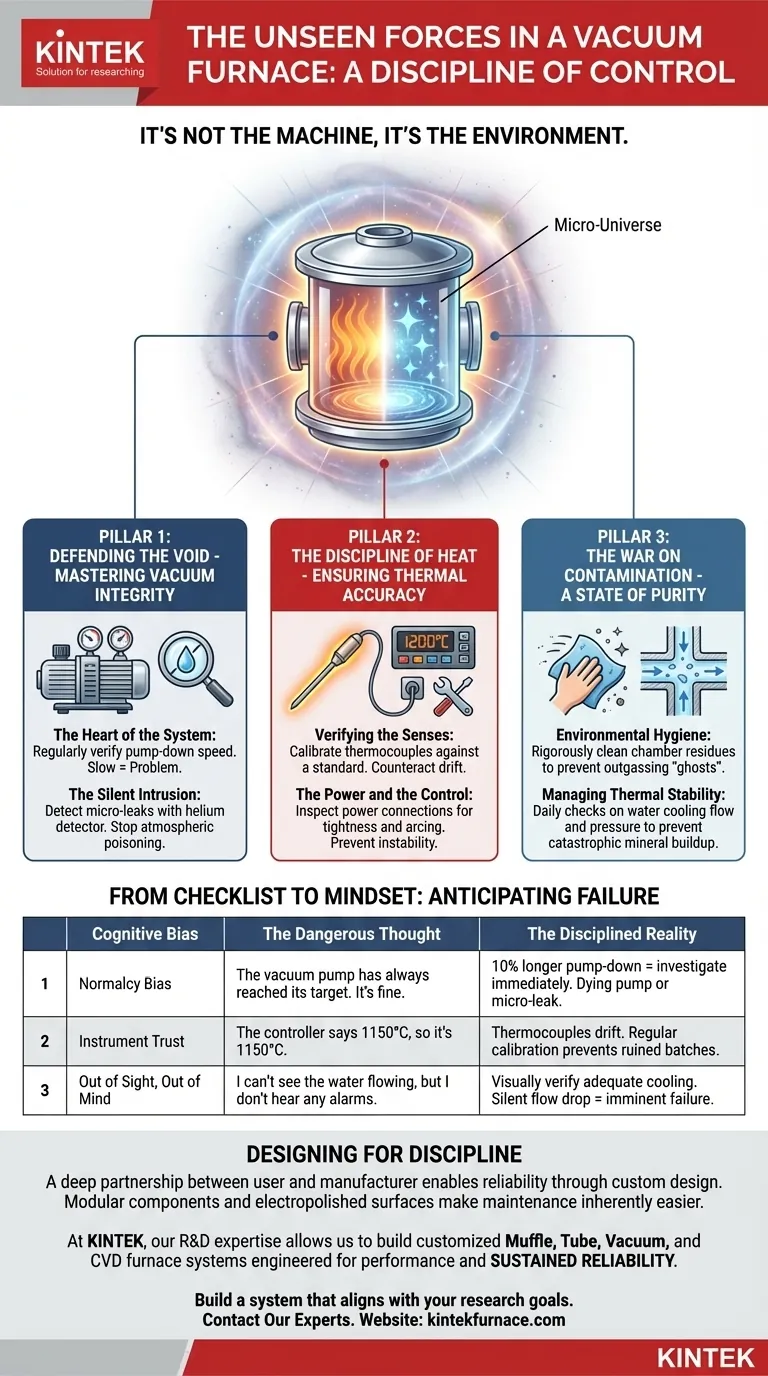
Pillar 1: Defending the Void - Mastering Vacuum Integrity
We cannot see a vacuum, so we instinctively underestimate its fragility. The pressure to compromise the void is constant and absolute.
-
The Heart of the System: Your vacuum pumps are not just motors; they are the gatekeepers. Regularly verifying that your roughing and high-vacuum pumps achieve their target pressures within the expected time is like checking the heartbeat of your system. A slow pump-down is the earliest symptom of a deeper problem.
-
The Silent Intrusion: The most common enemy is a leak—a microscopic betrayal by a worn gasket or a loose fitting. Using a helium leak detector is not just a technical step; it's like using a stethoscope to listen for the whisper of atmospheric intrusion that could poison your entire process with oxygen and nitrogen.
Pillar 2: The Discipline of Heat - Ensuring Thermal Accuracy
We have a deep cognitive bias to trust the numbers on a screen. When a controller reads 1200°C, we believe it. But the furnace's nervous system—its thermocouples—can fatigue, drift, and lie.
-
Verifying the Senses: A thermocouple is your furnace's only connection to thermal reality. Subjected to extreme heat and chemical vapors, they inevitably degrade. Calibrating them against a known standard isn't just good practice; it's a necessary defense against the illusion of accuracy. A few degrees of drift can be the difference between a perfect crystal structure and a worthless ingot.
-
The Power and the Control: Similarly, inspecting power connections for tightness and arcing is fundamental. These are the arteries of your system. A loose connection doesn't just risk a shutdown; it creates thermal instability that undermines the entire process.
Pillar 3: The War on Contamination - A State of Purity
The universe trends toward disorder. Inside your furnace, that disorder takes the form of contamination. Every fingerprint, every microscopic piece of dust, every molecule of vapor from a previous run is a potential saboteur.
-
Environmental Hygiene: Cleaning the chamber is not janitorial work. It is a rigorous process of removing residues that can outgas during a cycle, releasing "ghosts" into your vacuum that contaminate the melt. A clean chamber is a predictable chamber.
-
Managing Thermal Stability: The water-cooling system is the unsung hero, preventing catastrophic meltdown. But its enemy is insidious: the slow buildup of mineral deposits in a cooling channel. This is like a clot in an artery. Daily checks for flow and pressure are non-negotiable, as a failure here is not a minor inconvenience but a terminal event for the equipment.
From Checklist to Mindset: Anticipating Failure
Understanding the technical points is easy. The hard part is overcoming the psychological traps that lead to neglect.
| Cognitive Bias | The Dangerous Thought | The Disciplined Reality |
|---|---|---|
| Normalcy Bias | "The vacuum pump has always reached its target. It's fine." | A 10% longer pump-down time is the first sign of a dying pump or a new micro-leak. Investigate it immediately. |
| Instrument Trust | "The controller says 1150°C, so it's 1150°C." | Thermocouples drift. The cost of regular calibration is insignificant compared to the cost of a ruined research batch. |
| Out of Sight, Out of Mind | "I can't see the water flowing, but I don't hear any alarms." | The difference between adequate cooling and imminent failure can be a silent drop in flow rate. Visually verify it. |
Designing for Discipline
A maintenance discipline is easier to maintain when the system itself is designed for it. The layout of components, the choice of materials, and the quality of construction are not just features—they are enablers of reliability.
This is where a deep partnership between user and manufacturer becomes critical. A furnace customized for your specific process—whether for maximum uptime with modular components or for ultimate purity with electropolished surfaces—is inherently easier to maintain. The design itself reinforces the discipline.
At KINTEK, our expertise in R&D and manufacturing allows us to build customized Muffle, Tube, Vacuum, and CVD furnace systems that are engineered not just for performance, but for sustained reliability. A system built for your exact needs is a system you can more effectively control.
Creating this level of control starts with the right foundation. If you're ready to build a system that aligns with your research goals, Contact Our Experts.
Visual Guide
Related Products
- Vacuum Hot Press Furnace Machine Heated Vacuum Press Tube Furnace
- Vacuum Hot Press Furnace Machine Heated Vacuum Press
- 600T Vacuum Induction Hot Press Vacuum Heat Treat and Sintering Furnace
- 2200 ℃ Tungsten Vacuum Heat Treat and Sintering Furnace
- Vacuum Heat Treat Sintering Furnace with Pressure for Vacuum Sintering
Related Articles
- How Vacuum Hot Press Furnaces Transform Advanced Material Engineering
- How to Select the Right Vacuum Hot Pressing Furnace Temperature for Your Materials
- Beyond the Parts List: The Real Reason Your Vacuum Hot Press Fails (And How to Fix It)
- Why Your High-Temperature Materials Fail: The Hidden War Inside Your Furnace
- Is Your Material Data Real? Why Temperature Gradients Are Sabotaging Your Cu2Se Resistivity Measurements