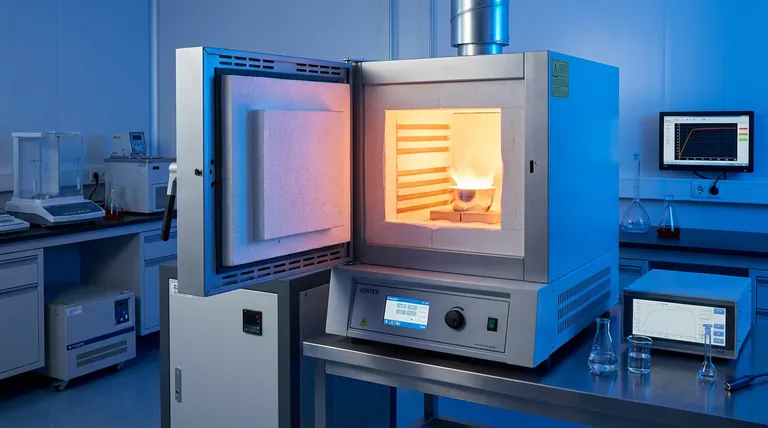
You’ve done everything by the book. The raw materials are certified, the crucible is clean, and the temperature profile is followed to the letter. Yet, the analysis report comes back with a familiar disappointment: contamination, inconsistent grain structure, or properties that just don't meet spec. An entire batch of a high-value alloy is compromised, sending your team back to square one.
This isn't a rare mishap; for many advanced labs and foundries, it's a chronic, expensive problem that feels impossible to solve.
Chasing Ghosts: Why Common Fixes Don't Work
When a melt fails, a familiar troubleshooting ritual begins. We question the material supplier. We try different crucible liners. We tweak the temperature ramp rates or hold times. We might even blame atmospheric humidity. We invest countless hours and resources treating symptoms, hoping to stumble upon a cure.
This reactive approach does more than just waste valuable materials. It creates crippling uncertainty that has serious business consequences:
- Project Delays: R&D timelines for new alloys are stretched from weeks into months.
- Budget Overruns: The cost of failed batches, wasted energy, and repeated labor hours accumulates rapidly.
- Quality & Reputation Risk: For components in aerospace, medical, or high-tech industries, inconsistent material quality is not an option. It can lead to product failure and damage your reputation.
These "common fixes" often fail because they are based on a faulty assumption. We assume the problem lies with our ingredients or our recipe, when in fact, the saboteur is the oven itself.
The Real Culprit: It's Not Your Materials, It's Your Heating Method
The vast majority of conventional furnaces—including many muffle, tube, and fuel-fired models—operate on a simple principle: they heat from the outside in. Resistive elements or flames heat the furnace chamber and the crucible, and that heat then slowly radiates into the material.
This seemingly logical process is the hidden source of your inconsistency and contamination. Here’s why:
-
Inevitable Contamination: The heating elements themselves can degrade at extreme temperatures, shedding microscopic particles into your melt. In fuel-fired furnaces, combustion byproducts are an unavoidable contaminant. Even in a clean electric furnace, you are heating the atmosphere and the container just as much as your sample, increasing the odds of unwanted chemical reactions and oxidation.
-
Unavoidable Temperature Gradients: Heating from the outside in means the material near the crucible wall is always hotter than the material in the center. This temperature difference creates inconsistencies in the melt, leading to unpredictable metallurgical properties and unreliable results.
You can’t solve a problem that is fundamentally built into your heating tool. It's like trying to perform sterile surgery in a dusty room—no matter how carefully you work, the environment itself is working against you.
A Smarter Way to Heat: Solving the Problem from the Inside Out
To achieve true purity and consistency, you need to eliminate the source of the problem: the indirect, contact-based heating mechanism. The solution is to generate heat directly within the material itself.
This is the principle behind induction heating. It uses a powerful, high-frequency magnetic field to generate electrical currents directly within the metal. In simple terms, it tells the metal to heat itself from the inside out.
This approach fundamentally changes the game:
- Purity by Design: There are no heating elements or flames to introduce contaminants. The heating is entirely non-contact. When operated in a vacuum or inert atmosphere, it provides the cleanest possible melting environment.
- Absolute Control: Because the heat is generated instantly and internally, you get incredibly fast, precise, and uniform temperature control. The temperature gradients that plague conventional furnaces disappear, ensuring consistent results, batch after batch.
KINTEK: Where Design Follows Physics
This isn't just a clever trick; it's a solution born from a deep understanding of the physics of materials processing. At KINTEK, our advanced furnace solutions, including our vacuum and atmosphere induction systems, are engineered specifically to overcome the inherent flaws of conventional heating.
We don't just sell furnaces; we provide a controlled environment. And because we recognize that every research project and production goal is unique, our deep customization capability ensures your furnace is not just a piece of equipment, but a precise tool tailored to your specific material, volume, and purity requirements.
Beyond Consistency: Unlocking New Material Possibilities
When you are no longer constantly firefighting issues of contamination and inconsistency, your focus can shift from troubleshooting the present to inventing the future. With the reliable control provided by an advanced furnace system, you can:
- Accelerate R&D: Rapidly and cleanly melt test batches to develop novel, next-generation alloys that were previously too sensitive to process.
- Manufacture with Confidence: Produce medical-grade, aerospace, or other critical components with guaranteed, repeatable metallurgical properties.
- Improve Yield and Reduce Waste: Eliminate the costly failures associated with contamination, saving precious metals and high-value materials.
- Explore New Frontiers: Push the boundaries of material science, from creating spherical metal powders for additive manufacturing to refining the world’s purest precious metals.
Your challenge isn't just about melting metal; it's about achieving a specific outcome with absolute confidence. If inconsistent results are holding back your projects and limiting your potential, it may be time to look beyond tweaking your process and instead upgrade the fundamental tool you use to execute it. Let's discuss how the right heating technology can eliminate uncertainty and accelerate your innovation.
Visual Guide

Related Products
- 1400℃ High Temperature Laboratory Tube Furnace with Alumina Tube
- 1800℃ High Temperature Muffle Oven Furnace for Laboratory
- 1700℃ High Temperature Laboratory Tube Furnace with Alumina Tube
- 1700℃ High Temperature Muffle Oven Furnace for Laboratory
- 1700℃ Controlled Inert Nitrogen Atmosphere Furnace
Related Articles
- The Alchemy of Control: Mastering Material Properties with High-Temperature Tube Furnaces
- Beyond Max Temp: The Systems Thinking Approach to Selecting a High-Temperature Tube Furnace
- Why Your High-Temperature Experiments Fail: The Hidden Flaw in Your Furnace
- The Hidden Saboteur in Your HT-LiCoO2 Synthesis: Why Precise Ramp Rates Can Make or Break Your Battery Materials
- Why High-Purity Gas Fails Your High-Temp Brazing—And How Mono-Silane Doping Fixes It



















