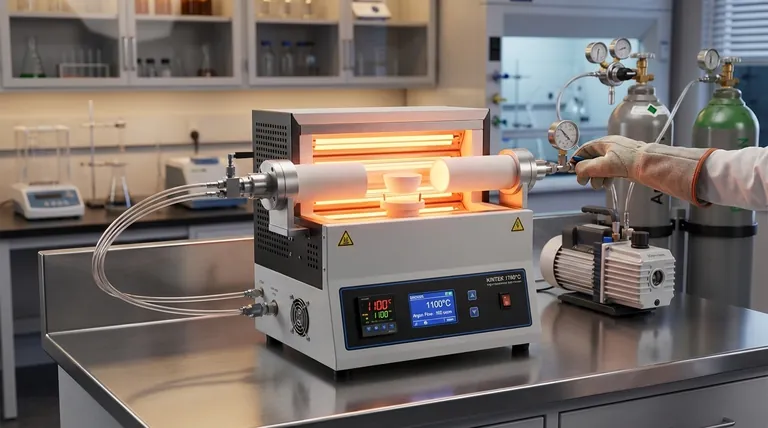
The Crucible of Discovery
Imagine a materials scientist staring at a cooled sample. Weeks of work have culminated in this moment, but the resulting crystal lattice is flawed, the thin film is oxidized, or the powder has failed to sinter.
The digital display on the furnace read 1100°C. The gas flow meter showed a steady stream of argon. Every step in the procedure was followed.
What went wrong?
The answer is rarely a single, dramatic failure. It’s almost always a subtle deviation in the system—a system composed of three interconnected disciplines: the absolute authority of temperature, the invisible command of the atmosphere, and the unwavering diligence of the operator. Mastering the tube furnace isn't about managing a machine; it's about orchestrating a micro-environment.
Discipline 1: The Tyranny of Temperature
Heat is the primary tool, but its application is a science of nuance. We are psychologically wired to trust a digital number, but the glowing digits on a controller are merely a representation of reality, not reality itself.
The Illusion of Precision
A furnace's temperature controller is an eloquent liar if left uncalibrated. The drift of a thermocouple over time is a slow, silent error that invalidates data. Regular calibration against a certified standard isn't just maintenance; it's an act of ensuring your scientific language is accurate. Without it, your setpoints are just suggestions.
Choreographing Heat
Modern material science relies on complex thermal recipes. The ramp rate, dwell time, and cooling rate are not just settings; they are a temporal choreography of atomic excitement and settlement. For processes like annealing metals or growing single crystals, this profile is everything. This level of granular control is where purpose-built systems shine, allowing researchers to program every phase with confidence.
The Geography of the Hot Zone
No furnace chamber is a perfect monolith of uniform heat. There exists a "hot zone"—a specific, mapped-out region of thermal stability. Placing a sample even slightly outside this zone means the experiment you think you're running isn't the one actually happening. It's a simple error of placement that can confound results for weeks. High-quality furnaces, like those from KINTEK, are engineered to maximize the size and stability of this critical zone.
Discipline 2: Commanding the Atmosphere
Many of the most transformative material processes are allergic to our oxygen-rich world. The true power of a tube furnace is its ability to create a pocket of an entirely different, controlled atmosphere.
The Power of Nothing
The first step is often to create a void. By connecting a vacuum pump, an operator removes the ambient air, purging the reactive oxygen and moisture that would otherwise contaminate the process. This isn't just "emptying the tube"; it's creating a clean slate, a foundational canvas upon which to work.
The Protective Blanket
Once a vacuum is established, an inert gas like argon or nitrogen is introduced. It flows through the tube, bathing the sample in a stable, non-reactive environment. This constant, low-pressure flow acts as a protective blanket, shielding the material from unwanted chemical reactions at high temperatures.
The Ritual of the Purge
Simply flowing a gas is not enough for high-purity applications. Trace amounts of oxygen can cling to the tube walls and sample. The solution is a meticulous ritual: repeatedly evacuating the tube and back-filling it with the inert gas. Each cycle dilutes the contaminants further, a critical process for sensitive experiments. This highlights the need for integrated systems where vacuum and gas delivery are designed to work in seamless harmony.
Discipline 3: The Human Element and Safety
The furnace is a powerful tool, but it operates at the intersection of high temperatures, high pressures, and chemical reactions. The most critical component in this system is the well-trained, vigilant operator.
Mindful Material Choices
The process tube itself is an active variable. A quartz tube is excellent for many applications but will fail at very high temperatures or react with certain precursors. An alumina tube offers a higher thermal ceiling but has its own chemical compatibility profile. The choice is a foundational decision, and for novel research, off-the-shelf options may not suffice, necessitating the customizable material and design solutions offered by expert manufacturers.
The Psychology of Safety
Safety protocols are not a checklist; they are a mindset. We skip wearing heat-resistant gloves because we become complacent. We forget to leak-check a gas fitting because we've done it a hundred times before.
This is human nature. That's why robust safety engineering is non-negotiable. While every operator must be trained on emergency shutdowns and proper ventilation, features like over-temperature protection serve as an essential guardrail against both equipment failure and human error.
A Systemic Approach
Success with a tube furnace comes from viewing these three disciplines not as separate tasks, but as a single, integrated system.
| Operational Focus | Key System Interactions |
|---|---|
| Temperature Control | Calibration ensures profile accuracy; Hot zone placement is vital for the sample. |
| Atmosphere Management | Vacuum creates the baseline; Gas purity is maintained by purging. |
| Operator & Safety | Correct tube material prevents reaction; PPE and protocols prevent accidents. |
Achieving this level of systemic control requires more than just a heating element; it requires an instrument engineered for precision, safety, and adaptability. Whether your work involves pioneering new CVD processes, sintering advanced ceramics, or conducting rigorous analytical tests, the right furnace is the foundation of reliable and insightful results.
If you are looking to elevate the precision and safety of your thermal processing, our team has deep experience in customizing Muffle, Tube, and Vacuum furnace systems for the most demanding research applications. Contact Our Experts
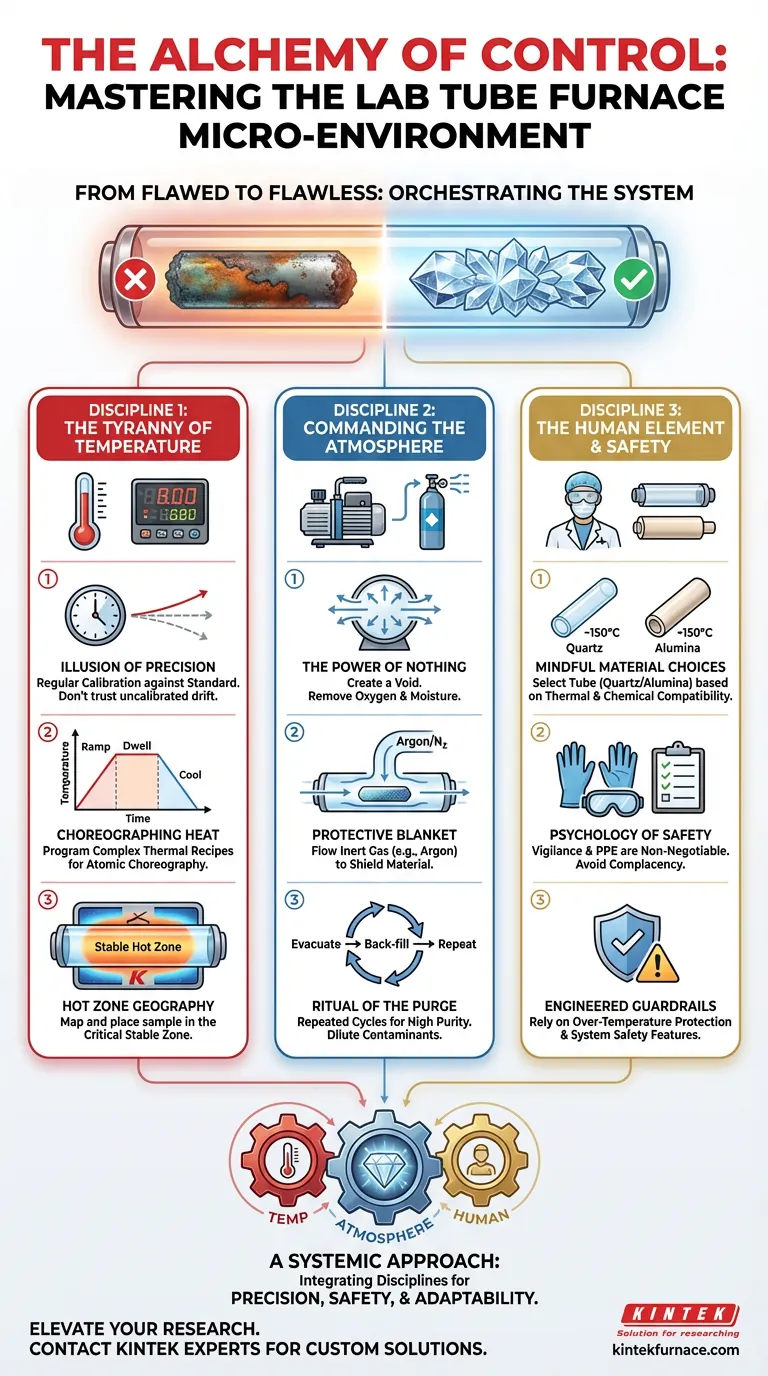
Visual Guide
Related Products
- 1400℃ High Temperature Laboratory Tube Furnace with Alumina Tube
- Laboratory Quartz Tube Furnace RTP Heating Tubular Furnace
- Laboratory Vacuum Tilt Rotary Tube Furnace Rotating Tube Furnace
- 1700℃ High Temperature Laboratory Tube Furnace with Alumina Tube
- 1200℃ Split Tube Furnace Laboratory Quartz Tube Furnace with Quartz Tube
Related Articles
- The Alchemy of Control: Mastering Material Properties with High-Temperature Tube Furnaces
- Beyond Max Temp: The Systems Thinking Approach to Selecting a High-Temperature Tube Furnace
- Why Your High-Temperature Experiments Fail: The Hidden Flaw in Your Furnace
- The Hidden Saboteur in Your HT-LiCoO2 Synthesis: Why Precise Ramp Rates Can Make or Break Your Battery Materials
- Why High-Purity Gas Fails Your High-Temp Brazing—And How Mono-Silane Doping Fixes It



















