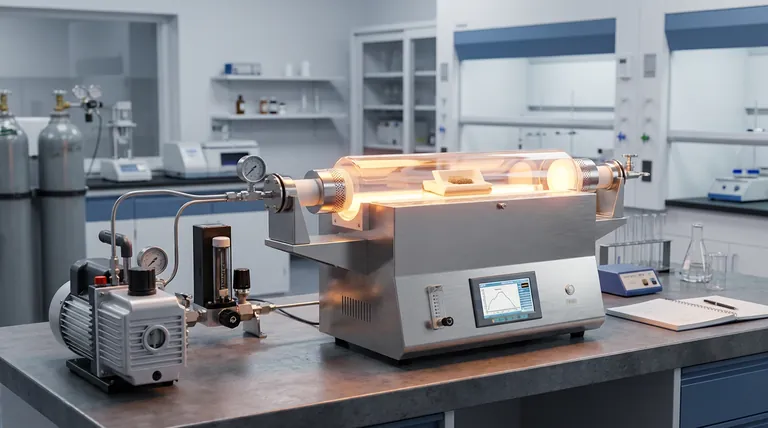
The Seduction of a Single Number
When a lab needs a new furnace, the first question is often, "What's the maximum temperature?"
The answer, whether 1400°C or 1700°C, feels definitive. It’s a hard specification, a number you can build a purchasing decision around. This is a cognitive shortcut—our minds love to simplify complex choices into a single, comparable metric.
But a furnace is not a number. It is an integrated system. And focusing only on the peak temperature is like judging a car solely by its top speed; it ignores the handling, the brakes, and the road you actually need to drive on. The real story is in the interplay of constraints.
Temperature's Hidden Partner: The Process Tube
The choice between a 1400°C and a 1700°C furnace isn't just about heat. It's fundamentally a choice about materials science.
For processes running below 1250°C—like many annealing or general heat-treating tasks—a robust and cost-effective metallic process tube is an excellent choice. A 1400°C furnace provides this flexibility. You can use durable metal for everyday work and switch to a ceramic tube for occasional higher-temperature experiments.
However, the moment your process requires temperatures above 1250°C, the laws of physics make a new demand. Metals soften and fail. You are now required to use a ceramic tube, such as alumina. A 1700°C furnace operates exclusively in this domain. It unlocks incredible capabilities for sintering advanced ceramics or crystal growth, but it also locks you into the higher cost and comparative fragility of ceramic work tubes.
The "max temp" specification is actually a gateway to a critical decision about the materials you can—and must—use.
The Physical Reality of the Heated Zone
The term "large volume," such as a 6-inch diameter by 14-inch length, describes the potential workspace. But heat is not perfectly uniform. In any single-zone furnace, the temperature will naturally be most stable at the center of the heated zone, with slight drop-offs toward the ends where heat escapes.
This isn't a flaw; it's thermodynamics.
For many batch processes or smaller samples placed in the center, this is a non-issue. But for an application requiring exceptional thermal uniformity across a long sample, this physical reality matters. It forces a more profound question: do you need a single, versatile workhorse, or a more complex (and costly) multi-zone furnace designed specifically for uniform, large-scale heating?
Understanding the physical limits of your workspace prevents costly process failures down the line.
Atmosphere: The Invisible Reagent
Consider a researcher developing a new oxygen-sensitive alloy. They run a cycle in their new furnace, perfectly hitting every temperature ramp and hold point. Yet the sample emerges brittle and discolored—a failure.
The furnace didn't fail. The process failed.
The unspoken variable was the air in the tube. At high temperatures, oxygen is not a passive bystander; it is a highly reactive chemical. True process control means controlling the chemical environment.
This is where atmosphere control systems become non-negotiable.
- A vacuum system is the first step, removing the reactive ambient air.
- A gas flow system is the second, backfilling the tube with an inert gas like argon or nitrogen, creating a protective bubble for your sample.
These features transform the furnace from a simple oven into a miniature, controlled universe, ensuring the only reactions that occur are the ones you designed.
From Human Error to Process Integrity
Modern digital controllers do more than just regulate temperature. They address a fundamental point of failure: the human element.
Precise, repeatable heating and cooling profiles are critical for material integrity. A manual process, reliant on an operator's constant attention, is vulnerable to distraction and minor inconsistencies. Automation eliminates this.
An intelligent control system executes a complex, multi-stage thermal profile perfectly, every single time. It allows for unattended operation, logs data for quality control, and ensures that the success of your experiment or production run doesn't depend on who was on shift that day. It shifts the focus from manual operation to process design.
Making the Right Choice: A Systems Approach
Selecting the right furnace isn't about finding the "best" specs. It's about matching a complete system to your specific goal. The decision requires balancing trade-offs across multiple domains.
| Decision Point | Lower Temperature System (e.g., 1400°C) | Higher Temperature System (e.g., 1700°C) |
|---|---|---|
| Primary Goal | Versatility, general-purpose heat treatment, annealing | High-temp synthesis, advanced ceramics, crystal growth |
| Process Tube | Flexible: durable metallic (<1250°C) or ceramic tubes | Mandatory: more fragile and expensive ceramic tubes |
| Atmosphere | Critical for sensitive materials; specify vacuum/gas systems as needed | Almost always required due to the reactivity of materials at these temps |
| Operational Mindset | Cost-effective flexibility for a wide range of R&D or process tasks | Specialized capability for processes that are otherwise impossible |
This level of decision-making benefits from a partner who understands the complete system, not just the components. With deep expertise in R&D and manufacturing, KINTEK provides customizable Muffle, Tube, and Vacuum furnace systems designed to meet these precise, application-specific needs. Instead of forcing your process to fit a standard furnace, we engineer the furnace to fit your process.
By understanding the interplay of temperature, materials, and atmosphere, you can select a tool that doesn't just get hot, but delivers reliable, repeatable results. To find the optimal system for your work, Contact Our Experts.
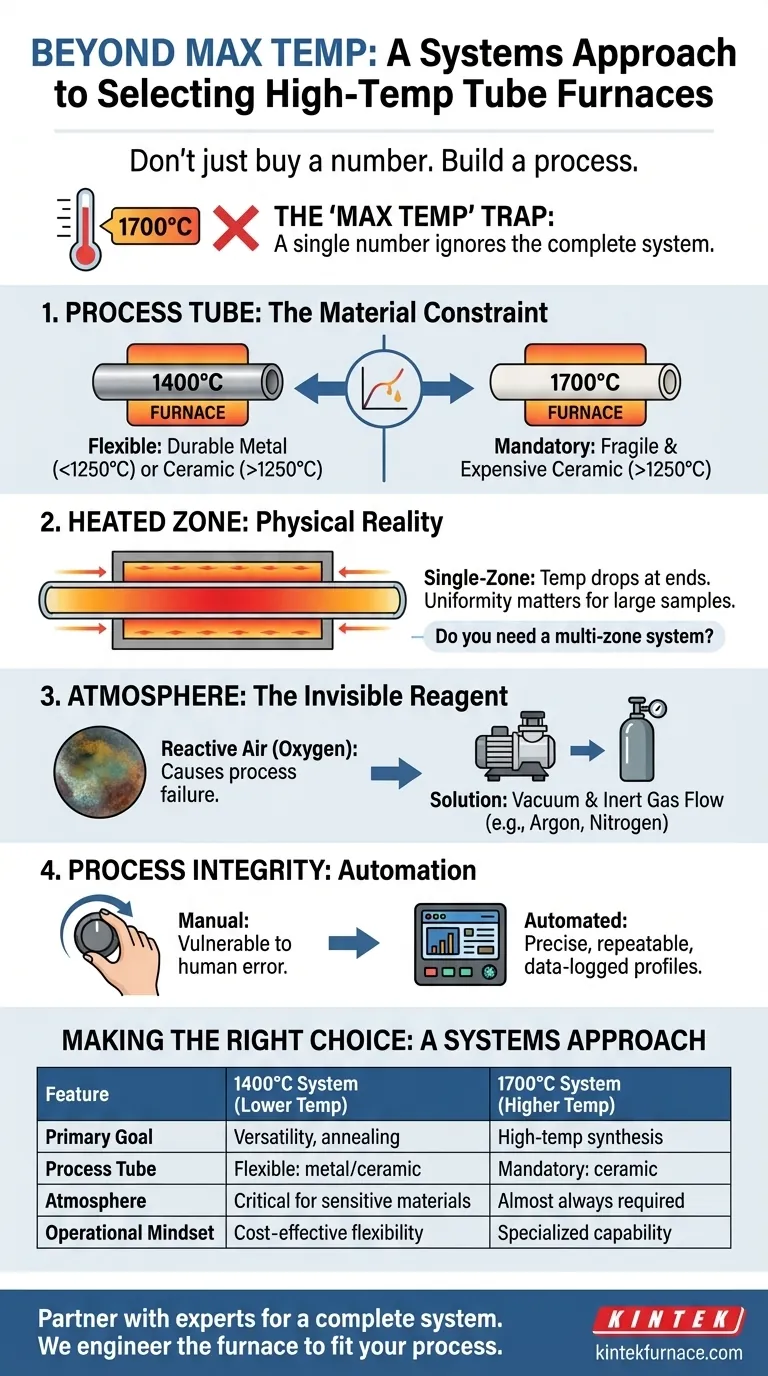
Visual Guide
Related Products
- 1400℃ High Temperature Laboratory Tube Furnace with Alumina Tube
- 1700℃ High Temperature Laboratory Tube Furnace with Alumina Tube
- 1200℃ Split Tube Furnace Laboratory Quartz Tube Furnace with Quartz Tube
- Vertical Laboratory Quartz Tube Furnace Tubular Furnace
- 1700℃ High Temperature Muffle Oven Furnace for Laboratory
Related Articles
- The Alchemy of Control: Mastering Material Properties with High-Temperature Tube Furnaces
- Why Your High-Temperature Experiments Fail: The Hidden Flaw in Your Furnace
- The Hidden Saboteur in Your HT-LiCoO2 Synthesis: Why Precise Ramp Rates Can Make or Break Your Battery Materials
- Why High-Purity Gas Fails Your High-Temp Brazing—And How Mono-Silane Doping Fixes It
- Beyond the Alarm: The Hidden Safety Risks in Your High-Temperature Furnace



















