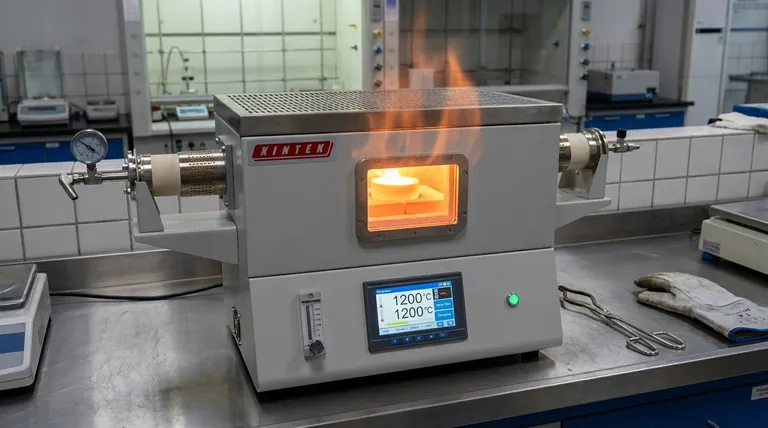
The Paradox of Control
Inside the controlled environment of a high-temperature furnace, a quiet but intense battle is waged. The objective seems simple: to evaporate a sample of metallic magnesium. But at 1200°C (1473K), the laws of chemistry become aggressive.
The very element you are trying to purify is also trying to react with, and corrupt itself against, anything it touches. Success in this experiment isn't just about reaching a temperature; it's about mastering an environment where every surface is a potential contaminant. It’s a profound challenge of control.
A Hostile Environment
To understand the solution, we must first respect the problem. Molten magnesium is not a gentle liquid. It is a highly reactive agent on a mission to find a chemical partner.
The Aggression of Molten Metal
At these temperatures, the metal's atoms are energized and volatile. They will readily form alloys with other metals, strip oxygen from oxides, and reduce many compounds that are stable at room temperature. The container isn't just a bowl; it's a potential reactant.
The Psychological Weight of Contamination
For a researcher, contamination is more than an inconvenience. It's an invalidation of data. It represents wasted time, resources, and the introduction of a variable that undermines the integrity of the entire experiment. The fear of an unknown reaction haunts every high-temperature process. The ideal container must not only be strong; it must be completely, fundamentally, boringly non-interactive.
The Search for an Invisible Wall
The challenge, then, is to find a material that can serve as a truly invisible wall—a barrier that can withstand extreme heat while remaining chemically aloof. This immediately disqualifies most common laboratory materials.
- Metals: Any metal container would eagerly form an alloy with the molten magnesium, destroying the sample's purity.
- Glass: Standard borosilicate glass would melt and deform long before reaching the required temperature, leading to catastrophic failure.
- Low-Purity Ceramics: This is the most subtle trap. Cheaper ceramics often contain silica or other impurities. The aggressive magnesium can react with these impurities, defeating the entire purpose of using a ceramic vessel.
The solution must be both thermally robust and chemically pure. This leads us to one exceptional material: corundum.
The Heroism of Inertness: Enter Corundum
Corundum, a form of high-purity aluminum oxide (Al₂O₃), is the unsung hero of high-temperature metallurgy. It doesn't do anything exciting. It simply endures. And in this context, its ability to remain passive is its greatest strength.
Unflinching in the Face of Heat
With a melting point over 2000°C (approx. 2300K), corundum remains structurally sound far beyond magnesium's evaporation point. It will not sag, crack, or deform. This provides a stable, reliable vessel that an engineer can trust, run after run.
A Chemical Peace Treaty
More importantly, high-purity alumina is chemically inert to molten magnesium. It refuses to react. This non-aggression pact is the core reason for its selection. It ensures that the final evaporated and condensed product is pure magnesium—not a magnesium-aluminum-silicate compound. The corundum crucible acts as a silent guardian, preserving the sample's identity.
The System is the Solution
A perfect crucible, however, is useless in an imperfect environment. The crucible contains the sample, but the furnace controls the experiment. The quest for purity is a systems problem.
The crucible's inertness prevents direct contamination, while a high-performance furnace provides the stable, controlled atmosphere required for a valid result. True precision is born from the synergy between the two.
| Challenge | The Crucible's Role (The Container) | The Furnace's Role (The Environment) |
|---|---|---|
| Extreme Temperature | Withstand heat without melting | Provide precise, stable, and uniform thermal energy |
| Chemical Reactivity | Remain inert to the molten metal | Maintain a pure vacuum or inert gas atmosphere |
| Experimental Integrity | Prevent leaching into the sample | Ensure repeatability and prevent outside contamination |
This interplay is the heart of successful materials science. You cannot trust your results if you cannot trust every component of your thermal system. It's about building a chain of reliability, from the crucible holding the material to the furnace controlling the forces acting upon it.
At KINTEK, we understand this principle deeply. We engineer high-temperature furnaces—including Muffle, Tube, Vacuum, and CVD systems—designed for the precision and reliability that critical research demands. We provide the stable, controlled environment your work depends on.
Achieving purity at 1200°C requires a system built on trust. If you're tackling challenges that demand ultimate control, Contact Our Experts.
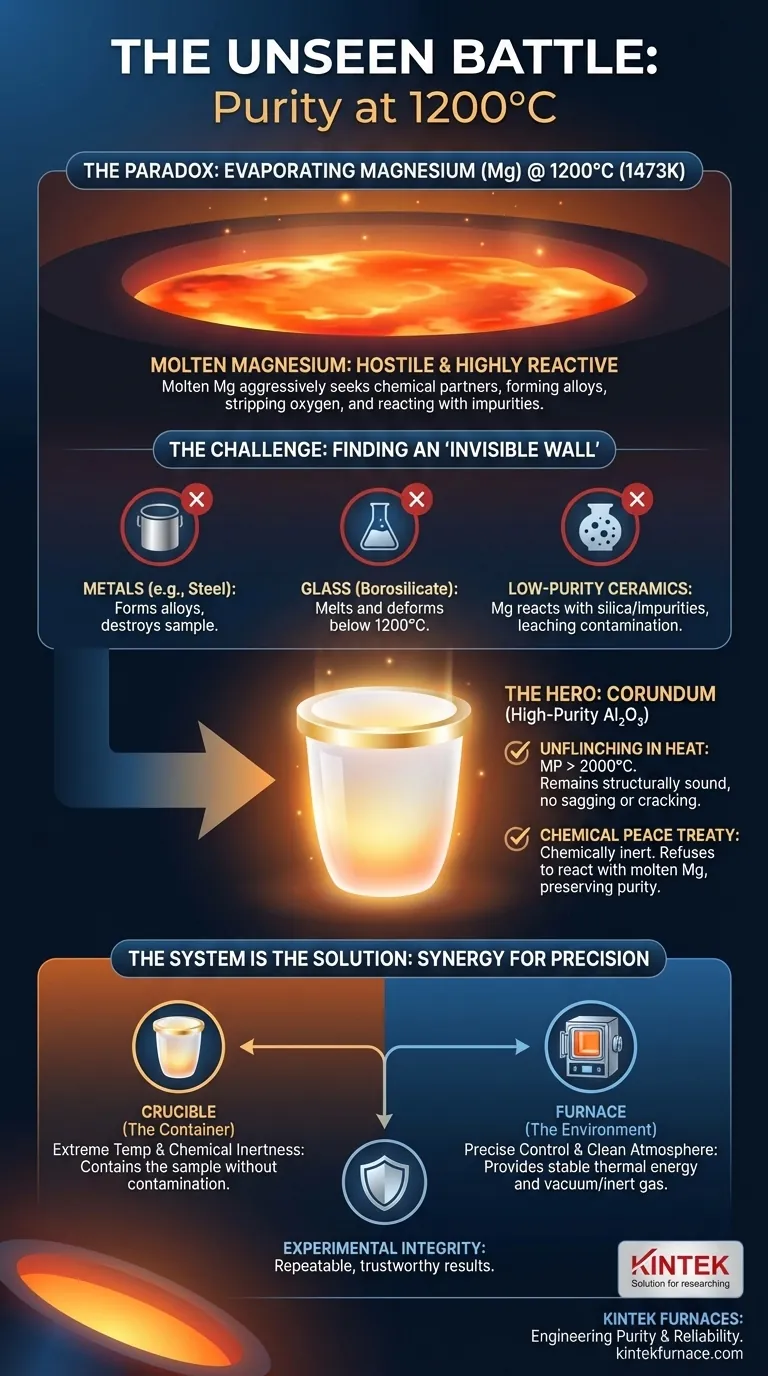
Visual Guide
Related Products
- 1400℃ High Temperature Laboratory Tube Furnace with Alumina Tube
- 1800℃ High Temperature Muffle Oven Furnace for Laboratory
- 1700℃ High Temperature Laboratory Tube Furnace with Alumina Tube
- 1700℃ High Temperature Muffle Oven Furnace for Laboratory
- 1700℃ Controlled Inert Nitrogen Atmosphere Furnace
Related Articles
- The Alchemy of Control: Mastering Material Properties with High-Temperature Tube Furnaces
- Beyond Max Temp: The Systems Thinking Approach to Selecting a High-Temperature Tube Furnace
- Why Your High-Temperature Experiments Fail: The Hidden Flaw in Your Furnace
- The Hidden Saboteur in Your HT-LiCoO2 Synthesis: Why Precise Ramp Rates Can Make or Break Your Battery Materials
- Why High-Purity Gas Fails Your High-Temp Brazing—And How Mono-Silane Doping Fixes It



















