The Ghost in the Machine
Imagine a state-of-the-art vacuum furnace processing a batch of critical aerospace components. The cycle runs perfectly, parameters are nominal, and the machine reports no errors. Yet, upon opening the door, the entire multi-million dollar load is ruined—discolored, brittle, and useless.
There was no mechanical failure. The culprit was invisible, silent, and has been present from the very beginning.
This is the reality of vacuum furnace contamination. It's not about wiping away obvious dirt; it's a constant battle against the physics of materials and the psychology of process control. The core challenge is managing the enemies you cannot see.
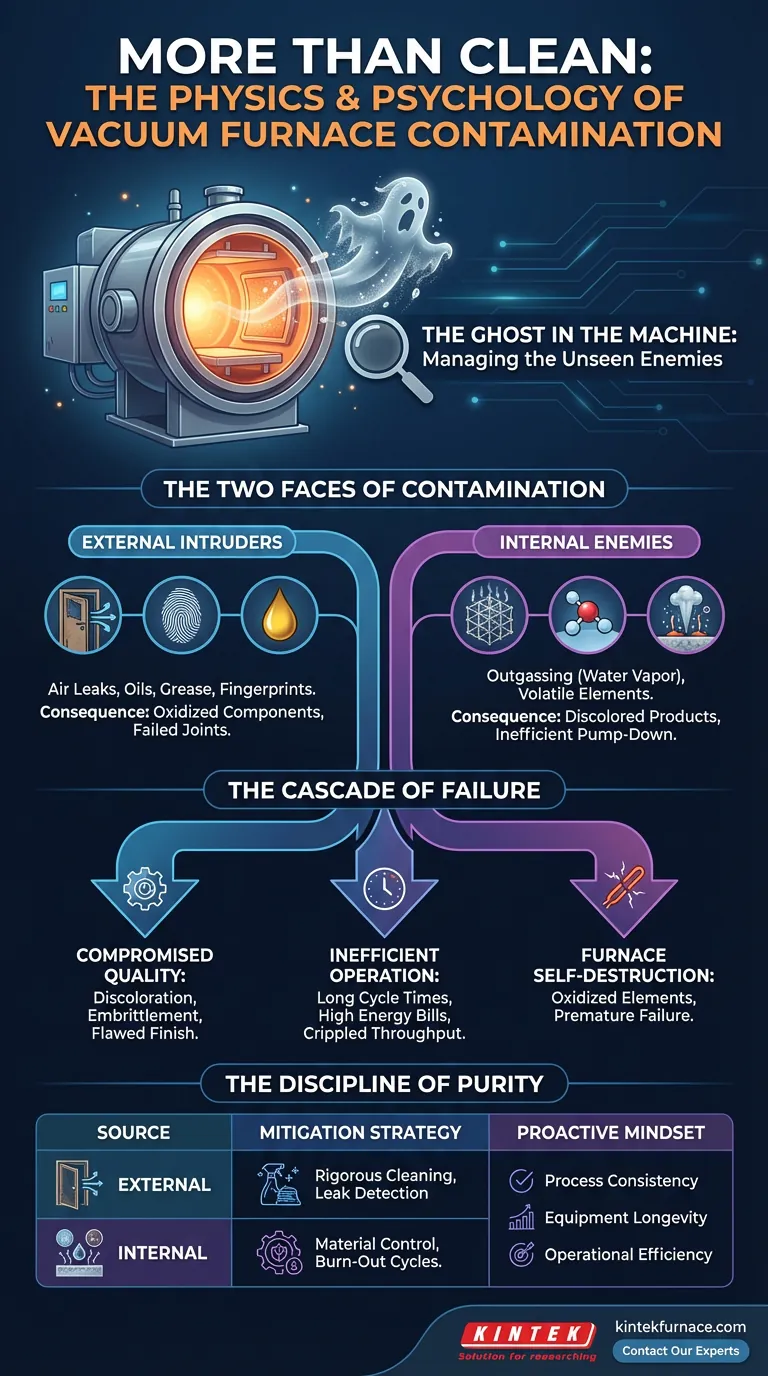
The Two Faces of Contamination
In a vacuum, every substance has a story, and some are waiting for the right conditions—heat and low pressure—to tell it. Contaminants fall into two camps: the ones you bring to the party, and the ones that were already hiding in the walls.
The Obvious Intruder: External Contaminants
This is the enemy you know. It’s the air that rushes in through a worn door seal, the microscopic fingerprint left on a part, or the thin film of cleaning residue that wasn't properly rinsed away.
These substances are straightforward threats. At high temperatures, oxygen and water vapor from a leak become voracious, attacking both the product and the furnace's expensive internal components. Oils and grease vaporize, creating a "virtual leak" that prevents the pumps from ever reaching the target vacuum. This is a battle of diligence.
The Enemy Within: Internal Contaminants
This is the more insidious threat. It comes from the very materials you are trying to process and the furnace itself. This is a battle of knowledge.
Outgassing is the primary culprit. Under vacuum and heat, gases that were adsorbed onto the surface of every part and every internal furnace fixture are released. The most common is water vapor, clinging stubbornly to surfaces, waiting to be liberated.
Even more deceptive are volatile elements hidden within an alloy. Metals like zinc, cadmium, or lead have a high vapor pressure. When heated, they can literally boil out of the solid part, turning into a metallic gas that contaminates the entire chamber and every other part in the load. The material itself betrays the process.
The Cascade of Failure
A single stray molecule doesn't just cause a single problem. In the pristine environment of a vacuum, its effects multiply, triggering a cascade of failures that compromise quality, efficiency, and the equipment itself.
Compromised Quality
Unwanted gases react with hot metal surfaces, leading to discoloration, embrittlement, or a flawed finish. In a process like vacuum brazing, contamination can poison the surface, preventing the braze alloy from wetting and flowing. The result isn't a slightly weaker joint; it's a complete failure.
Inefficient Operation
Contaminants create a gas load the vacuum pumps must constantly fight. It’s like trying to drain a tub while the faucet is still running. The system struggles for hours to reach a vacuum level that should have taken minutes. This directly translates to longer cycle times, higher energy bills, and crippled throughput.
Furnace Self-Destruction
Oxygen is the sworn enemy of the high-temperature components in a furnace. It rapidly oxidizes and destroys expensive graphite heating elements and carbon felt insulation. Some metallic contaminants can even alloy with stainless steel components, causing them to fail prematurely. The furnace begins to eat itself from the inside out.
The Discipline of Purity
Achieving a clean vacuum process is not an accident. It is the result of a deliberate, rigorous, and disciplined approach—a shift from reacting to problems to designing a system where they cannot thrive.
| Contamination Source | Key Examples | Primary Consequence | Mitigation Strategy |
|---|---|---|---|
| External | Air leaks, oils, grease, fingerprints | Oxidized components, failed product joints | Rigorous cleaning, leak detection |
| Internal | Outgassing (water vapor), volatile elements | Discolored products, inefficient pump-down | Material control, burn-out cycles |
A Proactive Mindset
Mastering contamination requires treating the entire process as an integrated system, from part handling to furnace design.
- Process Consistency: This demands absolute rigor in pre-cleaning and strict control over the materials entering the furnace. Every part must be considered a potential source of contamination.
- Equipment Longevity: This is ensured by routine leak detection and periodic high-temperature "burn-out" cycles, which bake out and pump away adsorbed contaminants from the furnace's internal surfaces.
- Operational Efficiency: A clean furnace is a fast furnace. By eliminating the gas load from contaminants, pumps work effectively, cycles shorten, and costs decrease.
Ultimately, controlling the unseen is fundamental to unlocking the true power of vacuum heat treatment. This requires not only disciplined procedures but also equipment designed for the realities of contamination control. Furnaces built with high-integrity vacuum chambers, low-outgassing materials, and robust pumping systems provide the foundation for a clean process.
KINTEK's expertise in R&D and manufacturing delivers advanced vacuum furnaces engineered to meet these exacting demands. From CVD systems to custom high-temperature solutions, our designs are built to help you master the unseen enemy of contamination. Contact Our Experts
Visual Guide
Related Products
- Vacuum Hot Press Furnace Machine Heated Vacuum Press Tube Furnace
- Vacuum Hot Press Furnace Machine Heated Vacuum Press
- 600T Vacuum Induction Hot Press Vacuum Heat Treat and Sintering Furnace
- 2200 ℃ Tungsten Vacuum Heat Treat and Sintering Furnace
- Vacuum Heat Treat Sintering Furnace with Pressure for Vacuum Sintering
Related Articles
- How Vacuum Hot Press Furnaces Transform Advanced Material Engineering
- How to Select the Right Vacuum Hot Pressing Furnace Temperature for Your Materials
- Beyond the Parts List: The Real Reason Your Vacuum Hot Press Fails (And How to Fix It)
- Why Your High-Temperature Materials Fail: The Hidden War Inside Your Furnace
- Is Your Material Data Real? Why Temperature Gradients Are Sabotaging Your Cu2Se Resistivity Measurements