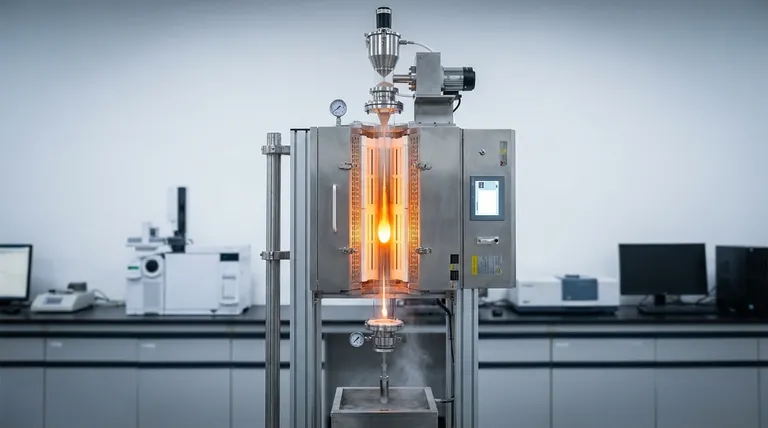
The Tyranny of Time
In the world of materials science, some of the most critical transformations are over in the blink of an eye. The combustion of a pulverized coal particle in a power plant, the calcination of a mineral in a rotary kiln, the gasification of a biomass pellet—these events unfold in a chaotic, high-temperature environment in mere seconds or milliseconds.
For a researcher, this presents a fundamental problem. How do you study an event that's finished before your instruments can get a stable reading? Using a conventional furnace, which operates on a timescale of minutes or hours, is like trying to photograph a hummingbird with a 19th-century box camera. You capture a blur, not the intricate reality of the process.
This isn't just an academic challenge; it's a multi-billion dollar industrial one. Optimizing these processes for efficiency and lower emissions requires understanding the life of a single particle during its violent, fleeting journey.
Harnessing Gravity: An Elegant Solution
This is where the drop tube furnace reveals its genius. It is not simply a furnace turned on its side; it is a purpose-built instrument designed to master time.
Its vertical orientation is the key. Instead of fighting gravity, it harnesses this fundamental force to create a perfectly controlled, highly repeatable experiment. By dropping a particle through a heated column, it gains precise control over the single most important variable: residence time.
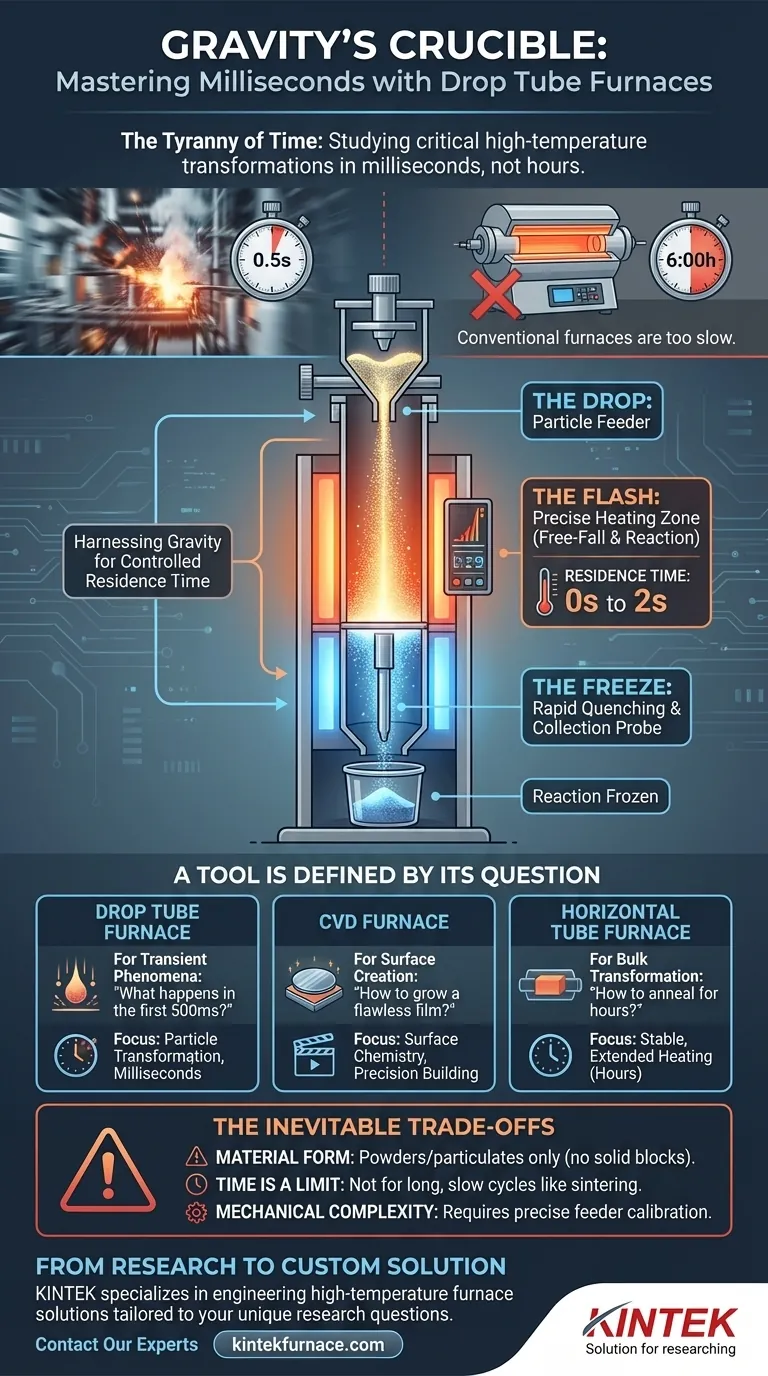
The journey of a particle is a three-act play, perfectly choreographed by physics:
- The Drop: A specialized feeder introduces a consistent stream of fine powder or particulates into the top of the furnace tube.
- The Flash: As the particle free-falls through the precisely controlled heating zone, its surface temperature skyrockets, initiating the reaction almost instantly. This mimics the sudden injection into an industrial boiler.
- The Freeze: After passing through the hot zone, the particle falls into a cooled collection probe. This rapid quenching effectively "freezes" the reaction at a specific stage, allowing scientists to collect and analyze intermediate products.
This entire process converts the chaotic reality of an industrial reactor into a controlled, observable cascade of single particles. It's a design of beautiful necessity.
A Tool is Defined by its Question
The brilliance of a specialized tool is also its boundary. A researcher's choice of furnace is ultimately a reflection of the question they are trying to answer. The wrong tool doesn't just yield poor data; it prevents you from even asking the right question.
For Transient Phenomena: The Drop Tube Furnace
If your question is, "What happens to this catalyst particle in the first 500 milliseconds of pyrolysis?"—you are studying a transient event. You need to isolate a moment in time. The drop tube furnace is built for this. Its focus is the transformation of the particle itself as it moves through a controlled environment.
For Surface Creation: The CVD Furnace
If your question is, "How can I grow a flawless semiconductor film on this wafer?"—you are focused on surface chemistry. You require precise control over precursor gases, flow rates, and substrate temperature. A Chemical Vapor Deposition (CVD) system is designed for this task of building, not for analyzing a particle in flight.
For Bulk Transformation: The Horizontal Tube Furnace
If your question is, "How do I anneal this alloy for six hours to achieve maximum hardness?"—time is your ally, not your enemy. You need stability over a long duration for a static sample. A standard horizontal tube furnace provides the simple, stable, and extended heating environment necessary for these processes.
The Inevitable Trade-Offs of Specialization
An instrument designed to master milliseconds is inherently unsuited for tasks that take hours. Understanding these limitations is as crucial as appreciating its strengths.
| Constraint | Implication |
|---|---|
| Material Form is Destiny | It only works with powders, fine particulates, or droplets. It cannot heat-treat a solid block, wafer, or crucible of material. |
| Time is a Hard Limit | Its rapid transit time is a feature, not a bug. This makes it completely unsuitable for processes requiring long, slow heating cycles, such as sintering or crystal growth. |
| Mechanical Complexity | The concept is simple (dropping), but the execution is not. The particle feeding system is a complex piece of engineering that requires careful calibration to ensure a consistent, non-agglomerated flow. |
From Research Question to Custom Solution
Choosing the right furnace begins with a clear understanding of your material's form and the specific thermal process you need to execute. Standard, off-the-shelf equipment works perfectly when your research question fits a standard model.
But pioneering research often pushes beyond standard parameters. You might need a unique temperature gradient, a specific gas atmosphere, or a multi-stage quenching system to answer your question. In these cases, your furnace is no longer just a tool; it's a custom-built part of your experiment.
This is where true partnership in manufacturing becomes critical. At KINTEK, we specialize in engineering high-temperature furnace solutions—from Muffle and Tube Furnaces to advanced CVD systems—that are tailored to the unique questions our clients are asking. Our expertise in customization ensures that the equipment doesn't just meet a spec sheet; it becomes a reliable and precise instrument for discovery.
If your research requires mastering thermal processes with uncompromising precision, we can build the tool you need. Contact Our Experts
Visual Guide
Related Products
- Vacuum Sealed Continuous Working Rotary Tube Furnace Rotating Tube Furnace
- Slide PECVD Tube Furnace with Liquid Gasifier PECVD Machine
- Custom Made Versatile CVD Tube Furnace Chemical Vapor Deposition CVD Equipment Machine
- 1200℃ Split Tube Furnace Laboratory Quartz Tube Furnace with Quartz Tube
- Laboratory Vacuum Tilt Rotary Tube Furnace Rotating Tube Furnace
Related Articles
- Beyond Heat: Mastering the Controlled Universe Inside a Tube Furnace
- Mastering the Void: How Tube Furnaces Forge the Atoms of Innovation
- Why Your Crystal Growth Experiments Are Failing: The Hidden Culprit in Your Tube Furnace
- The Art of Isolation: Mastering Material Properties with Tube Furnaces
- Beyond Heat: The Art of Control in a Tube Furnace



















