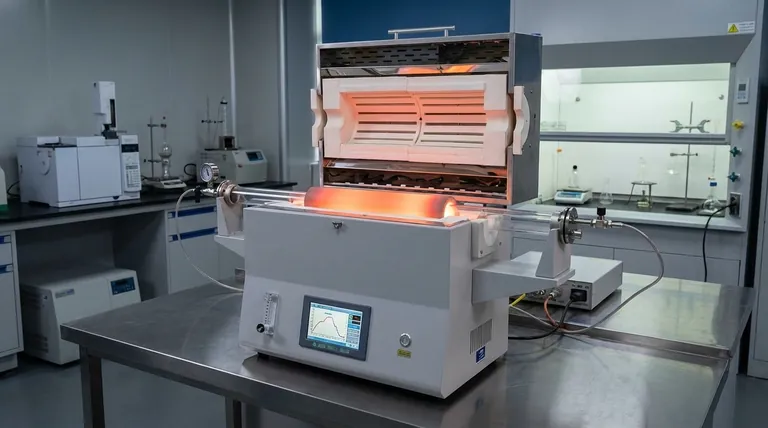
The Allure of Absolute Performance
Imagine this: a researcher, on the cusp of a breakthrough, needs to run a process at 1600°C. They consult material specifications, and one candidate stands out with heroic properties—exceptional temperature stability, high mechanical strength, and near-perfect chemical inertness.
That material is corundum (high-purity alumina). On paper, it is the perfect choice.
This is a common psychological trap in engineering and science: we are drawn to the maximums on a spec sheet. We fixate on the peak performance—the highest temperature, the greatest strength—because it represents possibility. But we often overlook the mundane, yet critical, operational liabilities that come with it.
The story of a corundum tube is a classic lesson in the trade-offs between peak performance and practical reality.
The Hidden Taxes of Corundum
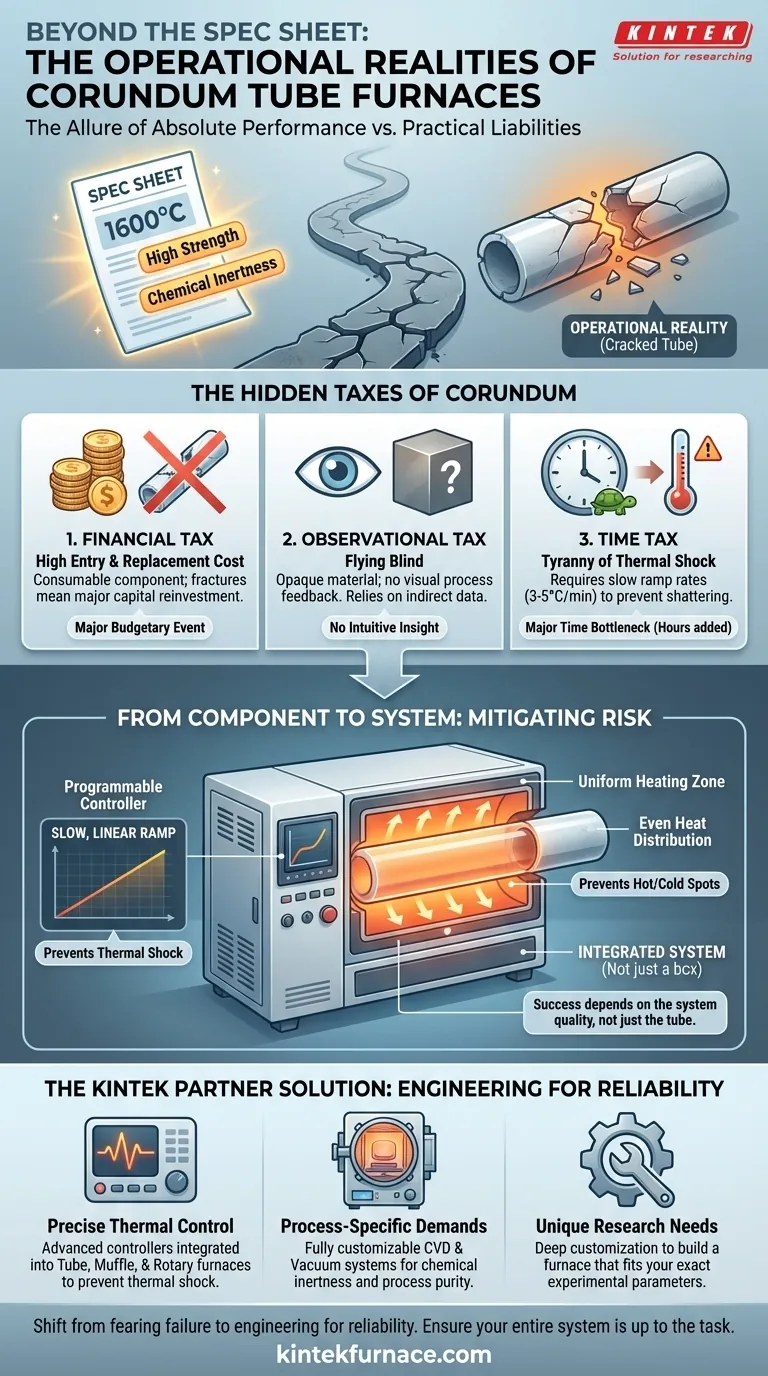
Choosing a material like corundum is not a single transaction. It’s an acceptance of three persistent "taxes"—on your budget, your time, and your senses.
1. The Financial Tax: A High Barrier to Entry and Replacement
High-purity aluminum oxide is expensive to refine and manufacture into precise tubular shapes. This isn't a one-time cost. Because the tube is a consumable component, every accidental fracture means re-investing a significant amount of capital.
This turns a simple component replacement into a major budgetary event, creating a constant, low-level anxiety around its use.
2. The Observational Tax: Flying Blind
Corundum is opaque. Unlike transparent quartz, it offers no window into your process. You cannot see your sample melt, change color, or sublime.
You are forced to rely entirely on indirect data from thermocouples and sensors. This is like trying to understand a complex story by only reading the footnotes. It robs you of the intuitive, real-time visual feedback that can often be the difference between a successful experiment and a failed one.
3. The Time Tax: The Tyranny of Thermal Shock
This is the most unforgiving liability. Corundum's relatively large thermal expansion coefficient makes it extremely vulnerable to thermal shock.
Heating or cooling it too quickly—often anything faster than 3-5°C per minute—creates internal stresses that can, and will, shatter the tube. This operational constraint imposes a steep tax on your most valuable resource: time. A four-hour process can easily require an additional four to six hours just for safe heating and cooling cycles.
This slow, mandated pace turns what should be a dynamic research tool into a slow, delicate, and often frustrating bottleneck.
From Component to System: Mitigating Inherent Risk
The mistake is not in choosing corundum; it is in seeing the tube as an isolated component. The success or failure of a corundum tube is almost entirely dependent on the quality of the system built around it.
A cracked tube is rarely the fault of the tube itself. It is a symptom of a system-level failure—most often, a furnace incapable of providing the precise, stable, and uniform thermal control required to protect its fragile, expensive heart.
The Role of the Furnace Controller
A programmable controller is the first line of defense against thermal shock. It enforces the slow, linear ramp rates necessary for the tube's survival. A high-quality furnace system ensures this control is not just a feature but a reliable, core function.
Uniformity is Everything
Uneven heating creates hot and cold spots along the tube—the perfect recipe for stress fractures. A furnace engineered for exceptional thermal uniformity, like those designed for demanding processes like Chemical Vapor Deposition (CVD), is essential. It ensures the entire tube heats and cools as a single, cohesive unit.
The Real Question: "Which Tube?" or "Which Partner?"
This brings us to a more insightful question. Instead of asking which material is best, we should ask: Who can provide a complete, integrated system designed to manage the risks of my chosen material?
This is where expertise in furnace manufacturing becomes critical. A company that understands the systemic nature of high-temperature processing doesn't just sell you a furnace; they provide a tailored environment engineered for success.
KINTEK, with its deep R&D and manufacturing expertise, builds systems—not just boxes.
| System Requirement | KINTEK Solution |
|---|---|
| Precise Thermal Control | Advanced programmable controllers integrated into Tube, Muffle, and Rotary furnaces to prevent thermal shock. |
| Process-Specific Demands | Fully customizable CVD and Vacuum Furnace systems designed for chemical inertness and process purity. |
| Unique Research Needs | Deep customization capabilities to build a furnace that fits your exact experimental parameters, not the other way around. |
By treating the furnace, the controller, and the process chamber as one integrated system, the inherent drawbacks of a material like corundum are no longer liabilities but manageable design parameters. The focus shifts from fearing failure to engineering for reliability.
Choosing the right material is only the first step. Building the right system around it is what ensures you can harness its full potential without paying the price of its hidden taxes. If your work demands the best, ensure your entire system is up to the task.
Visual Guide
Related Products
- 1700℃ High Temperature Laboratory Tube Furnace with Alumina Tube
- Vertical Laboratory Quartz Tube Furnace Tubular Furnace
- 1200℃ Split Tube Furnace Laboratory Quartz Tube Furnace with Quartz Tube
- 1400℃ High Temperature Laboratory Tube Furnace with Alumina Tube
- High Pressure Laboratory Vacuum Tube Furnace
Related Articles
- The Alchemy of Control: Mastering Material Properties with High-Temperature Tube Furnaces
- Beyond Max Temp: The Systems Thinking Approach to Selecting a High-Temperature Tube Furnace
- Why High-Purity Gas Fails Your High-Temp Brazing—And How Mono-Silane Doping Fixes It
- Why Your High-Temperature Experiments Fail: The Hidden Flaw in Your Furnace
- The Hidden Saboteur in Your HT-LiCoO2 Synthesis: Why Precise Ramp Rates Can Make or Break Your Battery Materials



















