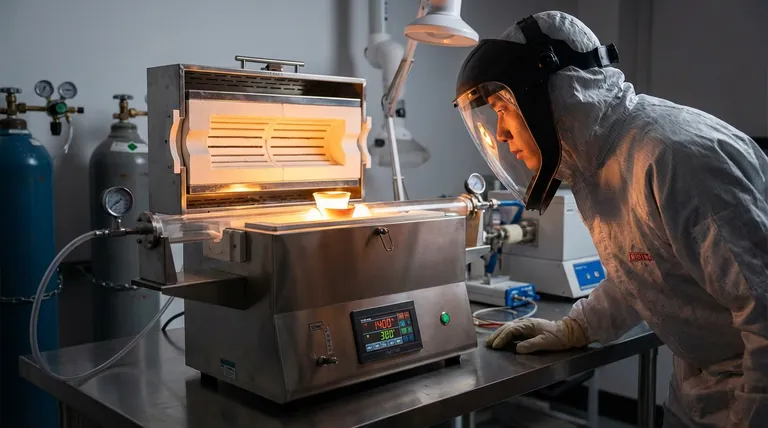
A materials scientist watches a crucible glow white-hot through a small viewport. Inside, a new alloy is being born—or failing to. The difference between a breakthrough and a cracked, useless sample isn't just the temperature. It's the hundred other variables that live and die by the furnace's design.
This is the hidden world of high-temperature processing. We think we are simply applying heat. In reality, we are trying to build a small, temporary, and perfect universe. The alumina tube furnace is the vessel for that universe.
The Illusion of 'Just Heat'
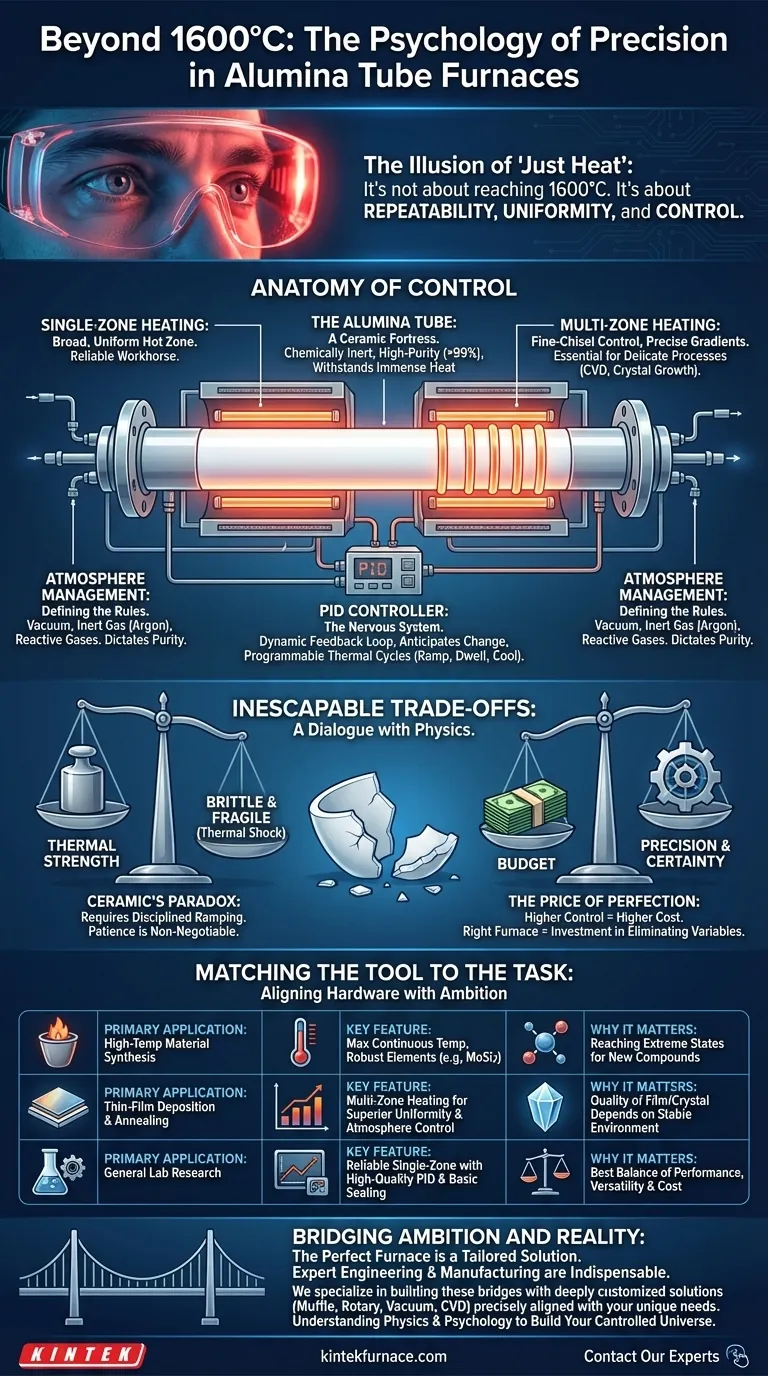
At first glance, a furnace's job is simple: get hot. But ask any researcher what they truly need, and the answer is never just "heat." It's repeatability. It's uniformity. It's control.
The psychological tension in a lab isn't about reaching 1600°C; it's about trusting that the furnace will reach the exact same 1600°C, under the exact same atmospheric conditions, every single time. Without this trust, every experiment is a gamble, and progress grinds to a halt.
An alumina tube furnace is not a brute-force instrument. It is an instrument of precision, and its value is defined by how well its components work in concert to create a predictable environment.
Anatomy of Control
To master the furnace, we must understand the systems that create its internal world. Each component serves a purpose far more nuanced than its name suggests.
The Alumina Tube: A Ceramic Fortress
The heart of the furnace is the tube itself. Made of alumina with purity often exceeding 99%, it is more than a container. It is a chemically inert fortress, ensuring that the only reactions happening are the ones you designed. Its ability to withstand immense, continuous heat is the bedrock upon which all high-temperature research is built.
The Heating System: Sculpting the Thermal Landscape
Heating elements, typically robust SiC or MoSi2 rods, surround the tube. But their job isn't just to radiate energy; it's to sculpt a thermal landscape.
- Single-Zone: A single control loop creates a broad, generally uniform hot zone. It's the powerful, reliable workhorse for many applications.
- Multi-Zone: Multiple independent heating zones and controllers act like fine chisels, allowing a researcher to create an exceptionally flat temperature profile over a long area or even introduce precise gradients. This is essential for delicate processes like crystal growth or chemical vapor deposition (CVD) .
The PID Controller: The Nervous System
The Proportional-Integral-Derivative (PID) controller is the furnace's brain. It uses a thermocouple to constantly sense the temperature and makes instantaneous adjustments to the power. This isn't a simple on/off switch; it's a dynamic feedback loop that anticipates change and maintains stability with surgical precision. It allows for complex, multi-step thermal cycles—ramping, dwelling, and cooling—transforming a simple heater into a programmable processing tool.
Atmosphere Management: Defining the Rules of the World
Sealing flanges on the ends of the tube turn it into a self-contained ecosystem. This system dictates the fundamental rules of the world inside. You can create a deep vacuum to simulate outer space, fill it with an inert gas like argon to prevent oxidation, or introduce reactive gases to drive specific chemical changes. The quality of these seals and controls determines the purity of your experiment.
The Inescapable Trade-offs: A Dialogue with Physics
With great power comes great responsibility. The capabilities of an alumina tube furnace are balanced by fundamental physical limitations that demand respect.
The Ceramic's Paradox: Strength vs. Fragility
Alumina is thermally strong but brittle. It can endure temperatures that would melt steel, yet it can be shattered by a rapid change in temperature. This is thermal shock. Heating or cooling too quickly creates internal stresses that the ceramic cannot withstand.
This paradox teaches a crucial lesson: patience is a non-negotiable part of the process. The furnace demands a disciplined approach, where ramp rates are as important as the target temperature.
The Price of Perfection: Precision vs. Budget
Greater control carries a higher cost. A three-zone furnace with advanced vacuum pumps and a gas mixing system is a far greater investment than a basic single-zone unit.
The critical question isn't "what is the best furnace?" but "what level of certainty do I need?" Every failed experiment due to poor uniformity or atmospheric leaks has a cost. The right furnace is an investment in minimizing that cost by eliminating variables.
Matching the Tool to the Task
Choosing a furnace configuration is an exercise in aligning the hardware with your scientific ambition. Your primary goal dictates the necessary architecture.
| Primary Application | Key Feature to Prioritize | Why It Matters |
|---|---|---|
| High-Temp Material Synthesis | Maximum continuous operating temperature and robust heating elements (e.g., MoSi2) | The goal is reaching extreme states for creating new compounds or alloys. |
| Thin-Film Deposition & Annealing | Multi-zone heating for superior temperature uniformity and advanced atmosphere control. | The quality of the film or crystal depends on a perfectly stable, consistent environment. |
| General Lab Research | A reliable single-zone furnace with a high-quality PID controller and basic sealing. | Provides the best balance of performance, versatility, and cost for diverse tasks. |
Bridging Ambition and Reality
Ultimately, the perfect furnace is not an off-the-shelf product. It's a tailored solution born from a deep understanding of your specific research or production goals. It must navigate the trade-offs between ideal performance and practical constraints.
This is where expert engineering and manufacturing become indispensable. At KINTEK, we specialize in building these bridges. Our expertise in R&D and in-house manufacturing allows us to move beyond standard models. We provide deeply customized solutions—from Muffle and Rotary furnaces to complex Vacuum and CVD systems—that are precisely aligned with your unique needs. By understanding the physics and the psychology of precision, we help you build not just a furnace, but the exact controlled universe your work demands.
If your ambition is to push the boundaries of what's possible, let's build the right tool for the job. Contact Our Experts
Visual Guide
Related Products
- 1400℃ High Temperature Laboratory Tube Furnace with Alumina Tube
- 1700℃ High Temperature Laboratory Tube Furnace with Alumina Tube
- Magnesium Extraction and Purification Condensing Tube Furnace
- Vertical Laboratory Quartz Tube Furnace Tubular Furnace
- High Pressure Laboratory Vacuum Tube Furnace
Related Articles
- The Alchemy of Control: Mastering Material Properties with High-Temperature Tube Furnaces
- Beyond Max Temp: The Systems Thinking Approach to Selecting a High-Temperature Tube Furnace
- Why Your High-Temperature Experiments Fail: The Hidden Flaw in Your Furnace
- The Hidden Saboteur in Your HT-LiCoO2 Synthesis: Why Precise Ramp Rates Can Make or Break Your Battery Materials
- Why High-Purity Gas Fails Your High-Temp Brazing—And How Mono-Silane Doping Fixes It



















