
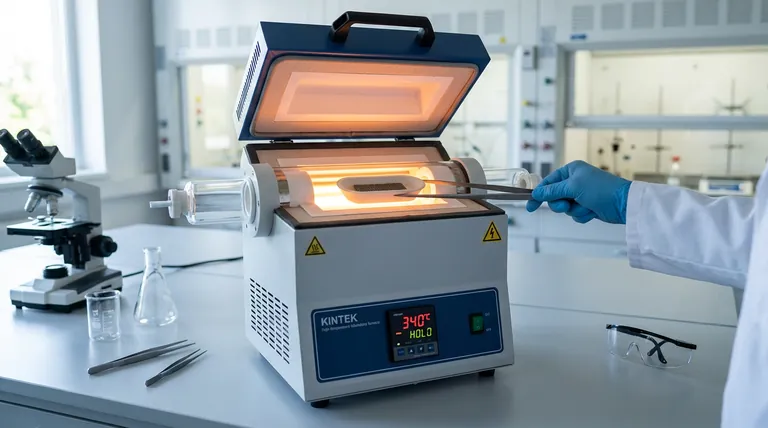
The temperature control precision of a high-temperature box furnace is the single most critical variable in the successful manufacturing of gas diffusion electrodes (GDEs).
To ensure performance, the furnace must maintain a temperature slightly above the melting point of polytetrafluoroethylene (PTFE), which sits at approximately 340 degrees Celsius. This narrow thermal window is required to induce the physical changes necessary for electrode stability while avoiding thermal damage to the component's delicate architecture.
Precision heat treatment is not just about drying the electrode; it is about inducing a controlled phase change that redistributes the PTFE binder into a uniform network, creating structural stability without sacrificing porosity.
The Mechanism of PTFE Redistribution
The Melting Point Threshold
Gas diffusion electrodes, often prepared via calendaring or spraying, rely heavily on PTFE as a binder and hydrophobic agent.
To activate these properties, the furnace must reach and maintain a temperature just above 340°C.
If the temperature fluctuates significantly below this point, the PTFE remains in its solid, particulate state and fails to initiate the necessary phase change.
Forming the Uniform Network
When the temperature is held precisely in this target zone, the PTFE undergoes physical melting.
This allows the polymer to flow and redistribute itself throughout the catalyst and diffusion layers.
This redistribution transforms isolated PTFE particles into a connected, uniform network that acts as the backbone of the electrode.
The Impact on Electrode Performance
Enhancing Interlayer Bonding
The primary structural benefit of this thermal precision is the enhancement of interlayer bonding.
As the PTFE melts and creates a network, it mechanically locks the catalyst and diffusion layers together.
This bonding is essential for the overall stability of the electrode, preventing delamination during operation.
Preserving the Porous Structure
The most difficult aspect of this process is achieving bonding without destroying the electrode's functionality.
The electrode must remain porous to allow gas diffusion.
Precise temperature control ensures the PTFE binds the materials together without damaging the porous structure or clogging the pathways required for gas transport.
Understanding the Risks of Imprecision
The Danger of Overheating
If the furnace temperature drifts too high, the PTFE may flow excessively.
This can lead to a collapse of the pore structure, effectively sealing off the catalyst sites and rendering the electrode useless for gas diffusion.
The Consequence of Underheating
Conversely, if the furnace fails to hold the temperature above 340°C, the hydrophobic network will not form.
This results in a mechanically weak electrode with poor interlayer adhesion.
Furthermore, without the proper PTFE network, the electrode may lack the necessary hydrophobicity to manage water balance effectively.
Making the Right Choice for Your Process
To optimize your heat treatment process for gas diffusion electrodes, prioritize furnace features that offer tight thermal uniformity and stability.
- If your primary focus is mechanical durability: Ensure your furnace can sustain temperatures above 340°C without fluctuation to guarantee complete interlayer bonding.
- If your primary focus is gas transport efficiency: Prioritize precision to prevent temperature spikes that could melt the PTFE excessively and degrade the porous structure.
True performance is achieved only when the thermal input is exact enough to bond the layers while leaving the pore network intact.
Summary Table:
| Factor | Below 340°C (Underheating) | Target (~340°C-350°C) | Above 350°C (Overheating) |
|---|---|---|---|
| PTFE State | Solid / Particulate | Controlled Melting / Flow | Excessive Melting / Degradation |
| Structural Result | Weak interlayer bonding | Uniform binder network | Pore structure collapse |
| Electrode Impact | Delamination & low stability | Enhanced mechanical durability | Clogged pathways / No diffusion |
| Hydrophobicity | Ineffective | Optimized water management | Loss of surface functionality |
Elevate Your GDE Manufacturing with KINTEK Precision
Precise thermal management is the difference between a high-performance gas diffusion electrode and a failed component. At KINTEK, we understand that maintaining a strict 340°C thermal window requires more than just standard heating—it requires expert engineering.
Backed by industry-leading R&D and manufacturing, KINTEK offers a comprehensive range of Muffle, Tube, Rotary, Vacuum, and CVD systems. Our lab high-temperature furnaces are fully customizable to meet your unique precision requirements, ensuring uniform PTFE redistribution and preserved porosity for your specific materials.
Ready to optimize your heat treatment process? Contact our technical experts today to find the perfect furnace solution for your research or production needs.
References
- Qinhao Chen, K. Andreas Friedrich. Scalable fabrication of multi-layered Cu-based electrodes <i>via</i> solvent-free method for the selective electrochemical conversion of CO<sub>2</sub> to C<sub>2+</sub> products. DOI: 10.1039/d4gc00711e
This article is also based on technical information from Kintek Furnace Knowledge Base .
Related Products
- 1400℃ High Temperature Laboratory Tube Furnace with Alumina Tube
- 1700℃ High Temperature Laboratory Tube Furnace with Alumina Tube
- 1800℃ High Temperature Muffle Oven Furnace for Laboratory
- 1700℃ High Temperature Muffle Oven Furnace for Laboratory
- 1200℃ Muffle Oven Furnace for Laboratory
People Also Ask
- How does zone-melting in tube furnaces synthesize bismuth micro-wires? Master Single-Crystal Thermoelectric Growth
- How are high-temp tube furnaces used to measure diffusion coefficients per Fick's law? Master Precision Annealing
- How are high-temperature laboratory tube furnaces applied in long-term vacuum homogenization heat treatments for intermetallic samples?
- How do high-temperature laboratory tube furnaces ensure environmental stability? Precision Thermal Reduction Tips
- How are high-temperature tube furnaces applied in testing ceramic-supported alloy membranes? Insights



















