
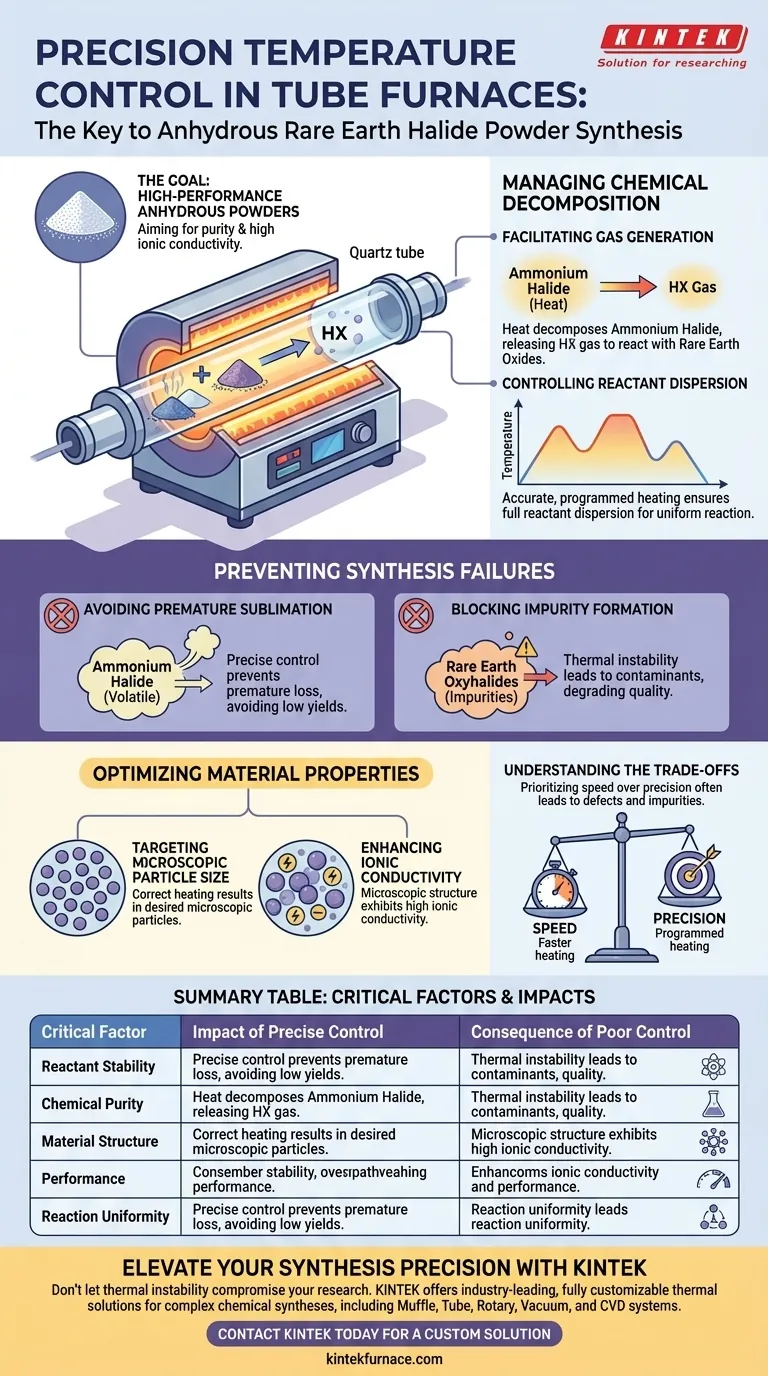
Precision is the dividing line between successful synthesis and wasted material. In the preparation of anhydrous rare earth halide powders, the tube furnace is not merely a heat source, but a critical control mechanism that governs the reaction between decomposing ammonium halide and rare earth oxides. Without exact thermal management, you risk losing reactants to sublimation or contaminating the final product with unwanted chemical byproducts.
Precise thermal regulation prevents the premature loss of reactants and the formation of impurities, ensuring the creation of microscopic particles with high ionic conductivity. It is the essential mechanism for facilitating the correct chemical decomposition and reaction sequence.

Managing the Chemical Decomposition
Facilitating Gas Generation
The primary function of the tube furnace in this context is to drive a specific chemical reaction. The heat causes ammonium halide to decompose.
This decomposition releases HX gas. This gas is the critical agent required to react with the rare earth oxides to form the desired halide powder.
Controlling Reactant Dispersion
You must rely on accurate, programmed heating rather than a static temperature application.
This dynamic thermal profile ensures that the reactants are fully dispersed. Proper dispersion is necessary to ensure the reaction occurs uniformly throughout the material batch.
Preventing Synthesis Failures
Avoiding Premature Sublimation
One of the most significant risks in this process is the volatility of the ammonium halide.
If the temperature is not controlled precisely, the ammonium halide may undergo premature sublimation. This means the reactant turns to gas and escapes the system before it has time to react with the rare earth oxides, leading to low yields or incomplete reactions.
Blocking Impurity Formation
Inaccurate heating does more than just reduce yield; it actively degrades quality.
Thermal instability can lead to the formation of rare earth oxyhalides. These are specific impurities that contaminate the final powder, rendering it less effective for its intended application.
Understanding the Trade-offs
The Cost of Thermal Inaccuracy
It is important to recognize that this synthesis process has very low tolerance for error.
While faster heating rates might seem efficient, they often bypass the necessary windows for reactant dispersion. Prioritizing speed over programmed precision inevitably leads to the structural defects and impurities mentioned above.
Optimizing Material Properties
Targeting Microscopic Particle Size
The ultimate goal of the thermal process is to engineer the physical structure of the powder.
Correctly executed heating results in the formation of microscopic particles. Large or irregular particles are often a sign of thermal mismanagement during the synthesis phase.
Enhancing Ionic Conductivity
The physical structure of the powder directly dictates its performance properties.
The microscopic particles produced through precise temperature control exhibit high ionic conductivity. If the temperature fluctuates, you compromise this conductivity, reducing the utility of the rare earth halide powder.
Making the Right Choice for Your Synthesis
To ensure consistent quality in your rare earth halide powders, align your thermal strategy with your specific production goals.
- If your primary focus is chemical purity: Maintain strict thermal stability to prevent the formation of rare earth oxyhalide impurities.
- If your primary focus is material performance: Utilize accurate programmed heating to ensure reactant dispersion and maximize ionic conductivity.
Mastering the temperature profile is the single most effective step toward producing high-performance anhydrous powders.
Summary Table:
| Critical Factor | Impact of Precise Control | Consequence of Poor Control |
|---|---|---|
| Reactant Stability | Prevents premature sublimation of ammonium halide | Low yield and lost reactants |
| Chemical Purity | Blocks the formation of rare earth oxyhalides | Contaminated, low-quality product |
| Material Structure | Ensures formation of microscopic particles | Large, irregular, or defective particles |
| Performance | Maximizes ionic conductivity of the powder | Reduced material utility and efficiency |
| Reaction Uniformity | Facilitates full dispersion of HX gas agents | Incomplete or non-uniform synthesis |
Elevate Your Synthesis Precision with KINTEK
Don’t let thermal instability compromise your research or production yields. KINTEK provides industry-leading thermal solutions specifically designed for complex chemical syntheses. Backed by expert R&D and manufacturing, KINTEK offers a comprehensive range of Muffle, Tube, Rotary, Vacuum, and CVD systems, all of which are fully customizable to meet the exacting temperature profiles required for high-performance rare earth halide powders.
Ready to optimize your material properties and eliminate impurities?
Contact KINTEK Today for a Custom Solution
Visual Guide
References
- Zhichao Zeng, Yaping Du. Vacuum evaporation-assisted reaction: sustainable solution for application of rare earth-based halide solid-state electrolytes. DOI: 10.1039/d5sc00003c
This article is also based on technical information from Kintek Furnace Knowledge Base .
Related Products
- Vertical Laboratory Quartz Tube Furnace Tubular Furnace
- Slide PECVD Tube Furnace with Liquid Gasifier PECVD Machine
- Inclined Rotary Plasma Enhanced Chemical Deposition PECVD Tube Furnace Machine
- Inclined Rotary Plasma Enhanced Chemical Deposition PECVD Tube Furnace Machine
- Laboratory Quartz Tube Furnace RTP Heating Tubular Furnace
People Also Ask
- What are the key differences between single-zone and multi-zone vertical tube furnaces? Choose the Right Furnace for Your Lab
- What is the purpose of using an industrial-grade vertical tube furnace in phosphorus recovery? High-Fidelity Simulation
- How do heat treatment processes influence the configuration of a vertical tube furnace? Optimize for Quenching, Annealing, and More
- What is a vertical tube furnace and how does it function? Optimize Material Processing with Precision
- How does a vertical single-temperature zone tube furnace facilitate the growth of high-quality PdSe2 single crystals?


















