
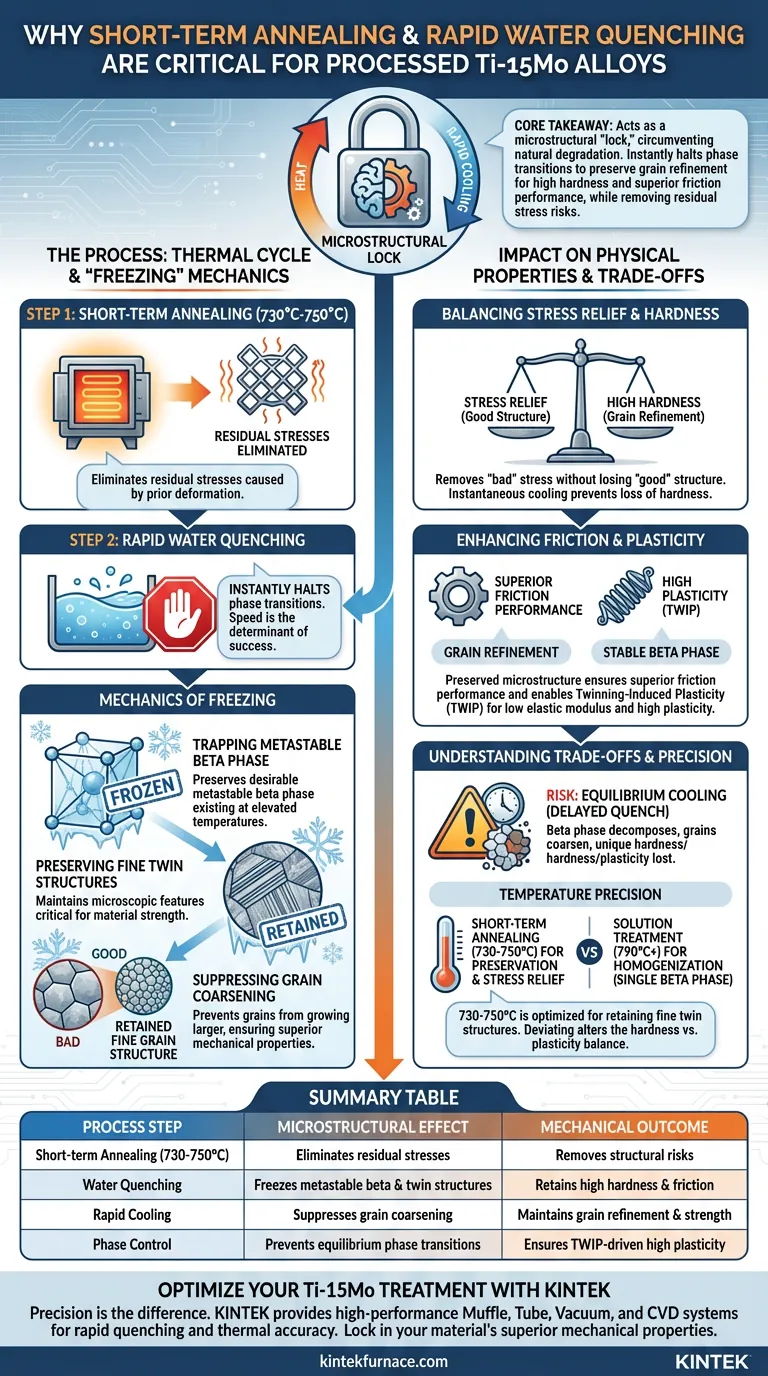
Short-term annealing followed by rapid water quenching is the definitive method for stabilizing the favorable microstructure of processed Ti-15Mo alloys. This specific thermal cycle eliminates residual stresses caused by prior deformation while simultaneously "freezing" the high-temperature metastable beta phase and fine twin structures before they can decay or grow.
Core Takeaway This process acts as a microstructural "lock," circumventing the natural degradation that occurs during slow cooling. By instantly halting phase transitions, it preserves grain refinement to ensure high hardness and superior friction performance, while still removing the structural risks associated with residual stress.
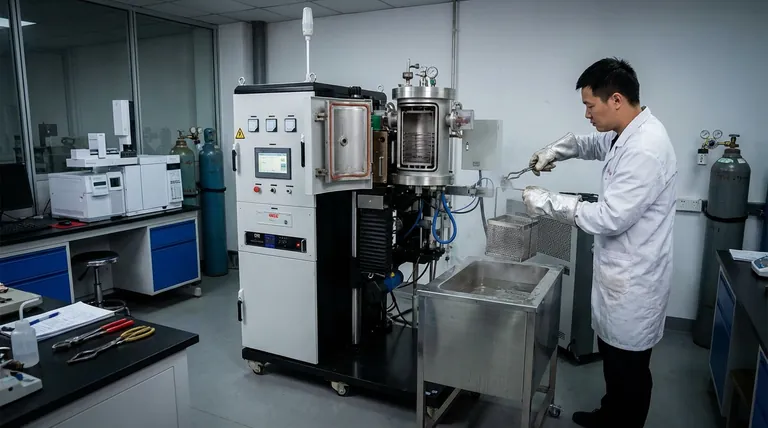
The Mechanics of Microstructural "Freezing"
Trapping the Metastable Beta Phase
At elevated temperatures (specifically 730°C to 750°C), Ti-15Mo alloys exist in a desirable metastable beta phase.
If allowed to cool slowly, the alloy would undergo equilibrium phase transitions, changing its fundamental structure. Water quenching acts as a thermal brake, instantly dropping the temperature to freeze this beta phase in place at room temperature.
Preserving Fine Twin Structures
Processed Ti-15Mo alloys often contain "fine twin structures"—microscopic features generated during deformation that contribute significantly to the material's strength.
Short-term annealing maintains these structures. The subsequent rapid cooling ensures these newly formed twins are retained rather than dissolving or altering, which is critical for maintaining the alloy's specific mechanical advantages.
Suppressing Grain Coarsening
Heat generally causes grains within a metal to grow larger (coarsen), which typically reduces strength and hardness.
The rapid nature of the water quenching process effectively suppresses microstructural coarsening. By cutting the heat exposure short and cooling instantly, the material retains a fine-grained structure, which is directly linked to superior mechanical properties.
Impact on Physical Properties
Balancing Stress Relief and Hardness
The primary challenge in processing these alloys is removing the "bad" stress without losing the "good" structure.
The short-term annealing phase (730°C–750°C) provides enough thermal energy to eliminate the residual stresses caused by cyclic deformation. However, because the cooling is instantaneous, this stress relief does not come at the cost of grain refinement, ensuring the material retains high hardness.
Enhancing Friction Performance
The friction performance of Ti-15Mo is heavily dependent on its surface microstructure.
By preserving the grain refinement and fine twin structures, the annealing-quenching cycle ensures the material exhibits superior friction performance. A coarser microstructure resulting from slower cooling would likely degrade these wear-resistant characteristics.
Enabling Plasticity Mechanisms
While the primary goal of this specific 730°C–750°C range is balancing hardness and stress, the retention of the metastable beta phase is also essential for plasticity.
A stable beta-phase structure allows for effects such as Twinning-Induced Plasticity (TWIP). This ensures that while the material is hard, it maintains a low elastic modulus and high plasticity, preventing it from becoming brittle.
Understanding the Trade-offs
The Risk of Equilibrium Cooling
The most critical pitfall in this process is a delay in quenching.
Any hesitation allows the material to enter "equilibrium phase transitions." If this occurs, the beta phase decomposes, grains coarsen, and the unique combination of high hardness and plasticity is lost. Speed is not just a variable; it is the determinant of success.
Temperature Precision
There is a distinct difference between "short-term annealing" for preservation (730°C–750°C) and higher-temperature solution treatments (e.g., 790°C).
While higher temperatures (790°C) are useful for homogenization and creating a single beta-phase structure, the specific 730°C–750°C range described is optimized for retaining fine twin structures alongside stress relief. Deviating from this range alters the final balance of hardness vs. plasticity.
Making the Right Choice for Your Goal
To optimize the heat treatment of your Ti-15Mo alloy, align the process parameters with your specific performance requirements:
- If your primary focus is High Hardness and Friction Performance: Adhere strictly to the short-term annealing at 730°C–750°C followed by immediate water quenching to preserve fine twin structures.
- If your primary focus is Homogenization and Maximum Plasticity: Consider higher temperature solution treatments (around 790°C) to achieve a uniform single beta-phase structure, accepting potential changes in hardness.
- If your primary focus is Stress Relief: Ensure the annealing is sufficient to remove cyclic deformation stresses but follows with rapid quenching to prevent the loss of mechanical strength.
The success of Ti-15Mo processing relies on the speed of the quench; you must freeze the structure to lock in performance.
Summary Table:
| Process Step | Microstructural Effect | Mechanical Outcome |
|---|---|---|
| Short-term Annealing (730-750°C) | Eliminates residual stresses from deformation | Removes structural risks/brittleness |
| Water Quenching | "Freezes" metastable beta phase & twin structures | Retains high hardness & friction performance |
| Rapid Cooling | Suppresses grain coarsening | Maintains grain refinement & strength |
| Phase Control | Prevents equilibrium phase transitions | Ensures TWIP-driven high plasticity |
Optimize Your Ti-15Mo Alloy Treatment with KINTEK
Precision is the difference between material success and failure. At KINTEK, we understand that for Ti-15Mo alloys, speed and temperature control are non-negotiable. Backed by expert R&D and world-class manufacturing, we provide high-performance Muffle, Tube, Vacuum, and CVD systems designed to deliver the rapid quenching and thermal accuracy your alloys require.
Whether you need customizable lab furnaces for grain refinement or high-temp systems for stress relief, KINTEK offers the specialized equipment to lock in your material's superior mechanical properties.
Ready to elevate your heat treatment results? Contact our experts today for a custom solution!
Visual Guide
References
- Tiewei Xu, Bin-Jiang Lv. The {332}<113> Twinning Behavior of a Ti-15Mo Medical Alloy during Cyclic Deformation and Its Effect on Microstructure and Performance. DOI: 10.3390/ma17071462
This article is also based on technical information from Kintek Furnace Knowledge Base .
Related Products
- Controlled Inert Nitrogen Hydrogen Atmosphere Furnace
- Molybdenum Vacuum Heat Treat Furnace
- Vacuum Heat Treat Sintering Furnace Molybdenum Wire Vacuum Sintering Furnace
- 2200 ℃ Tungsten Vacuum Heat Treat and Sintering Furnace
- 1700℃ Controlled Inert Nitrogen Atmosphere Furnace
People Also Ask
- What are the characteristics and uses of hydrogen atmosphere in furnaces? Achieve Superior Surface Purity and Bonding
- What are the characteristics and uses of hydrogen atmospheres in furnaces? Unlock Clean Metal Processing
- Mechanism of Fe81Ga19 Secondary Recrystallization? High-Precision Furnace Control for Goss Grain Growth
- How does a controlled atmosphere furnace contribute to energy efficiency? Lower Costs with Advanced Thermal Management
- Why is controlled atmosphere capability important in an atmosphere furnace? Unlock Precise Material Processing






