
Precise temperature control is the single most critical variable determining the success of $Fe_3GaTe_2$ crystal synthesis. Specifically, the growth process requires a stable hold at 1273 K followed by an extremely slow, regulated cooling period to 1053 K over 100 hours. Without high-precision equipment, you cannot maintain the stable nucleation environment required to prevent the formation of multiphase impurities.
Core Takeaway $Fe_3GaTe_2$ synthesis relies on a long-duration, specific thermal profile to transition from raw material to single crystal. High-precision furnaces are mandatory to execute the slow cooling rates necessary for pure crystal nucleation, minimizing defects and preventing the solidification of unwanted secondary phases.
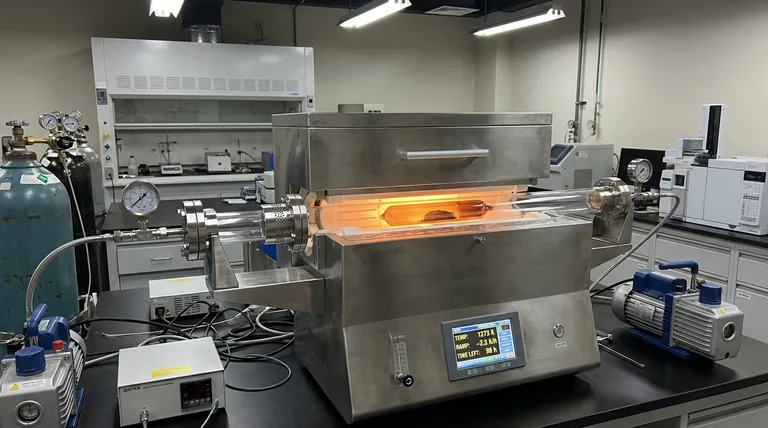
The Thermal Physics of $Fe_3GaTe_2$ Growth
The Necessity of Controlled Cooling
The synthesis of $Fe_3GaTe_2$ is not merely about reaching a melting point; it is about the path taken back down to solid state.
The primary reference indicates that after holding at 1273 K, the material must undergo a cooling ramp to 1053 K over a duration of 100 hours. This equates to a cooling rate of roughly 2.2 K per hour.
Enabling Nucleation
This slow rate is essential for crystal nucleation. Rapid temperature drops prevent the orderly arrangement of atoms, leading to amorphous structures or small, polycrystalline grains rather than large single crystals.
High-precision controls ensure the furnace follows this linear ramp exactly, without sudden drops that would "shock" the crystal growth.
Preventing Multiphase Impurities
The most significant risk in this process is phase competition. If temperature control fluctuates, the chemical equilibrium shifts.
Instead of pure $Fe_3GaTe_2$, the mixture may separate into other combinations of Iron, Gallium, and Tellurium. Precise thermal regulation keeps the system within the narrow thermodynamic window where only the desired phase is stable.
Role of Furnace Architecture
Uniformity via Electric Heating
Modern muffle and tube furnaces utilize high-temperature electric heating elements rather than combustion-based methods.
This creates a contamination-free environment, which is vital for high-purity applications. Furthermore, electric elements provide superior heat distribution, ensuring the temperature at the center of the quartz tube matches the temperature at the sensor.
Repeatability Through Programmable Logic
Given that the cooling cycle lasts over four days (100 hours), manual control is impossible.
Digital programmable controls allow researchers to input the exact profile (1273 K $\rightarrow$ 1053 K). This ensures that the successful growth parameters can be repeated exactly in future runs, eliminating "drift" between batches.
Understanding the Trade-offs
The Risk of Thermal Overshoot
While maintaining heat is important, avoiding "overshoot" is equally critical.
As seen in analogous materials like $Mo_2Ga_2C$, crossing a specific temperature threshold can lead to material decomposition. In $Fe_3GaTe_2$, an uncontrolled spike above 1273 K could potentially alter the stoichiometry or damage the sealed quartz ampoule.
Precision vs. Processing Time
The requirement for high precision imposes a time penalty. A 100-hour cooling cycle significantly limits throughput.
However, attempting to accelerate this process (increasing the cooling rate) to save time involves a direct trade-off with quality. Faster cooling invariably leads to higher defect densities and the inclusion of multiphase impurities.
Making the Right Choice for Your Goal
To ensure successful $Fe_3GaTe_2$ growth, your equipment strategy should align with the following priorities:
- If your primary focus is Crystal Purity: Prioritize a furnace with multi-zone control to ensure the entire length of the quartz tube experiences the exact same thermal history, preventing gradient-induced impurities.
- If your primary focus is Process Repeatability: Ensure your furnace controller has programmable PID (Proportional-Integral-Derivative) loops to manage the 100-hour ramp without deviation or fluctuation.
Ultimately, the quality of your $Fe_3GaTe_2$ crystal is a direct reflection of your furnace's ability to maintain absolute stability over long durations.
Summary Table:
| Parameter | Requirement for Fe3GaTe2 Growth | Importance of Precision |
|---|---|---|
| Hold Temperature | 1273 K | Ensures complete melting and homogenization |
| Cooling Range | 1273 K to 1053 K | Critical window for pure phase nucleation |
| Cooling Duration | 100 Hours (~2.2 K/hr) | Prevents defects and amorphous structures |
| Environment | Contamination-free / Uniform | Eliminates phase competition and gradients |
Elevate Your Material Synthesis with KINTEK Precision
Achieving the perfect $Fe_3GaTe_2$ single crystal requires more than just heat—it requires absolute thermal stability. KINTEK provides industry-leading Muffle, Tube, Rotary, and Vacuum furnaces designed to handle the most demanding 100-hour cooling cycles with zero deviation.
Why choose KINTEK for your lab?
- Advanced R&D: Our systems feature programmable PID controllers for flawless long-duration ramps.
- Customizable Solutions: Whether you need multi-zone CVD or specialized high-temp furnaces, we tailor our tech to your stoichiometry.
- Expert Manufacturing: Built for uniformity and repeatable results in high-purity applications.
Don't let temperature fluctuations ruin your research. Contact KINTEK today to discuss your unique furnace needs!
References
- Ki‐Hoon Son, Hyejin Ryu. Persistent ferromagnetic ground state in pristine and Ni-doped Fe3GaTe2 flakes. DOI: 10.1186/s40580-024-00458-x
This article is also based on technical information from Kintek Furnace Knowledge Base .
Related Products
- Magnesium Extraction and Purification Condensing Tube Furnace
- Vertical Laboratory Quartz Tube Furnace Tubular Furnace
- Multi Zone Laboratory Quartz Tube Furnace Tubular Furnace
- Laboratory Quartz Tube Furnace RTP Heating Tubular Furnace
- Slide PECVD Tube Furnace with Liquid Gasifier PECVD Machine
People Also Ask
- What are the advantages of using a condensing tube furnace for magnesium extraction? Achieve High Purity and Efficient Metal Recovery
- What is the heating rate of a tube furnace? Balancing Speed with Safety for Your Lab
- Why use nitrogen atmosphere control in chromite reduction? Ensure Process Integrity and Prevent Oxidation
- What role does precursor molecular structure play in sol-gel fiber processing? Master Spinnability
- What technical challenges are associated with tube furnace cracking? Master Extreme Heat and Material Limits

















