
Precise temperature control is the fundamental driver of aluminum alloy casting quality. It allows for the strict management of the cooling rate as the melt transitions from a liquid to a solid state. This precision is critical to prevent premature solidification, which can lead to incomplete mold filling and structural defects.
By strictly managing the cooling rate and solidification gradient, temperature control equipment prevents particle segregation and ensures a uniform microstructure. This directly translates to consistent material performance and the elimination of defects like incomplete fills.
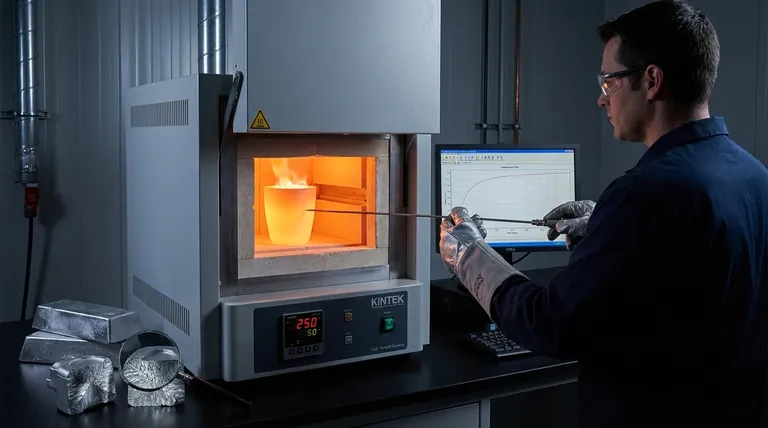
Managing the Phase Transition
Controlling the Cooling Rate
The transition from liquid to solid is the most critical phase in casting. Equipment that provides precise monitoring allows operators to dictate the exact speed at which the aluminum cools.
Avoiding Premature Solidification
If the temperature drops too quickly or unpredictably, the metal may freeze before it reaches every corner of the mold.
Strict temperature management prevents this premature solidification. This ensures the melt remains fluid long enough to achieve complete mold filling.
Achieving Microstructural Uniformity
Establishing a Constant Gradient
Beyond simply filling the mold, the internal structure of the alloy determines its strength. High-quality equipment maintains a constant solidification gradient throughout the process.
Preventing Particle Segregation
When cooling is uneven, particles tend to separate or "segregate" at the solidification front.
Precise control stabilizes the solidification front. This prevents the segregation of particles, ensuring the material properties are consistent throughout the entire part.
Distributing Reinforcement Phases
For high-performance alloys, achieving the desired microstructural characteristics is non-negotiable.
Proper thermal management ensures that reinforcement phases remain uniformly distributed within the matrix. This uniformity is what guarantees reliable material performance in the final product.
Understanding the Risks of Instability
The Cost of Gradient Fluctuations
While equipment is essential, the process relies on the consistency of the application. Even minor fluctuations in the solidification gradient can compromise the material.
If the gradient shifts, reinforcement phases may cluster rather than disperse. This leads to weak points in the alloy, negating the benefits of using high-performance materials.
Making the Right Choice for Your Goal
To maximize the quality of your aluminum alloy melts, prioritize equipment capabilities based on your specific defect risks.
- If your primary focus is Geometric Accuracy: Ensure your equipment prevents premature solidification to guarantee complete mold filling.
- If your primary focus is Material Strength: Prioritize systems that maintain a constant solidification gradient to prevent particle segregation and uniformly distribute reinforcement phases.
Precise thermal management transforms a variable casting process into a predictable engineering science.
Summary Table:
| Key Factor | Impact on Solidification | Benefit to Final Product |
|---|---|---|
| Cooling Rate Management | Prevents premature freezing | Ensures complete mold filling & geometric accuracy |
| Constant Gradient | Stabilizes the solidification front | Prevents particle segregation for consistent properties |
| Phase Distribution | Maintains uniform reinforcement matrix | Enhances material strength and structural integrity |
| Thermal Stability | Reduces gradient fluctuations | Eliminates weak points and unpredictable defects |
Elevate Your Casting Precision with KINTEK
Don't let temperature fluctuations compromise your material integrity. At KINTEK, we understand that high-performance aluminum alloys require absolute thermal stability. Backed by expert R&D and world-class manufacturing, we provide advanced Muffle, Tube, and Vacuum furnace systems tailored to your specific solidification needs.
Whether you are aiming for perfect geometric accuracy or superior microstructural uniformity, our customizable high-temperature lab solutions empower you to transform casting into a predictable science. Contact KINTEK today to optimize your melt quality and discover how our precision equipment can drive your success.
References
- C P Vandana, Q. Mohammad. Revolutionizing Aluminum-Based Composites: Enhancing Strength with Eggshell and Bagasse Ash Reinforcement via Stir Casting. DOI: 10.1051/e3sconf/202450701052
This article is also based on technical information from Kintek Furnace Knowledge Base .
Related Products
- 1700℃ High Temperature Laboratory Tube Furnace with Alumina Tube
- 1400℃ High Temperature Laboratory Tube Furnace with Alumina Tube
- High Temperature Muffle Oven Furnace for Laboratory Debinding and Pre Sintering
- 1700℃ Controlled Inert Nitrogen Atmosphere Furnace
- Vacuum Induction Melting Furnace
People Also Ask
- How does zone-melting in tube furnaces synthesize bismuth micro-wires? Master Single-Crystal Thermoelectric Growth
- How are high-temperature laboratory tube furnaces applied in long-term vacuum homogenization heat treatments for intermetallic samples?
- How are high-temp tube furnaces used to measure diffusion coefficients per Fick's law? Master Precision Annealing
- How do high-temperature laboratory tube furnaces ensure environmental stability? Precision Thermal Reduction Tips
- How are high-temperature tube furnaces applied in testing ceramic-supported alloy membranes? Insights




