
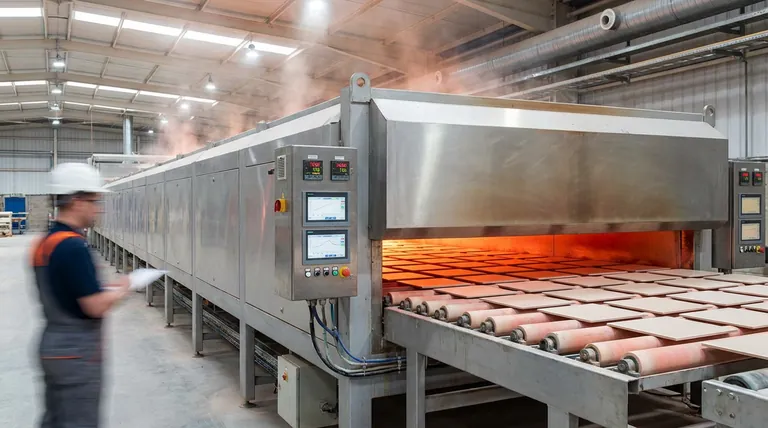
The primary technical advantage of a single-channel roller kiln lies in its specific design for continuous, direct thermal exposure, which drastically reduces firing cycles. By utilizing conveyor rollers to transport tiles through precisely controlled temperature zones, this technology creates an environment where sintering can occur in as little as 55 to 59 minutes while maintaining the ceramic's mechanical integrity.
Core Insight: This kiln technology transforms ceramic production by decoupling speed from quality loss. It leverages the synergy between direct high-temperature radiation and chemical fluxing to significantly boost production capacity and lower CO2 emissions without compromising the structural properties of the tile.
Mechanisms Driving Fast Sintering
Continuous Conveyance System
The fundamental efficiency of this kiln stems from its use of conveyor rollers.
Rather than batch processing, tiles are transported continuously. This ensures a steady flow of material and eliminates the downtime associated with loading and unloading static kilns.
Direct Thermal Exposure
The single-channel design facilitates direct exposure to high-temperature radiation.
Because the heat source interacts directly with the tiles on the rollers, thermal transfer is immediate and highly efficient. This eliminates the thermal lag often found in more complex or insulated kiln designs.
Precision Control and Material Synergy
Zoned Temperature Management
Speed requires precision. The kiln allows for precise control over specific temperature zones.
Operators can fine-tune the thermal profile across the length of the kiln. This ensures the tiles receive the exact heat required for different stages of the sintering cycle, preventing thermal shock despite the rapid pace.
Chemical Fluxing Integration
The hardware works best when paired with the right chemistry. The technology is particularly effective when combined with inorganic additives.
These additives induce chemical fluxing effects. When processed under the kiln's direct radiation, these fluxes accelerate the sintering reactions, enabling the sub-hour cycle times mentioned earlier.
Operational and Environmental Impact
Significant Time Reduction
The most measurable technical gain is the reduction of sintering times to a range of 55 to 59 minutes.
This is a stark contrast to traditional methods, allowing for faster turnover and significantly higher daily production volumes.
Sustainability Without Compromise
Faster cycles directly correlate to energy efficiency. This method results in reduced CO2 emissions per unit produced.
Crucially, this efficiency does not degrade the product. The process preserves the mechanical properties of the ceramics, ensuring the final tile meets industry standards for strength and durability.
Operational Considerations and Trade-offs
Dependency on Feedstock Formulation
Achieving the 55-minute cycle is not solely a function of the kiln hardware.
It often relies on the correct chemical composition, specifically the use of inorganic additives. Without the proper chemical fluxing agents, the rapid firing cycle may not yield full densification.
Tight Process Windows
The advantage of speed brings the challenge of precision.
Because the sintering time is compressed into such a short window, the margin for error in temperature zone control is minimal. Deviations that might be forgiven in a longer cycle could lead to defects in this accelerated process.
Making the Right Choice for Your Goal
When evaluating a single-channel roller kiln for your production line, consider your primary objectives:
- If your primary focus is Production Throughput: Capitalize on the 55-59 minute cycle time to maximize daily output volume.
- If your primary focus is Sustainability: Leverage the reduced firing time to lower fuel consumption and reportable CO2 emissions.
- If your primary focus is Product Quality: Ensure your raw material formulation includes the necessary inorganic additives to maintain mechanical properties at high speeds.
This technology offers a clear path to high-velocity manufacturing, provided the thermal and chemical parameters are strictly synchronized.
Summary Table:
| Feature | Technical Advantage | Impact on Production |
|---|---|---|
| Conveyance System | Continuous roller transport | Eliminates batch downtime and ensures steady flow |
| Thermal Transfer | Direct high-temp radiation | Immediate heat transfer; eliminates thermal lag |
| Cycle Time | 55 - 59 minutes | Dramatically increased throughput vs. traditional kilns |
| Sustainability | Rapid firing technology | Lower energy consumption and reduced CO2 emissions |
| Zoned Control | Precise temperature management | Prevents thermal shock during accelerated processing |
| Material Synergy | Integrated chemical fluxing | Accelerates sintering reactions for full densification |
Maximize Your Production Efficiency with KINTEK
Ready to transform your manufacturing with high-speed sintering technology? Contact our experts today to discover how our advanced thermal solutions can optimize your workflow.
Backed by expert R&D and world-class manufacturing, KINTEK offers a comprehensive range of Muffle, Tube, Rotary, Vacuum, and CVD systems, along with specialized lab high-temperature furnaces. Whether you need a standard solution or a fully customizable system tailored to your unique chemical formulations, we provide the precision and reliability required for elite material processing. Partner with KINTEK to achieve superior mechanical properties and sustainable production goals.
References
- Siniša Sremac, Nebojša Vasić. Shortening of fast firing in the ceramic tile production by inorganic additives - an upscale to the industry. DOI: 10.2298/sos231213004s
This article is also based on technical information from Kintek Furnace Knowledge Base .
Related Products
- Chairside Dental Porcelain Zirconia Sintering Furnace with Transformer for Ceramic Restorations
- Dental Porcelain Zirconia Sintering Ceramic Vacuum Press Furnace
- Vacuum Heat Treat Sintering Furnace Molybdenum Wire Vacuum Sintering Furnace
- Electric Rotary Kiln Small Rotary Furnace for Activated Carbon Regeneration
- Electric Rotary Kiln Pyrolysis Furnace Plant Machine Small Rotary Kiln Calciner
People Also Ask
- What factors determine the quality of sintered zirconia restorations? Master Material, Equipment, and Technique
- How do conventional vs rapid sintering in dental furnaces affect zirconia? Optimize Efficiency Without Sacrificing Strength
- What industries use zirconia sintering furnaces? Beyond Dental and Jewelry Applications
- What type of heating elements are preferred for zirconia sintering and why? Choose SiC or MoSi2 for Optimal Results
- Why is a zirconia sintering furnace considered essential for dental laboratories and clinics? Unlock Precision and Durability










