
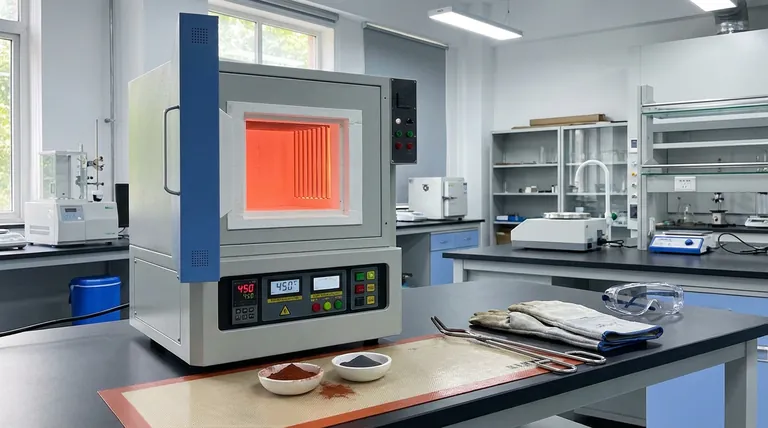
The critical necessity is moisture elimination. Using a laboratory high-temperature furnace to preheat reinforcement materials—specifically iron oxide and cobalt—is required to thoroughly remove trace moisture adsorbed on the particle surfaces. Without this step, water residue introduces catastrophic defects when the powder enters the semi-solid aluminum alloy melt.
Core Insight: By holding these materials at 450°C for 45 minutes, you prevent the explosive generation of water vapor upon contact with molten metal. This process is the defining factor in minimizing porosity and ensuring the reinforcement actually bonds to the aluminum matrix.
The Mechanics of Moisture Removal
Addressing Adsorbed Moisture
Even if powders appear dry to the naked eye, they often carry trace moisture adsorbed onto their surfaces from the ambient environment.
To effectively strip this moisture, the materials must be subjected to sustained heat. The optimal protocol requires heating the iron oxide and cobalt powders at 450°C for 45 minutes.
Preventing Vapor Generation
When room-temperature particles containing moisture contact molten aluminum, the temperature difference is extreme.
Any remaining water instantly flashes into steam. This rapid expansion creates water vapor bubbles within the melt, which are difficult to remove once formed.
Impact on Material Integrity
Reducing Interfacial Pores
The primary physical defect caused by moisture is porosity.
The water vapor generated during mixing gets trapped as gas pockets around the reinforcement particles. Preheating creates a dry environment, significantly reducing these interfacial pores in the final composite.
Enhancing Matrix Adhesion
For a composite to be strong, the aluminum (matrix) must physically grip the iron oxide and cobalt (reinforcement).
Vapor barriers prevent this contact, effectively insulating the particle from the metal. By removing moisture, you allow for direct contact, thereby enhancing the interfacial adhesion between the matrix and the reinforcement phases.
Common Pitfalls in Preparation
The Risk of Inadequate Heating
Simply warming the materials is often insufficient to break the bond of adsorbed moisture.
Failing to reach the target temperature of 450°C or rushing the 45-minute duration may leave residual moisture. This results in inconsistent material quality and unpredictable porosity levels.
The Consequence of Gas Defects
If gas defects occur, the mechanical properties of the alloy suffer.
Pores act as stress concentrators, making the final material prone to cracking and failure under load. Skipping the preheat step compromises the structural integrity of the entire cast.
Ensuring Quality in Composite Fabrication
To achieve a high-performance aluminum matrix composite, strict adherence to thermal preparation is required.
- If your primary focus is Structural Integrity: Ensure the preheating cycle is fully completed to eliminate porosity, which is the main cause of mechanical weakness.
- If your primary focus is Material Bonding: Prioritize moisture removal to maximize the surface area available for adhesion between the aluminum and the reinforcement particles.
A disciplined preheating routine is the invisible foundation of a defect-free, high-strength metal composite.
Summary Table:
| Parameter | Specification | Purpose |
|---|---|---|
| Target Materials | Iron Oxide, Cobalt Powders | Reinforcement for Aluminum Matrix |
| Preheating Temperature | 450°C | Desorption of trace surface moisture |
| Holding Time | 45 Minutes | Ensures thorough thermal equilibrium |
| Key Outcome | Reduced Porosity | Prevents water vapor bubbles in the melt |
| Matrix Benefit | Enhanced Adhesion | Direct metal-to-particle bonding surface |
Maximize Material Integrity with KINTEK
Don't let moisture-induced porosity compromise your composite materials. Backed by expert R&D and manufacturing, KINTEK offers high-precision Muffle, Tube, Rotary, Vacuum, and CVD systems tailored for the rigorous demands of laboratory heat treatment. Whether you need a standard solution or a system customized for your unique metallurgical needs, our high-temp furnaces ensure the consistent 450°C thermal stability required for superior matrix adhesion.
Ready to elevate your research and production quality?
Contact KINTEK Today to Find Your Ideal Furnace
References
- T. Joseph Sahaya Anand, G. Prabaharan. Study on Mechanical Behaviour of AA2014 Aluminium Alloy Blended with Cobalt (Co) and Iron Oxide (Fe<sub>2</sub>O<sub>3</sub>). DOI: 10.1051/matecconf/202439301015
This article is also based on technical information from Kintek Furnace Knowledge Base .
Related Products
- 1400℃ High Temperature Laboratory Tube Furnace with Alumina Tube
- 1700℃ High Temperature Laboratory Tube Furnace with Alumina Tube
- 1800℃ High Temperature Muffle Oven Furnace for Laboratory
- 1700℃ High Temperature Muffle Oven Furnace for Laboratory
- 1200℃ Muffle Oven Furnace for Laboratory
People Also Ask
- How does zone-melting in tube furnaces synthesize bismuth micro-wires? Master Single-Crystal Thermoelectric Growth
- How do high-temperature laboratory tube furnaces ensure environmental stability? Precision Thermal Reduction Tips
- How are high-temp tube furnaces used to measure diffusion coefficients per Fick's law? Master Precision Annealing
- How are high-temperature laboratory tube furnaces applied in long-term vacuum homogenization heat treatments for intermetallic samples?
- How are high-temperature tube furnaces applied in testing ceramic-supported alloy membranes? Insights



















