
High temperature control precision is the defining factor between a successful component and a failed run. In solid-phase sintering, accurate thermal regulation prevents the material from accidentally crossing its melting point, ensuring the matrix remains solid while strictly avoiding liquid-phase defects.
Precision control acts as a rigid barrier against unintentional melting, preventing material overflow from the mold and averting severe reductions in material density and mechanical strength.
The Critical Physics of Solid-Phase Sintering
Defining the Thermal Threshold
The fundamental goal of solid-phase sintering is to densify powder into a solid mass without turning it into a liquid.
This process operates very close to the material's melting point to facilitate atomic diffusion.
High precision is required because the margin for error is extremely narrow; a deviation of even 20°C can trigger an unwanted phase change.
Preventing Unintended Melting
If the temperature control drifts upward, the matrix material can cross its melting point.
Once melted, the material changes state and volume, leading to overflow from the mold.
This not only damages the tooling but ruins the geometric integrity of the part being formed.
Impact on Material Properties
Ensuring Maximum Density
Unexpected melting does not help densification; conversely, it often leads to a sharp decline in material density.
Solid-phase sintering relies on pressure and heat to remove voids, whereas uncontrolled melting introduces porosity and structural inconsistencies.
Precise thermal management ensures the material compacts uniformly without collapsing into a liquid state.
Preserving Mechanical Strength
The mechanical properties of the final alloy are dictated by the microstructure formed during the solid-phase state.
If the process fluctuates into the liquid phase, the resulting microstructure is often degraded.
Maintaining the correct temperature profile ensures the final product meets the necessary specifications for strength and durability.
Understanding the Trade-offs
Equipment Complexity vs. Uniformity
Achieving high precision often requires sophisticated engineering, such as multi-zone heating systems using graphite or high nickel alloys.
While these systems allow for tight uniformity (e.g., +/- 2°C), they increase the complexity and initial cost of the furnace.
Ramping Speed vs. Overshoot Risk
To maintain strict precision, the heating ramp rates must be carefully controlled to prevent thermal inertia from causing an "overshoot."
Aggressive heating might save time, but it increases the risk of momentarily spiking above the melting point, triggering the defects mentioned above.
Making the Right Choice for Your Goal
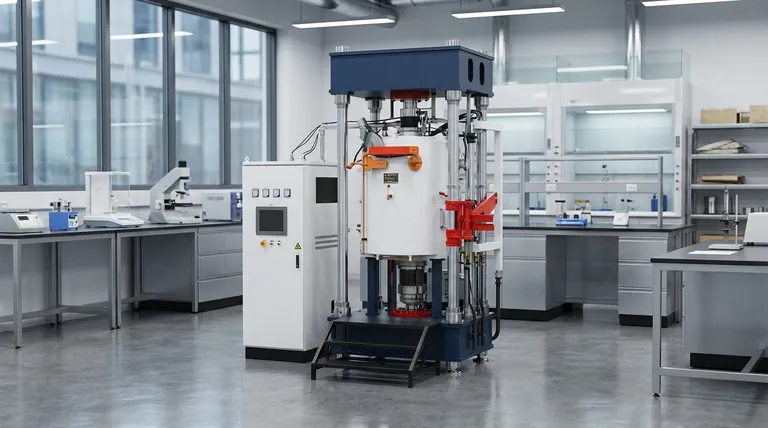
When configuring or selecting a vacuum hot pressing furnace, consider your specific material constraints:
- If your primary focus is Geometric Integrity: Prioritize control systems that guarantee zero overshoot to prevent mold overflow and dimensional loss.
- If your primary focus is Mechanical Performance: Ensure the furnace offers multi-zone heating to maintain uniform density across the entire part, preventing localized melting.
Precision in temperature control is not merely a feature; it is the prerequisite for keeping solid-phase sintering purely solid.
Summary Table:
| Factor | Requirement in Solid-Phase Sintering | Impact of Precision Failure |
|---|---|---|
| Phase State | Remains strictly solid | Unintended melting/liquid-phase defects |
| Temperature Margin | Very narrow (close to melting point) | Material overflow from the mold |
| Density | Uniform compaction & void removal | Sharp decline in density and high porosity |
| Microstructure | Controlled atomic diffusion | Degraded microstructure & weak mechanical strength |
| Tooling Integrity | Protected by solid-state containment | Damage to molds due to material leakage |
Elevate Your Sintering Precision with KINTEK
Don’t let temperature fluctuations compromise your material integrity. KINTEK’s advanced vacuum hot pressing systems are engineered with high-precision control and multi-zone heating to ensure your solid-phase sintering stays strictly solid. Backed by expert R&D and manufacturing, we offer customizable Muffle, Tube, Rotary, Vacuum, and CVD systems tailored for your unique laboratory needs.
Ready to achieve maximum density and mechanical strength? Contact our technical experts today to find the perfect high-temperature solution for your lab.
Visual Guide

Related Products
- 600T Vacuum Induction Hot Press Vacuum Heat Treat and Sintering Furnace
- Vacuum Heat Treat Sintering Furnace with Pressure for Vacuum Sintering
- 9MPa Air Pressure Vacuum Heat Treat and Sintering Furnace
- Vacuum Hot Press Furnace Machine Heated Vacuum Press Tube Furnace
- 2200 ℃ Tungsten Vacuum Heat Treat and Sintering Furnace
People Also Ask
- Why use Vacuum Hot Press (VHP) for ZnS Ceramics? Achieve Superior IR Transparency and Mechanical Strength
- How does a vacuum hot press sintering furnace mitigate copper sintering swelling? Solve Fe-Cu Expansion Issues
- What are the key advantages of vacuum hot press sintering furnaces? Achieve Superior Density and Purity in Materials
- What is the core function of a vacuum hot press sintering furnace in the preparation of high-density RuTi alloys? Achieve Maximum Density and Purity
- How does the vacuum environment in a vacuum hot press sintering furnace protect chromium-containing ceramics? Find out.



















