
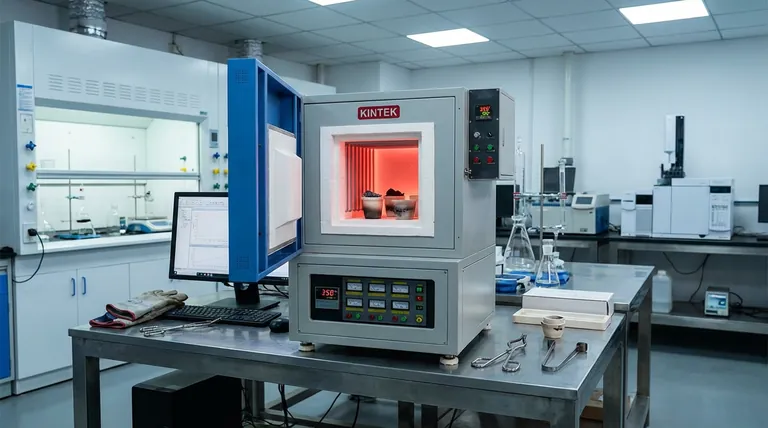
High-temperature annealing is the decisive post-processing step that transforms a raw graphene slurry into a functional, high-performance cathode. For screen-printed graphene, this process utilizes a muffle furnace to create a controlled thermal environment—typically between 240°C and 350°C—which burns off non-conductive organic binders and establishes the necessary electromechanical properties for reliable operation.
The primary role of the muffle furnace is not just drying, but purification and structural consolidation. By thermally degrading organic residues, annealing eliminates the root causes of arcing and high resistance, ensuring the cathode is stable enough for field emission.
Enhancing Electrical Conductivity
The screen-printing process requires a viscous slurry, which is created by mixing graphene with organic binders and surfactants. While necessary for printing, these additives are detrimental to electrical performance.
Removing Insulating Barriers
In their raw state, the organic binders encasing the graphene act as electrical insulators.
Annealing burns these organics off, effectively "cleaning" the graphene network. This restores the intrinsic conductivity of the material that was previously inhibited by the slurry formulation.
Minimizing Contact Resistance
To function effectively, electrons must flow freely from the substrate (or buffer layer) into the graphene emitters.
High-temperature treatment significantly reduces contact resistance at this interface. It ensures a direct, low-resistance pathway for electron transfer, which is essential for efficient field emission.
Ensuring Operational Stability
Beyond conductivity, the physical integrity of the cathode is paramount. The muffle furnace solidifies the structure to withstand the rigors of operation.
Increasing Bonding Strength
Screen-printed layers can be fragile and prone to delamination if not properly treated.
The thermal energy provided by the furnace facilitates strong adhesion between the multi-layer graphene and the underlying substrate. This mechanical bonding prevents the cathode material from detaching during handling or operation.
Preventing Field Emission Failures
One of the most critical functions of annealing is the prevention of "outgassing."
If organic residues remain in the cathode, they can release gas molecules within the vacuum environment of a field emission device. This outgassing frequently leads to electrical arcing, which can permanently damage the cathode. Annealing eliminates these residues before the device is ever sealed.
Understanding the Constraints
While annealing is essential, it requires strict parameter control to avoid diminishing returns.
The Temperature Window
The process relies on a specific temperature range (240°C to 350°C) for a reason.
Temperatures must be high enough to fully decompose the specific binders used in the slurry. However, if the temperature is too low, residues remain, risking stability. Conversely, excessively high temperatures (outside the primary window) could potentially damage sensitive substrates or oxidize the graphene if the atmosphere is not perfectly controlled.
Making the Right Choice for Your Goal
To maximize the performance of your screen-printed cathodes, tailor your focus based on your primary performance metric:
- If your primary focus is Device Longevity: Prioritize the completeness of the burn-off phase to eliminate all organic residues, preventing outgassing and arcing.
- If your primary focus is Emission Efficiency: Focus on maximizing the bonding strength and reducing contact resistance to lower the turn-on voltage required for electron emission.
A well-calibrated annealing cycle is the difference between a conductive paste and a robust, high-stability electron emitter.
Summary Table:
| Aspect | Process Impact | Benefit to Cathode |
|---|---|---|
| Electrical | Removes organic binders/insulators | Restores intrinsic conductivity and lowers resistance |
| Mechanical | Increases bonding strength | Prevents delamination and ensures substrate adhesion |
| Stability | Eliminates outgassing residues | Prevents electrical arcing and device failure |
| Efficiency | Optimizes interface contact | Lowers turn-on voltage for field emission |
Elevate Your Field Emission Research with KINTEK
Don’t let organic residues compromise your graphene cathode performance. KINTEK provides industry-leading thermal solutions, including high-precision Muffle, Tube, and Vacuum furnaces, specifically designed for the rigorous demands of material science. Our systems offer the temperature uniformity and controlled environments necessary for perfect annealing cycles, ensuring your screen-printed layers achieve maximum conductivity and bonding strength.
Ready to optimize your high-temperature processes? Contact our expert team today to discuss how our customizable laboratory furnaces can support your unique R&D and manufacturing goals.
References
- Wenmei Lv, Yongliang Tang. A Study on the Field Emission Characteristics of High-Quality Wrinkled Multilayer Graphene Cathodes. DOI: 10.3390/nano14070613
This article is also based on technical information from Kintek Furnace Knowledge Base .
Related Products
- 1400℃ Muffle Oven Furnace for Laboratory
- 1700℃ High Temperature Muffle Oven Furnace for Laboratory
- 1800℃ High Temperature Muffle Oven Furnace for Laboratory
- 1200℃ Muffle Oven Furnace for Laboratory
- High Temperature Muffle Oven Furnace for Laboratory Debinding and Pre Sintering
People Also Ask
- How does a high-temperature laboratory muffle furnace affect material properties? Transform Anodic Oxide Films Fast
- What is the primary function of a high-temperature laboratory muffle furnace in chemical synthesis? Achieve Precision.
- What is the muffle furnace function in ilmenite oxidative roasting? Enhance Phase Change & Magnetic Separation
- What is the purpose of using a laboratory high-temperature muffle furnace for drying Fe-Ni-Co catalysts? Boost Purity
- What are the primary objectives of using a muffle furnace in zirconia synthesis? Achieve precision phase control.



















