
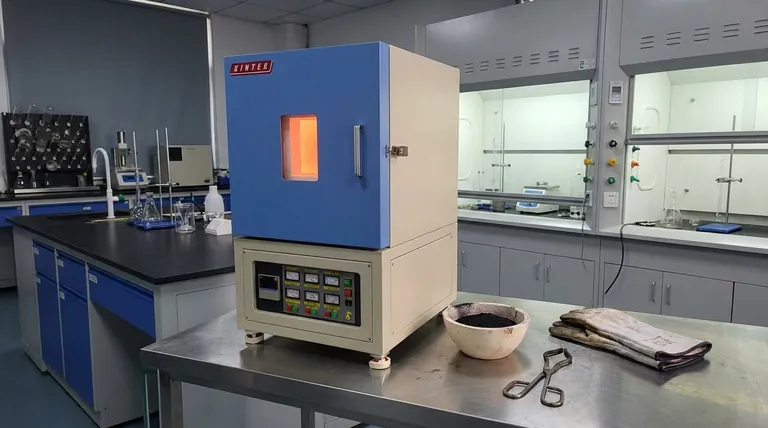
The muffle furnace serves as the critical reaction chamber for converting raw precursor foams into functional ER-SnmCunOx-t/CC electrocatalysts. Its primary function is to provide a controlled high-temperature environment, specifically between 400 °C and 700 °C, which drives the essential chemical transformations required to activate the material.
Core Takeaway The muffle furnace facilitates high-temperature pyrolysis and oxidation, acting as the "engine" that burns away organic templates (like glucose) while simultaneously oxidizing metal precursors into their active crystalline forms (CuO and SnO2).
The Mechanism of Transformation
Thermal Pyrolysis of Organics
The initial role of the furnace is to execute the complete removal of organic templates.
In this specific preparation, the precursor foam contains organic materials, such as glucose residues.
The high heat of the muffle furnace ensures these organics undergo pyrolysis, effectively "ashing" them away to leave only the desired inorganic structure.
Oxidation of Metal Precursors
Simultaneously, the furnace drives the oxidation process necessary for catalytic activity.
It converts the metal precursors within the foam into stable metal oxides.
This results in the formation of specific active components, primarily copper oxide (CuO) and tin oxide (SnO2).
Crystal Structure Definition
Beyond simple burning, the furnace acts as a crystallizing agent.
The thermal energy supplied allows atoms to rearrange into specific, stable crystal structures.
This step determines the final component ratios and the physical architecture of the catalyst powders.
Understanding the Trade-offs
Temperature Sensitivity
While high heat is necessary, the specific range (400 °C to 700 °C) is non-negotiable.
The Risk of Incomplete Pyrolysis
If the temperature is too low or the duration too short, organic glucose residues may remain.
This contamination blocks active sites and reduces the purity of the final metal oxide powder.
The Risk of Structural Degradation
Conversely, deviations in temperature can alter the intended crystal phase or component ratio.
Inconsistent heating can lead to poor crystallinity, which directly impacts the electrochemical performance of the final ER-SnmCunOx-t/CC catalyst.
Making the Right Choice for Your Goal
To maximize the effectiveness of the muffle furnace in this preparation, align your parameters with your specific targets:
- If your primary focus is Purity: Ensure the furnace reaches the upper threshold of the required annealing temperature to guarantee the complete combustion of glucose residues.
- If your primary focus is Catalytic Activity: Prioritize precise temperature stability within the 400–700 °C range to optimize the crystallinity and ratio of CuO and SnO2 phases.
The muffle furnace is not just a heater; it is the tool that chemically defines the identity and efficiency of your electrocatalyst.
Summary Table:
| Process Stage | Function of Muffle Furnace | Key Outcome |
|---|---|---|
| Pyrolysis | High-temp removal of organic templates (glucose) | High purity, ash-free inorganic structure |
| Oxidation | Conversion of precursors into CuO and SnO2 | Formation of active catalytic metal oxides |
| Crystallization | Controlled thermal rearrangement of atoms | Stable crystal structures and defined architecture |
| Optimization | Precise 400°C – 700°C temperature range | Maximized electrochemical performance |
Elevate Your Catalyst Synthesis with KINTEK
Precision is the difference between a contaminated precursor and a high-performance electrocatalyst. At KINTEK, we understand that ER-SnmCunOx-t/CC preparation requires exact temperature stability and uniform heating to ensure complete pyrolysis and perfect crystallinity.
Backed by expert R&D and world-class manufacturing, KINTEK offers a comprehensive range of Muffle, Tube, Rotary, Vacuum, and CVD systems. Our lab high-temp furnaces are fully customizable to meet your unique research needs, providing the reliability you need for sensitive annealing and oxidation processes.
Ready to optimize your thermal processing? Contact our technical experts today to find the perfect furnace solution for your laboratory.
References
- Cu-Sn Electrocatalyst Prepared with Chemical Foaming and Electroreduction for Electrochemical CO2 Reduction. DOI: 10.3390/catal15050484
This article is also based on technical information from Kintek Furnace Knowledge Base .
Related Products
- 1400℃ Muffle Oven Furnace for Laboratory
- 1700℃ High Temperature Muffle Oven Furnace for Laboratory
- 1800℃ High Temperature Muffle Oven Furnace for Laboratory
- 1200℃ Muffle Oven Furnace for Laboratory
- Laboratory Muffle Oven Furnace with Bottom Lifting
People Also Ask
- What is the primary function of a high-temperature laboratory muffle furnace in chemical synthesis? Achieve Precision.
- How does a high-temperature laboratory muffle furnace affect material properties? Transform Anodic Oxide Films Fast
- How does a laboratory high-temperature muffle furnace facilitate the homogenization of borosilicate glass samples? Expert Insights
- What is the function of a muffle furnace in MOF-derived zirconia conversion? Optimize Phase & Pore Engineering
- What is the muffle furnace function in ilmenite oxidative roasting? Enhance Phase Change & Magnetic Separation



















