
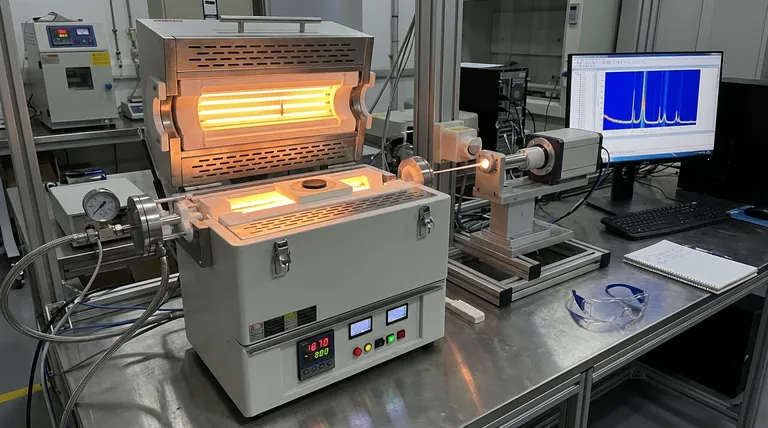
An in-situ X-ray diffraction (XRD) system equipped with a high-temperature furnace is strictly necessary because it captures the dynamic structural evolution of the material in real-time. Rather than providing a static "before and after" snapshot, this setup allows researchers to observe exactly when amorphous peak intensities change or crystalline phases precipitate, directly linking temperature to material failure.
Core Insight: The value of in-situ XRD lies in its ability to pinpoint the exact moment of phase transformation. It transforms thermal stability testing from a guessing game into a precise measurement of oxidation kinetics and application limits.
Capturing Structural Evolution in Real-Time
Monitoring Phase Changes
Y-W-N ceramics are often amorphous (non-crystalline) in their as-deposited state. High temperatures can force these materials to crystallize, which often degrades their mechanical or protective properties.
An in-situ XRD system continuously scans the material as it heats. It detects the precipitation of crystalline phases the moment they occur.
Tracking Amorphous Peak Intensity
As the material is heated, the characteristic broad "humps" in the XRD pattern—indicative of an amorphous structure—may shift or decrease in intensity.
Monitoring these changes in real-time provides a direct readout of the material's structural integrity vs. thermal energy.
The Role of Controlled Atmospheres
High-temperature testing requires more than just heat; it requires environmental control. The furnace chamber allows the introduction of specific gases, such as a mixture of Nitrogen and Hydrogen (N2 + H2).
This controlled environment isolates thermal stability from external chemical attacks, or conversely, allows for the specific study of oxidation kinetics under controlled conditions.
Defining Material Performance Boundaries
Establishing Application Limits
For materials like Y-W-N, knowing they are "heat resistant" is insufficient. Engineers need to know the precise temperature threshold where failure begins.
In-situ characterization provides the data necessary to define the absolute upper limits of the material's operating environment.
Understanding Oxidation Kinetics
By observing how the crystal structure changes over time at a fixed temperature, or as temperature ramps up, researchers can calculate the rate of oxidation.
This kinetic data is essential for predicting the lifespan of the ceramic in real-world high-temperature applications.
Understanding the Limitations
Complexity of Setup
While powerful, in-situ XRD is significantly more complex than standard room-temperature analysis. It requires rigorous calibration of the high-precision temperature control to ensure the sample surface temperature matches the sensor reading.
Surface vs. Bulk Sensitivity
X-rays interact primarily with the near-surface region of the material.
While excellent for coatings, one must be careful when interpreting results for bulk materials, as surface oxidation may occur faster than internal structural changes.
Making the Right Choice for Your Goal
To maximize the utility of this characterization method, align your testing protocols with your specific data needs.
- If your primary focus is identifying the maximum safe operating temperature: Monitor the onset of crystalline peaks to define the exact thermal limit where the amorphous structure degrades.
- If your primary focus is studying environmental durability: Utilize the furnace's atmosphere control to compare structural evolution in inert versus oxidizing environments.
Ultimately, in-situ XRD serves as the definitive tool for converting theoretical thermal properties into actionable engineering data.
Summary Table:
| Feature | In-Situ XRD Advantage | Impact on Y-W-N Characterization |
|---|---|---|
| Real-Time Monitoring | Captures phase precipitation instantly | Pinpoints exact temperature of crystallization |
| Structural Tracking | Monitors amorphous peak intensity | Evaluates structural integrity vs. thermal energy |
| Atmosphere Control | N2 + H2 or specific gas mixtures | Isolates thermal effects from oxidation kinetics |
| Kinetic Data | Continuous scanning during heating | Predicts material lifespan and operating limits |
Elevate Your Material Research with KINTEK Precision
Unlock the full potential of your thermal characterization with KINTEK’s advanced high-temperature solutions. Backed by expert R&D and world-class manufacturing, KINTEK offers a comprehensive range of Muffle, Tube, Rotary, Vacuum, and CVD systems, as well as specialized lab furnaces—all fully customizable to meet the rigorous demands of in-situ XRD and structural analysis.
Whether you are defining application limits for Y-W-N ceramics or exploring complex oxidation kinetics, our high-precision systems provide the stability and control your research deserves. Contact KINTEK today to discuss your unique needs and let us help you build the perfect thermal environment for your laboratory.
References
- Oleksandr Pshyk, Sebastian Siol. Discovering Stable Amorphous Ceramics: From Computational Prediction to Thin‐Film Synthesis. DOI: 10.1002/adma.202501074
This article is also based on technical information from Kintek Furnace Knowledge Base .
Related Products
- 1700℃ Controlled Inert Nitrogen Atmosphere Furnace
- 1200℃ Muffle Oven Furnace for Laboratory
- 1400℃ High Temperature Laboratory Tube Furnace with Alumina Tube
- 1700℃ High Temperature Laboratory Tube Furnace with Alumina Tube
- 1400℃ Controlled Inert Nitrogen Atmosphere Furnace
People Also Ask
- How does oxygen partial pressure control affect ceramic sintering? Master Defect Chemistry
- Why is thorough binder burnout necessary before sintering advanced ceramics? Ensure Peak Density & Zero Defects
- How does real-time dilatometric analysis in a controlled-atmosphere furnace optimize PZT ceramic sintering?
- How do controlled-atmosphere furnaces support polymer pyrolysis? Master SiC & Si3N4 Ceramic Conversion
- Why is controlled-atmosphere heating required for functional ceramics and sensors? Master Defect Engineering
















