
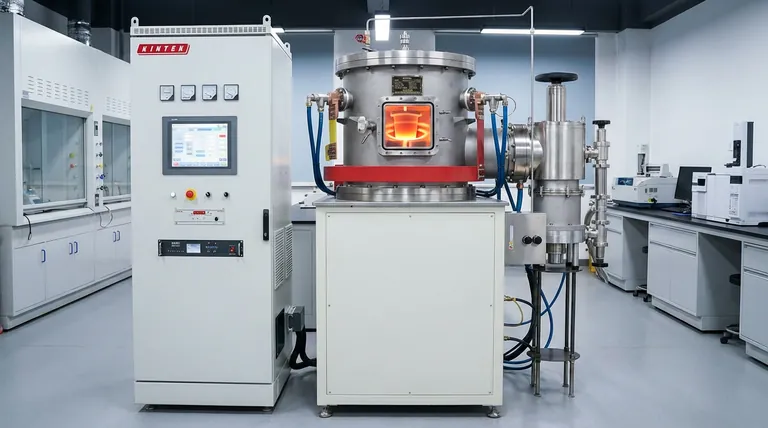
Vacuum Induction Melting (VIM) is the preferred method for preparing Cu-Zn-Al-Sn medium-entropy alloys because it simultaneously manages conflicting metallurgical properties. Specifically, it utilizes a controlled argon atmosphere to prevent the rapid oxidation of reactive Aluminum (Al) while suppressing the evaporation of volatile Zinc (Zn), ensuring the final composition matches your design.
Core Takeaway Success with Cu-Zn-Al-Sn alloys requires balancing chemical protection with physical containment. VIM uniquely solves this by providing a protective atmosphere that stops oxidation without creating the deep vacuum conditions that would cause volatile elements to boil away.
Mastering Chemical Stability
The primary challenge in this alloy system is that it contains elements with vastly different behaviors under heat. VIM addresses this through precise environmental control.
Preventing Aluminum Oxidation
Aluminum is highly reactive and has a strong affinity for oxygen. If melted in open air or a low-quality atmosphere, it instantly forms oxide inclusions (slag).
VIM solves this by creating a high-vacuum or high-purity argon environment. This effectively eliminates oxygen from the melting chamber, ensuring the Aluminum remains metallic and fully integrated into the alloy matrix.
Minimizing Zinc Evaporation
Zinc poses a different problem: high volatility. In a standard high-vacuum environment, Zinc has a tendency to evaporate (boil off) before the other metals are fully melted, ruining the alloy's composition.
The VIM process allows for a protective argon atmosphere to be introduced after the initial vacuum stage. This partial pressure suppresses the vapor pressure of the Zinc, keeping it in the liquid melt rather than allowing it to be lost to the vacuum system.
Achieving Chemical Homogeneity
Medium-entropy alloys rely on the uniform distribution of multiple principal elements to achieve their mechanical properties.
Electromagnetic Induction Stirring
Unlike static melting techniques, VIM inherently agitates the molten metal. The induction coils used to heat the metal create strong electromagnetic stirring forces within the crucible.
This continuous movement ensures that elements with different densities—such as heavy Tin (Sn) and lighter Aluminum (Al)—are thoroughly mixed. This results in high chemical homogeneity throughout the ingot, which is critical for consistent material performance.
Understanding the Trade-offs
While VIM is ideal for this specific alloy, it is important to understand the operational nuances required to maintain quality.
Balancing Pressure is Critical
The operator must carefully balance the vacuum level against the argon backfill pressure. If the vacuum is maintained too long to protect the Aluminum, you risk losing Zinc. If the pressure is too high, you may trap gases.
Crucible Interactions
Because VIM uses induction coils, the melt is contained within a refractory crucible. While generally safe, extreme temperatures can sometimes lead to minor interactions between the melt and the crucible wall. However, for Cu-Zn-Al-Sn alloys, the benefits of stirring and volatility control vastly outweigh this risk compared to methods like Arc Melting.
Making the Right Choice for Your Goal
When preparing Cu-Zn-Al-Sn alloys, your processing method dictates the quality of your results.
- If your primary focus is Compositional Accuracy: VIM is mandatory to prevent the loss of Zinc (volatility) and Aluminum (oxidation), ensuring the final chemistry matches your calculations.
- If your primary focus is Microstructural Uniformity: VIM provides the necessary electromagnetic stirring to prevent segregation of the Tin and Aluminum phases.
The controlled atmosphere and active stirring of VIM provide the only reliable path to a high-purity, chemically accurate Cu-Zn-Al-Sn ingot.
Summary Table:
| Feature | Challenge in Cu-Zn-Al-Sn Alloys | VIM Solution |
|---|---|---|
| Oxidation Control | Aluminum (Al) is highly reactive with oxygen | High-purity argon environment prevents oxide slag |
| Volatility Management | Zinc (Zn) evaporates easily under heat/vacuum | Argon partial pressure suppresses vapor loss |
| Mixing Efficiency | Elements have different densities (e.g., Al vs Sn) | Electromagnetic stirring ensures chemical homogeneity |
| Compositional Accuracy | Loss of volatile elements alters alloy properties | Controlled atmosphere maintains designed chemistry |
Elevate Your Material Research with KINTEK
Precision alloy development requires equipment that can handle conflicting metallurgical demands. KINTEK provides industry-leading Vacuum Induction Melting (VIM) systems designed to master the volatility and reactivity of complex medium-entropy alloys.
Backed by expert R&D and manufacturing, KINTEK offers a full suite of thermal solutions—including Muffle, Tube, Rotary, Vacuum, and CVD systems—all fully customizable to meet your unique laboratory or production needs. Ensure your chemical accuracy and microstructural uniformity with our high-performance technology.
Contact KINTEK Today to Customize Your Furnace Solutions
References
- Spyridon Chaskis, Spyros Papaefthymiou. Compositional Design and Thermal Processing of a Novel Lead-Free Cu–Zn–Al–Sn Medium Entropy Brass Alloy. DOI: 10.3390/met14060620
This article is also based on technical information from Kintek Furnace Knowledge Base .
Related Products
- Vacuum Induction Melting Furnace
- 600T Vacuum Induction Hot Press Vacuum Heat Treat and Sintering Furnace
- Vacuum Heat Treat Sintering and Brazing Furnace
- Small Vacuum Heat Treat and Tungsten Wire Sintering Furnace
- Vacuum Heat Treat Sintering Furnace Molybdenum Wire Vacuum Sintering Furnace
People Also Ask
- What are the core functions of the High Vacuum Induction Melting (VIM) furnace? Optimize DD5 Superalloy Purification
- What role does a Vacuum Induction Melting furnace play in the production of high-aluminum nickel-based superalloys?
- What are the technical advantages of using a Vacuum Induction Melting furnace in the development of advanced packaging steel?
- What are the advantages of using a VIM furnace to control residual oxygen pressure? Achieve Superior Metal Uniformity
- What is the role of VIM and directional solidification in aero-engine blade substrates? Engineering Extreme Durability



















