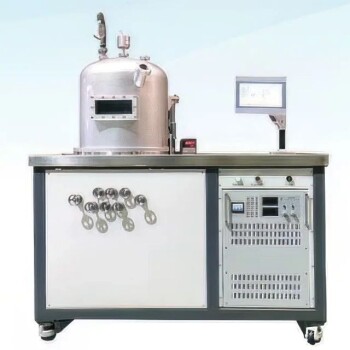
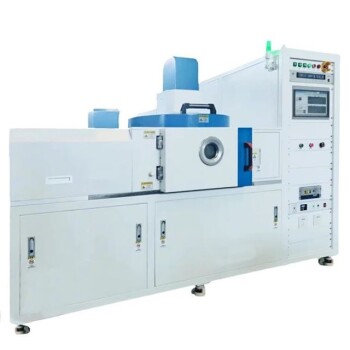
A vacuum deposition system equipped with a resistive heating evaporation boat is required to achieve nanogram-level precision when doping bilayer molybdenum disulfide (BL-MoS2). This equipment allows for the controlled sublimation of solid organic dopants, enabling the creation of highly uniform layers while strictly maintaining the purity of the material's surface interface.
The combination of ultra-high vacuum and resistive heating provides the only reliable method to deposit organic molecules with sub-monolayer accuracy. This precision is essential for facilitating pure interfacial charge transfer and preventing atmospheric contaminants from skewing the analysis of potential distribution.
The Mechanics of Precision Doping
Sublimation via Resistive Heating
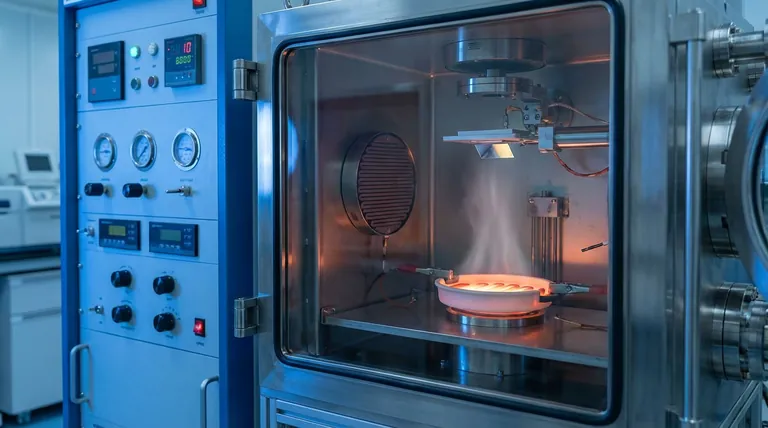
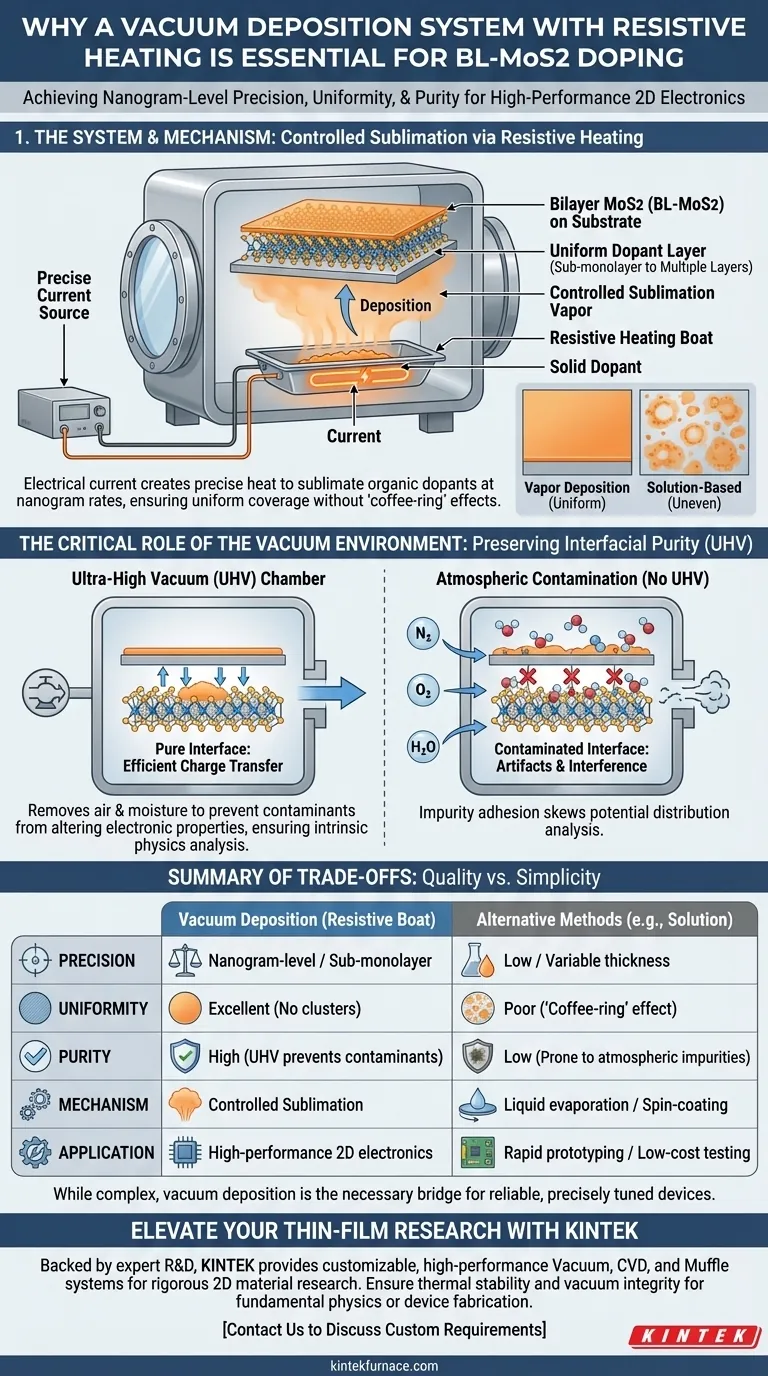
The core function of the resistive heating evaporation boat is to convert solid organic matter into a vapor state through controlled sublimation.
By running an electrical current through the boat, the system generates precise heat. This sublimates organic dopants, such as F6TCNNQ, at a rate that can be fine-tuned down to the nanogram level.
Achieving Uniform Coverage
Unlike solution-based methods which may leave "coffee-ring" stains or uneven clusters, this vapor-phase deposition ensures uniform surface coverage.
Researchers can control the deposition thickness with extreme accuracy, ranging from sub-monolayers (partial coverage) to specific multiple layers on the BL-MoS2 surface.
The Critical Role of the Vacuum Environment
Preserving Interfacial Purity
The ultra-high vacuum (UHV) environment is not merely for pressure control; it is a cleanliness requirement.
By removing air and moisture, the system prevents atmospheric impurities from adhering to the atomically thin MoS2 surface. This ensures that any change in electronic properties is solely due to the dopant, not random contaminants.
Facilitating Charge Transfer Analysis
For bilayer MoS2 to function effectively in electronic applications, the interfacial charge transfer between the semiconductor and the dopant must be efficient and predictable.
The vacuum environment protects this delicate interface. It ensures that the analysis of potential distribution reflects the intrinsic physics of the heterostructure, rather than artifacts caused by environmental interference.
Understanding the Trade-offs
System Complexity vs. Process Speed
While this method offers superior quality, it introduces significant operational complexity compared to simpler methods like spin-coating or drop-casting.
The process requires expensive equipment, longer setup times to achieve high vacuum, and precise calibration of the resistive boat current. However, for high-performance electronic studies, this trade-off is necessary to eliminate the variability inherent in faster, lower-tech methods.
Making the Right Choice for Your Goal
While Chemical Vapor Deposition (CVD) is used to grow the high-quality MoS2 foundation, the subsequent doping step requires the specific precision of vacuum evaporation.
- If your primary focus is fundamental physics: Use this vacuum system to ensure that charge transfer measurements are free from atmospheric artifacts.
- If your primary focus is device fabrication: Rely on the nanogram-level control to tune the doping concentration precisely without degrading the underlying atomic lattice.
In summary, the resistive heating vacuum system is the bridge between a raw 2D material and a functional, precisely tuned electronic device.
Summary Table:
| Feature | Vacuum Deposition (Resistive Boat) | Alternative Methods (e.g., Solution) |
|---|---|---|
| Precision | Nanogram-level / Sub-monolayer | Low / Variable thickness |
| Uniformity | Excellent (no cluster formation) | Poor (subject to 'coffee-ring' effect) |
| Purity | High (UHV prevents contaminants) | Low (prone to atmospheric impurities) |
| Mechanism | Controlled Sublimation | Liquid evaporation / Spin-coating |
| Application | High-performance 2D electronics | Rapid prototyping / Low-cost testing |
Elevate Your Thin-Film Research with KINTEK
Precise molecular doping requires specialized equipment that ensures both nanogram-level accuracy and absolute material purity. Backed by expert R&D and world-class manufacturing, KINTEK provides high-performance Vacuum, CVD, and Muffle systems—all fully customizable to meet the rigorous demands of your lab's unique 2D material research.
Whether you are studying interfacial charge transfer or scaling device fabrication, our systems deliver the thermal stability and vacuum integrity you need. Contact us today to discuss your custom furnace requirements!
Visual Guide
References
- Louisa Scholz, Norbert Koch. Atomic-Scale Electric Potential Landscape across Molecularly Gated Bilayer MoS<sub>2</sub> Resolved by Photoemission. DOI: 10.1021/acsnano.5c10363
This article is also based on technical information from Kintek Furnace Knowledge Base .
Related Products
- HFCVD Machine System Equipment for Drawing Die Nano Diamond Coating
- Custom Made Versatile CVD Tube Furnace Chemical Vapor Deposition CVD Equipment Machine
- Cylindrical Resonator MPCVD Machine System for Lab Diamond Growth
- Slide PECVD Tube Furnace with Liquid Gasifier PECVD Machine
- Multi Heating Zones CVD Tube Furnace Machine for Chemical Vapor Deposition Equipment
People Also Ask
- What is Hot-filament Chemical Vapor Deposition (HFCVD)? Achieve High-Quality Thin Films with Precision Control
- What are the equipment for chemical vapor deposition? A Guide to the 5 Essential Components
- What is the significance of the vacuum pressure control system in the CVD coating process for powders?
- What is the function of high-purity Argon (Ar) gas during CVD? Optimize Your Thin Film Uniformity and Purity
- What are the advantages of using Chemical Vapor Deposition (CVD) for coating turbine blades? Enhance Life & Performance