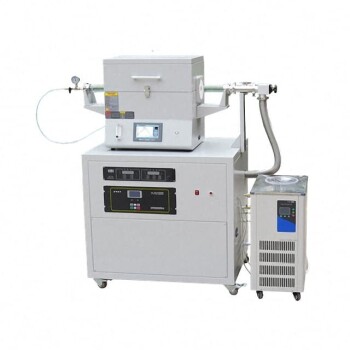
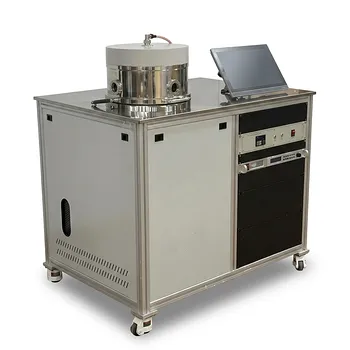
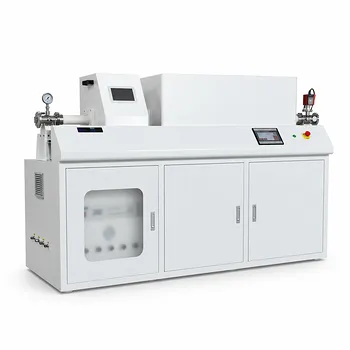
The use of a tube furnace with inert gas protection is essential to prevent the oxidative decomposition of molten salts and to isolate the lithium aluminosilicate framework from atmospheric moisture and oxygen. This controlled environment ensures that the alkali metal ion exchange process remains chemically pure and kinetically predictable, avoiding side reactions that would otherwise degrade the material’s structural integrity.
Central Takeaway: Inert gas protection isolates sensitive molten salts and silicate frameworks from oxygen and moisture, ensuring that ion migration occurs without environmental interference or material oxidation.
Protecting the Integrity of the Molten Salt Bath
Preventing Oxidative Decomposition
At typical exchange temperatures—such as 320°C for molten sodium nitrate ($NaNO_3$)—exposure to oxygen can trigger the thermal decomposition or oxidation of the salt. This alters the chemical composition of the bath, potentially introducing impurities that interfere with the intended ion exchange.
Eliminating Atmospheric Moisture
Moisture in the air can react with molten alkali salts to form hydroxides or other corrosive byproducts. Maintaining a high-purity argon environment ensures the molten bath remains anhydrous, which is critical for maintaining the specific chemical potential required for ion substitution.
Guarding the Silicate Framework and Migration Paths
Preserving Ion Migration Channels
The "Deep Need" in these experiments is to ensure that lithium ions can exit and sodium (or other alkali) ions can enter the silicate framework without obstruction. Atmospheric interference can lead to surface reactions that "clog" these microscopic pathways, effectively halting the exchange process.
Maintaining Elemental Valence States
Precise control of the atmosphere helps maintain the specific elemental valence states within the sensitive ceramic components. This prevents the loss of volatile components and ensures that the phase composition of the aluminosilicate remains stable throughout the high-temperature cycle.
Supporting Reaction Kinetics and Purity
Suppressing Unwanted Side Reactions
Just as inert gases prevent the formation of oxide films on aluminum powders, they prevent oxidation layers from forming on the surface of the aluminosilicate. This ensures that the solid-state reaction between the activator (the molten salt) and the substrate proceeds smoothly and uniformly.
Ensuring Controllable Ion Exchange
By displacing oxygen with a stable argon flow, researchers can achieve a neutral environment. This allows for a "clean" exchange where the only variables are temperature and time, rather than fluctuating atmospheric conditions.
Understanding the Trade-offs and Risks
Gas Selection and Cost
While argon is the preferred inert gas due to its complete lack of reactivity, it is more expensive than nitrogen. However, at the high temperatures required for metal exchange, nitrogen can sometimes react with certain materials, making the higher cost of argon a necessary investment for accuracy.
The Criticality of Seal Integrity
The effectiveness of the inert environment is entirely dependent on the vacuum integrity of the tube furnace. Even minor leaks can introduce enough oxygen to cause "etching" or unintended porosity, similar to the chemical activation processes used in carbon materials, which would ruin a precision ion exchange experiment.
How to Apply This to Your Project
Recommendations for Equipment Setup
- If your primary focus is Maximum Purity: Utilize high-purity argon (99.999%) and a tube furnace with double-surface vacuum seals to ensure zero oxygen ingress.
- If your primary focus is Process Scalability: Implement precise mass flow controllers to regulate the inert gas pressure, ensuring consistent results across multiple batches.
- If your primary focus is Preventing Salt Loss: Monitor the furnace exhaust for signs of volatile components to ensure the thermal profile is not exceeding the stability limits of your molten salt bath.
By strictly controlling the atmospheric variables within a tube furnace, you transform a highly sensitive chemical reaction into a predictable and repeatable engineering process.
Summary Table:
| Key Requirement | Primary Function | Impact of Atmospheric Exposure |
|---|---|---|
| Inert Atmosphere (Argon) | Prevents oxidative decomposition of molten salts | Chemical impurities and altered bath composition |
| Anhydrous Environment | Eliminates moisture and hydroxide formation | Corrosion and degradation of the silicate framework |
| Vacuum Seal Integrity | Blocks oxygen ingress and surface oxidation | "Clogged" ion migration channels and material etching |
| Precise Flow Control | Maintains neutral environment for kinetics | Unpredictable reaction rates and surface layers |
Elevate Your Research Precision with KINTEK
Don't let atmospheric interference compromise your material integrity. KINTEK specializes in high-performance laboratory equipment, offering a comprehensive range of tube furnaces, vacuum furnaces, CVD systems, and atmosphere-controlled furnaces—all customizable to meet the rigorous demands of alkali metal exchange and advanced ceramics research.
Whether you need superior vacuum integrity or precise mass flow control, our team is ready to help you achieve repeatable, high-purity results. Contact KINTEK today to find your perfect furnace solution!
References
- Yves Thibault, Joanne Gamage McEvoy. Alkali-Induced Phase Transition to β-Spodumene along the LiAlSi2O6-LiAlSi4O10 Join. DOI: 10.3390/cryst13081182
This article is also based on technical information from Kintek Furnace Knowledge Base .
Related Products
- Vacuum Sealed Continuous Working Rotary Tube Furnace Rotating Tube Furnace
- 1400℃ High Temperature Laboratory Tube Furnace with Alumina Tube
- 1700℃ High Temperature Laboratory Tube Furnace with Alumina Tube
- Magnesium Extraction and Purification Condensing Tube Furnace
- High Pressure Laboratory Vacuum Tube Furnace
People Also Ask
- What is the purpose of rotary tube furnaces? Achieve Uniform Heat Treatment for Powders and Granules
- What are the key advantages of using a rotary tube furnace? Achieve Dynamic, Uniform Heating for Powders
- How does the amount of material processed vary between batch and continuous rotary tube furnaces? Scale Your Production Efficiently
- What are the advantages of rotary tube furnaces in fuel compatibility? Boost Efficiency and Cut Costs
- What is the temperature range of some rotary tube furnaces? Achieve Uniform Heating Up to 1200°C