
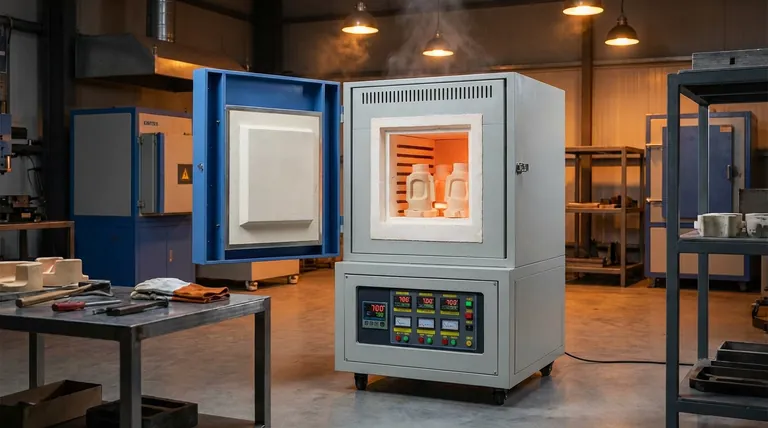
The shell roasting furnace serves a dual purpose: it eliminates contaminants to ensure shell integrity and conditions the mold thermally to prevent casting defects.
Prior to pouring C1023 superalloys, this furnace heats the ceramic shells to approximately 700±25 °C. This specific thermal treatment thoroughly removes residual moisture and volatile substances, preventing gas defects and chemical instability. Simultaneously, it preheats the shell to minimize the thermal shock between the ceramic and the molten metal, directly reducing the risk of cold shuts and stress cracks.
Core Takeaway The shell roasting furnace is not merely for heating; it is a purification and stabilization tool. Its primary role is to maximize the thermal strength and chemical inertness of the ceramic mold while establishing a thermal baseline that prevents catastrophic defects during the pouring phase.
Ensuring Chemical and Structural Integrity
Removal of Volatile Contaminants
The primary function of the roasting phase is the elimination of impurities.
Ceramic shells often contain residual moisture and volatile substances from the binding agents used during their creation.
By maintaining a temperature of 700±25 °C, the furnace burns off these residuals completely.
Increasing Thermal Strength
If these volatile substances remain, they compromise the shell's structure.
Thorough removal increases the shell's thermal strength, ensuring it can withstand the immense pressure and heat of the molten alloy without cracking or collapsing.
This process also enhances chemical stability, ensuring the shell does not react adversely with the active elements in the C1023 superalloy.
Thermal Management and Defect Prevention
Reducing Temperature Gradients
Pouring molten superalloy into a cold shell causes a violent thermal disparity.
The roasting furnace acts as a preheating environment, raising the baseline temperature of the shell.
This reduces the temperature gradient between the mold and the incoming metal, smoothing the thermal transition.
Preventing Casting Defects
A controlled thermal environment is the best defense against solidification issues.
By minimizing the temperature differential, the process prevents cold shuts, where metal solidifies before filling the mold completely.
It also significantly reduces stress cracks, which occur when the ceramic and metal expand or contract at drastically different rates.
Understanding the Trade-offs
Roasting vs. High-Temperature Preheating
It is critical to distinguish between roasting and final preheating.
While roasting at 700°C stabilizes the shell and removes volatiles, complex thin-walled castings often require a separate, higher-temperature preheat (often around 1100°C) to ensure proper fluidity.
The Consequence of Inadequate Roasting
Failing to roast the shell sufficiently at the 700°C stage cannot be fixed by simply cranking up the heat later.
If moisture remains deep in the shell layers, it can flash into steam upon contact with the metal, causing dangerous blowouts or porosity in the final part.
Therefore, the roasting phase must be viewed as a non-negotiable cleaning step, not just a heating step.
Making the Right Choice for Your Goal
To ensure the highest quality C1023 superalloy castings, align your furnace operations with your specific defect-reduction goals:
- If your primary focus is Shell Integrity: Ensure the roasting furnace holds at 700±25 °C long enough to fully burn out all binders and moisture before moving to higher temperatures.
- If your primary focus is Filling Complex Geometries: Recognize that roasting is only the first step; you must follow it with a high-temperature preheat (e.g., 1100°C) to optimize metal fluidity.
Reliable casting starts with a clean, chemically stable shell that has been thermally conditioned to accept the molten metal without shock.
Summary Table:
| Process Objective | Key Parameter | Outcome/Benefit |
|---|---|---|
| Volatile Removal | 700 ± 25 °C | Eliminates moisture/binders; prevents gas porosity. |
| Structural Stability | High Thermal Strength | Ensures shell integrity under molten metal pressure. |
| Thermal Conditioning | Preheating Baseline | Reduces thermal shock, cold shuts, and stress cracks. |
| Chemical Inertness | Full Burn-out | Prevents adverse reactions between shell and superalloy. |
Maximize Your Casting Success with KINTEK
Precision is non-negotiable when working with C1023 superalloys. At KINTEK, we understand that the perfect casting starts with rigorous thermal conditioning. Backed by expert R&D and world-class manufacturing, we provide high-performance Muffle, Tube, Rotary, Vacuum, and CVD systems designed to meet the exacting standards of lab and industrial high-temperature applications.
Whether you need to optimize shell roasting or achieve complex high-temperature preheating, our equipment is fully customizable to your unique requirements. Partner with KINTEK to eliminate casting defects and enhance your production efficiency.
Ready to elevate your thermal processing? Contact our experts today!
References
- Qualification and Certification of Nickel based C1023 Super Alloys for Aero-Engine Applications. DOI: 10.14429/dsj.19931
This article is also based on technical information from Kintek Furnace Knowledge Base .
Related Products
- High Temperature Muffle Oven Furnace for Laboratory Debinding and Pre Sintering
- Laboratory Muffle Oven Furnace with Bottom Lifting
- 1200℃ Muffle Oven Furnace for Laboratory
- Vacuum Heat Treat Sintering and Brazing Furnace
- 1800℃ High Temperature Muffle Oven Furnace for Laboratory
People Also Ask
- What thermal phenomena occur during polymer binder burnout in ceramic green bodies? Lab Furnace Guide
- What role does a high-temperature muffle furnace play in STFO synthesis? Achieve Pure Perovskite Results
- Why is controlled heat treatment in a muffle furnace necessary for calcined clay? Achieve Optimal Pozzolanic Activity
- How does a high-temperature muffle furnace facilitate the formation of LaNbxAl1−xO3+δ perovskite structures? Key Roles
- What role does a high-temperature muffle furnace play in the multi-stage synthesis of Li0.5MnFe1.5O4? Key to Pure Spinel



















