
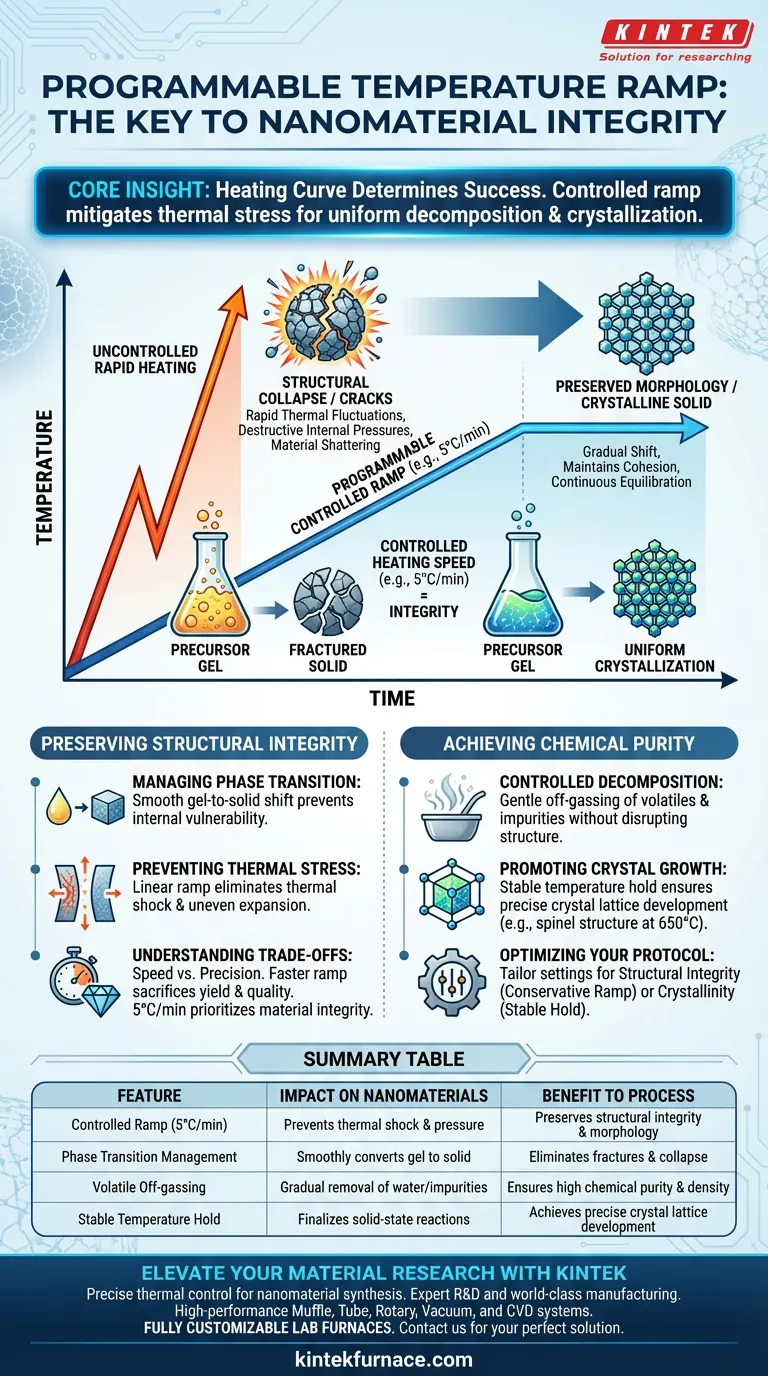
A programmable temperature ramp rate is critical for preserving the structural integrity of nanomaterial precursors during thermal processing. By enforcing a controlled heating speed, such as 5°C per minute, you prevent rapid thermal fluctuations that lead to destructive internal pressures. This control is the only way to successfully navigate the delicate transition from a precursor gel to a crystalline solid without causing the material to collapse.
Core Insight: The difference between a high-quality nanostructure and a failed batch often lies in the heating curve. A programmable ramp mitigates thermal stress, allowing the material to decompose and crystallize uniformly rather than shattering under the pressure of rapid temperature changes.
Preserving Structural Integrity
Managing the Phase Transition
Processing nanomaterials often involves converting a precursor gel into a solid. This is a significant physical transformation that creates vulnerability within the material.
If this transition happens too quickly, the material cannot adapt to its new state. A programmable ramp ensures this shift occurs gradually, maintaining the material's internal cohesion.
Preventing Thermal Stress
Rapid heating causes uneven expansion and internal pressures. When the temperature creates stress inside the material, the delicate nanostructure can fracture or collapse entirely.
By utilizing a steady ramp rate (e.g., 5°C/min), you eliminate the thermal shock that leads to these structural failures. This linear increase allows the material to equilibrate continuously as it heats.
Achieving Chemical Purity and Definition
Controlled Decomposition
Before the final crystal structure forms, the material must undergo thermal decomposition. This process removes residual water and volatile impurities trapped within the precursor.
If the furnace heats uncontrolled, these volatiles may expand violently on a microscopic level, destroying morphology. A controlled ramp allows these byproducts to off-gas gently without disrupting the solidifying structure.
Promoting Crystal Growth
The ultimate goal is to achieve a specific crystal arrangement, such as the standard cubic spinel structure found in high-quality NiFe2O4 nanoparticles.
Reaching a stable target temperature (e.g., 650°C) is necessary for the solid-state reaction that finalizes this structure. However, the path to that temperature determines whether those crystals form correctly or contain defects.
Understanding the Trade-offs
The Risk of Speed
The primary temptation in furnace operations is to increase the heating rate to reduce processing time.
However, saving time comes at the direct cost of yield and quality. Accelerating the ramp beyond the material's thermal tolerance almost guarantees structural collapse or incomplete phase formation.
The Cost of Precision
Conversely, a highly controlled, slow ramp rate extends the total processing time and increases energy consumption.
You must balance the need for structural perfection with operational efficiency. The rate of 5°C/min represents a proven baseline that prioritizes material integrity over speed.
Optimizing Your Thermal Protocol
To achieve the best results with nanomaterial precursors, tailor your furnace settings to your specific quality requirements.
- If your primary focus is Structural Integrity: Prioritize a conservative ramp rate (around 5°C/min) to minimize internal pressure during the gel-to-solid transition.
- If your primary focus is Crystallinity: Ensure your protocol includes a stable hold at the requisite annealing temperature (e.g., 650°C) to allow for full crystal lattice development.
Consistency in your heating profile is the single most important factor in reproducing high-quality nanoparticle morphology.
Summary Table:
| Feature | Impact on Nanomaterials | Benefit to Process |
|---|---|---|
| Controlled Ramp (e.g., 5°C/min) | Prevents thermal shock and internal pressure. | Preserves structural integrity and morphology. |
| Phase Transition Management | Smoothly converts precursor gel to crystalline solid. | Eliminates fractures and material collapse. |
| Volatile Off-gassing | Gradual removal of water and impurities. | Ensures high chemical purity and density. |
| Stable Temperature Hold | Finalizes solid-state reactions (e.g., spinel structures). | Achieves precise crystal lattice development. |
Elevate Your Material Research with KINTEK
Precise thermal control is the difference between a breakthrough and a failed batch. At KINTEK, we understand the delicate science of nanomaterial synthesis. Backed by expert R&D and world-class manufacturing, we provide high-performance Muffle, Tube, Rotary, Vacuum, and CVD systems designed to meet the most rigorous heating profiles.
Whether you need custom ramp programming or specialized atmosphere control, our lab high-temp furnaces are fully customizable to your unique research needs. Ensure the integrity of your next discovery—contact our technical specialists today to find the perfect furnace solution.
Visual Guide
References
- Changwei Shan, Liwei Mi. Co<sub>1−<i>x</i></sub>S@CNT composite with a three-dimensional skeleton for high-performance magnesium–lithium hybrid batteries. DOI: 10.1039/d3ma01089a
This article is also based on technical information from Kintek Furnace Knowledge Base .
Related Products
- 1700℃ High Temperature Muffle Oven Furnace for Laboratory
- 1800℃ High Temperature Muffle Oven Furnace for Laboratory
- 1400℃ Muffle Oven Furnace for Laboratory
- 1200℃ Muffle Oven Furnace for Laboratory
- Laboratory Muffle Oven Furnace with Bottom Lifting
People Also Ask
- What is the primary function of a high-temperature laboratory muffle furnace in chemical synthesis? Achieve Precision.
- How does a high-temperature laboratory muffle furnace affect material properties? Transform Anodic Oxide Films Fast
- What role does a muffle furnace play in BCZY712 electrolyte powder production? Achieve Perfect Phase Purity
- What role does a muffle furnace play in sintering photocathodes? Enhance Electrode Conductivity & Catalytic Activity
- How does the two-stage sintering process contribute to the synthesis of MeCuFeO3 perovskite? Optimize crystal purity.



















