
A preheated annealing furnace serves as a critical buffer against catastrophic structural failure. In the production of glass, specifically materials like chromium-doped borosilicate glass, the rapid quenching phase creates significant internal thermal stress. Without the controlled environment of a preheated furnace, the glass is liable to crack spontaneously if cooled directly to room temperature.
The annealing process functions as a controlled release valve for internal tension. By maintaining a specific temperature and cooling the material at a remarkably slow rate, the furnace eliminates residual stresses to ensure the glass is both mechanically stable and optically uniform.
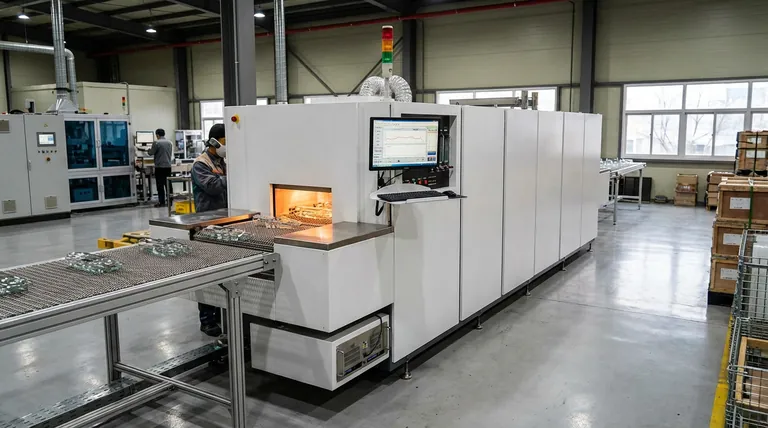
The Physics of Thermal Stress
The Consequence of Rapid Quenching
When glass is produced, it often undergoes a rapid quenching process. While necessary for certain formation steps, this sudden change accumulates dangerous levels of internal thermal stress.
The Risk of Spontaneous Cracking
If this stressed material is allowed to cool immediately to room temperature, the internal tension exceeds the material's strength. This results in spontaneous cracking, rendering the sample useless.
The Function of the Preheated State
A preheated furnace mitigates this shock. By introducing the glass into an environment already heated to a specific target—such as 400°C—you prevent the thermal shock that occurs in ambient air.
The Mechanics of the Annealing Process
Stabilizing the Material
Once inside the preheated furnace, the glass is held at a stable temperature. This allows the thermal gradients within the glass to equalize, effectively "resetting" the internal stress levels.
The Importance of Slow Cooling
The most critical phase is the cooling ramp. Rather than cooling naturally, the furnace lowers the temperature at a strictly controlled rate, such as 30°C per hour.
Releasing Residual Stress
This gradual reduction allows the atomic structure of the glass to relax without forming new stress points. This controlled descent is the primary mechanism for releasing residual internal stresses.
Benefits for End-Use Applications
Enhancing Mechanical Stability
Glass that has been properly annealed is significantly more durable. By removing internal tension, the material achieves greater mechanical stability, making it less prone to fracture during handling or operation.
Improving Optical Uniformity
Stress affects how light travels through glass. For applications involving chromium-doped borosilicate glass, removing these stresses is vital for achieving high optical uniformity and clarity.
Understanding the Trade-offs
Process Bottlenecks
The annealing process is inherently slow. A cooling rate of 30°C per hour means a cycle can take many hours to complete, potentially creating a throughput bottleneck in production.
Energy Consumption
Maintaining a furnace at 400°C and controlling a slow ramp-down requires significant energy. This adds to the operational cost of the post-processing phase compared to air cooling.
Sensitivity to Temperature Precision
The furnace must be preheated accurately. If the temperature differential between the quenched glass and the furnace is too large, the thermal shock the process is meant to prevent may occur anyway.
Making the Right Choice for Your Goal
Whether you are prioritizing throughput or absolute material integrity, understanding the role of annealing is key.
- If your primary focus is Mechanical Durability: You must strictly adhere to the slow cooling protocol (e.g., 30°C/hr) to ensure all internal tension is resolved.
- If your primary focus is Optical Quality: Prioritize the uniformity of the furnace temperature to prevent refractive inconsistencies caused by residual stress.
By treating the annealing furnace not as an accessory, but as a fundamental component of the glass structure, you ensure a reliable, high-performance final product.
Summary Table:
| Feature | Purpose | Key Benefit |
|---|---|---|
| Preheating (e.g., 400°C) | Prevents thermal shock during entry | Eliminates spontaneous cracking |
| Thermal Stabilization | Equalizes internal gradients | Resets internal stress levels |
| Controlled Cooling (e.g., 30°C/hr) | Gradual atomic relaxation | High mechanical stability |
| Stress Removal | Eliminates residual tension | Superior optical uniformity |
Optimize Your Glass Post-Processing with KINTEK
Don't let internal thermal stress compromise your material quality. Backed by expert R&D and precision manufacturing, KINTEK offers specialized Muffle, Tube, and Vacuum furnace systems designed to handle the rigorous slow-cooling requirements of glass annealing. Whether you need a standard solution or a customizable high-temp furnace for unique laboratory needs, our equipment ensures your chromium-doped borosilicate glass and other materials achieve peak mechanical stability and optical clarity.
Ready to eliminate structural failure and enhance throughput? Contact KINTEK today to discuss your customized furnace solution!
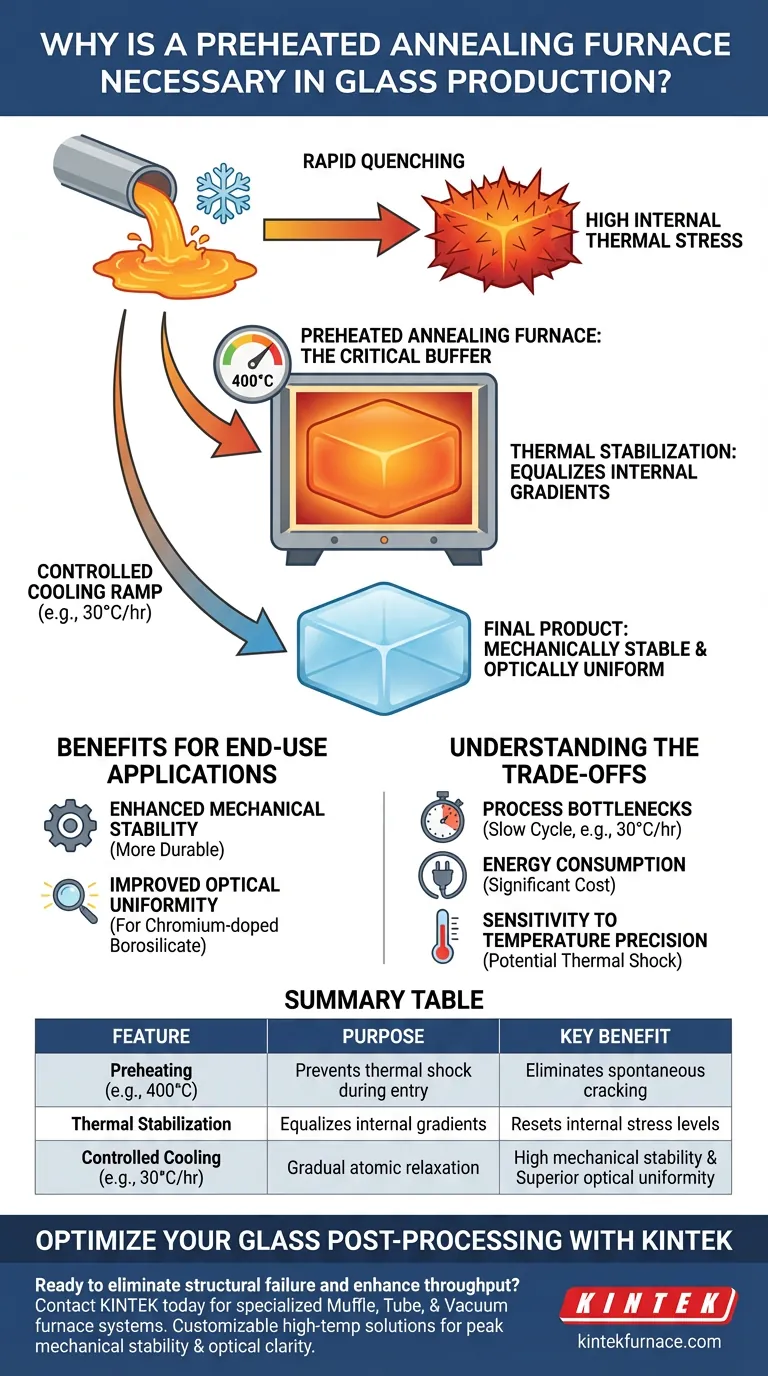
Visual Guide
References
- Fathy Abdel-Wahab, Heba Abdelmaksoud. Investigation of oxygen defects in chromium-doped borosilicate glass co-doped with alkali metal (Na2O) and transition metal (ZnO) for photonic applications. DOI: 10.1007/s00339-024-08114-1
This article is also based on technical information from Kintek Furnace Knowledge Base .
Related Products
- High Temperature Muffle Oven Furnace for Laboratory Debinding and Pre Sintering
- Controlled Inert Nitrogen Hydrogen Atmosphere Furnace
- Vacuum Heat Treat Sintering Furnace with Pressure for Vacuum Sintering
- Vacuum Heat Treat Sintering and Brazing Furnace
- Vacuum Heat Treat Sintering Furnace Molybdenum Wire Vacuum Sintering Furnace
People Also Ask
- What thermal phenomena occur during polymer binder burnout in ceramic green bodies? Lab Furnace Guide
- Why is controlled heat treatment in a muffle furnace necessary for calcined clay? Achieve Optimal Pozzolanic Activity
- What role does a high-temperature muffle furnace play in STFO synthesis? Achieve Pure Perovskite Results
- How does a high-temperature muffle furnace facilitate the formation of LaNbxAl1−xO3+δ perovskite structures? Key Roles
- What role does a high-temperature muffle furnace play in the multi-stage synthesis of Li0.5MnFe1.5O4? Key to Pure Spinel



















