
The synthesis of sodium-ion layered oxide cathodes relies fundamentally on precise thermal management. A muffle furnace is required to provide the stable, high-temperature environment necessary to drive solid-state reactions. This equipment ensures that chemical precursors undergo the structural reorganization needed to form specific P3-type or P2-type crystal lattices, which are essential for the material's ability to store energy.
Core Insight: The muffle furnace is not merely a heating source; it is the tool used to engineer the material's atomic structure. By strictly controlling heating rates and dwell temperatures, it facilitates the ordered arrangement of elements, directly dictating the electrochemical activity and efficiency of the final cathode.
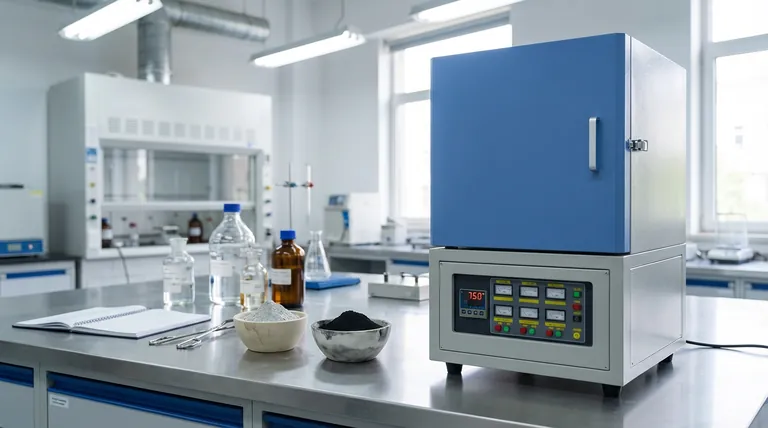
Facilitating Critical Solid-State Reactions
Overcoming Activation Energy Barriers
Sodium-ion cathode precursors are stable chemicals that require significant energy to react. A muffle furnace reaches temperatures such as 750 °C, providing the thermal energy necessary to break initial chemical bonds.
Enabling Structural Reorganization
Once bonds are broken, the atoms must rearrange themselves. The sustained heat allows for the diffusion of atoms, enabling the mixture to transform from a raw blend into a unified crystalline material.
Controlling Crystal Phase Formation
Targeting P2 and P3 Layered Structures
The primary reference highlights that specific structures, such as P3-type or P2-type layered oxides, are the desired outcome. These designations refer to the specific stacking order of the oxygen and sodium layers.
Achieving Atomic Ordering
The furnace environment promotes the ordered arrangement of elements within the crystal lattice. Without this precise ordering, the sodium ions cannot move efficiently in and out of the cathode, rendering the battery ineffective.
The Importance of Thermal Consistency
Regulating Heating Rates
The transition from precursor to cathode must happen gradually. A muffle furnace allows for a constant heating rate, such as 5 °C/min.
Ensuring Uniform Crystallinity
Sudden spikes in temperature can lead to defects or mixed phases. The controlled ramp-up ensures that the entire batch of material crystallizes uniformly, resulting in high electrochemical activity.
Understanding the Trade-offs and Pitfalls
Sensitivity to Temperature Fluctuations
While muffle furnaces provide high heat, the specific temperature is critical. Deviating even slightly from the target (e.g., 750 °C) can result in an inactive phase or a structure that degrades quickly during battery cycling.
Atmosphere Limitations
Standard muffle furnaces typically operate in air. If your specific oxide chemistry is sensitive to oxidation or requires an inert atmosphere (like argon) to prevent degradation, a standard box furnace may need modification or a vacuum setup.
The Risk of Thermal Shock
Cooling the material too quickly can induce stress in the crystal lattice. Just as the heating rate (5 °C/min) is controlled, the cooling profile must often be managed to prevent the material from cracking at the microscopic level.
Making the Right Choice for Your Goal
To ensure high-performance cathode materials, apply the following guidelines to your synthesis strategy:
- If your primary focus is Phase Purity: Prioritize a furnace with high thermal uniformity to ensure every gram of precursor converts to the desired P2 or P3 structure without secondary phases.
- If your primary focus is Particle Morphology: Strictly adhere to the controlled heating rates (e.g., 5 °C/min) to prevent rapid grain growth that could limit ion diffusion.
Ultimately, the quality of your sodium-ion cathode is defined by the precision of your heat treatment.
Summary Table:
| Parameter | Influence on Cathode Quality | Significance |
|---|---|---|
| Temperature (e.g., 750°C) | Overcomes activation energy | Essential for solid-state structural reorganization |
| Heating Rate (5°C/min) | Prevents rapid grain growth | Ensures uniform crystallinity and high electrochemical activity |
| Dwell Time | Promotes diffusion | Facilitates ordered arrangement of P-type crystal lattices |
| Thermal Uniformity | Phase Purity | Prevents secondary phases and inactive structural defects |
Optimize Your Battery Material Synthesis with KINTEK
Precision thermal management is the difference between a high-capacity cathode and an inactive phase. Backed by expert R&D and world-class manufacturing, KINTEK provides high-performance Muffle, Tube, Rotary, Vacuum, and CVD systems designed to meet the rigorous demands of sodium-ion battery research.
Whether you need strictly controlled ramp rates for P2-type lattices or customizable atmospheres for sensitive oxide chemistries, our lab high-temp furnaces are tailored to your unique specifications.
Ready to achieve superior phase purity? Contact our technical experts today to find the perfect furnace for your next breakthrough.
References
- Enhanced Anionic Redox Reaction of Na-Layered Li-Containing Mn-Based Cathodes by Cu-Mediated Reductive Coupling Mechanism. DOI: 10.3390/nano15120893
This article is also based on technical information from Kintek Furnace Knowledge Base .
Related Products
- High Temperature Muffle Oven Furnace for Laboratory Debinding and Pre Sintering
- 1400℃ Muffle Oven Furnace for Laboratory
- Laboratory Muffle Oven Furnace with Bottom Lifting
- 1200℃ Muffle Oven Furnace for Laboratory
- 1800℃ High Temperature Muffle Oven Furnace for Laboratory
People Also Ask
- What thermal phenomena occur during polymer binder burnout in ceramic green bodies? Lab Furnace Guide
- What role does a high-temperature muffle furnace play in STFO synthesis? Achieve Pure Perovskite Results
- Why is controlled heat treatment in a muffle furnace necessary for calcined clay? Achieve Optimal Pozzolanic Activity
- How does a high-temperature muffle furnace facilitate the formation of LaNbxAl1−xO3+δ perovskite structures? Key Roles
- What role does a high-temperature muffle furnace play in the multi-stage synthesis of Li0.5MnFe1.5O4? Key to Pure Spinel

















