
A laboratory muffle furnace acts as the critical vessel for calcination, the process that chemically transforms raw materials into functioning catalysts. Through long-term heat treatment—often lasting hours at temperatures such as 550 °C—it eliminates organic residues and converts metal precursors into active metal oxide particles. This exposure of active sites and high specific surface area is what ultimately enables the catalyst to drive chemical reactions.
Core Takeaway The muffle furnace is essential because it facilitates the transition from "precursor" to "active product." It burns off surfactant templates to open pore structures and thermally decomposes metal salts into stable oxides, ensuring the catalyst achieves the necessary geometry and chemical reactivity.
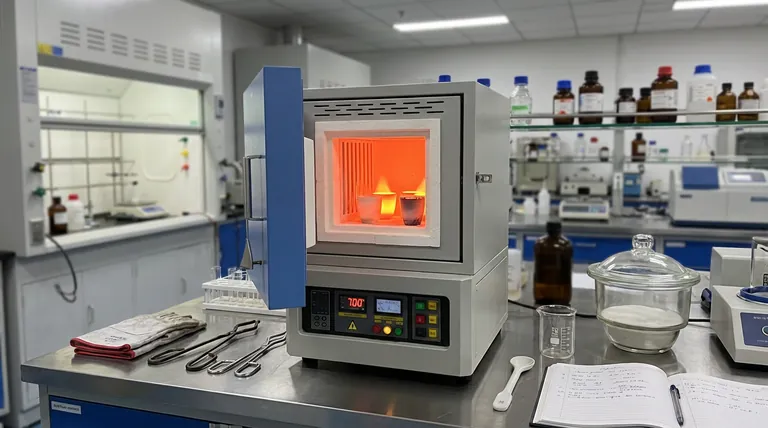
Transforming Precursors into Active Sites
Converting Metal Salts to Oxides
Raw catalyst materials often exist as metal precursors, such as nickel acetate or copper nitrate. The muffle furnace provides the thermal energy required to decompose these salts. This decomposition converts them into active metal oxide phases, which are the chemically functional components of the catalyst.
Establishing Component Interactions
For complex catalysts, simple heating is not enough; the thermal environment must be precise. High-precision temperature control allows for the development of ideal interactions between active components (like iron), supports (like titanium-aluminum), and promoters. This establishes the fundamental structural foundation required for the catalyst's operation.
Optimizing Physical Structure and Surface Area
Eliminating Residual Templates
During synthesis, surfactants are often used as templates to shape the catalyst. The muffle furnace performs a critical cleaning function by calcining these dried products. This process burns off the residual surfactant templates, clearing the pores and exposing the catalyst's high specific surface area.
Activating Support Materials
The furnace does not just affect the metal; it activates the carrier material as well. High-temperature treatment (e.g., 700 °C) can activate carbon carriers, creating a hollow, porous structure. This structural change significantly improves contact between reactants and the catalyst surface.
Facilitating Specialized Reaction Types
Triggering Solution Combustion Synthesis (SCS)
Beyond standard calcination, the muffle furnace is used to initiate vigorous self-propagating reactions. By preheating the furnace (typically to 500 °C) before introducing a mixture of metal nitrates and fuel, the furnace triggers an instantaneous exothermic reaction.
Rapid Skeleton Construction
In processes like SCS, the uniform heating of the muffle furnace ensures the reaction is rapid and intense. This quickly evaporates water and decomposes salts, constructing a solid-phase skeleton in a very short time. The result is a highly dispersed, porous powder that is difficult to achieve through slow heating methods.
Understanding the Trade-offs
The Risk of Sintering
While high heat is necessary for activation, excessive heat or lack of control can lead to sintering. Sintering occurs when catalyst particles fuse together, drastically reducing the active surface area and ruining the catalyst's performance.
Atmosphere Limitations
Most standard muffle furnaces operate with a static air atmosphere. While this is excellent for oxidation (calcination), it may not be suitable for reduction steps requiring hydrogen or inert gas flows without specialized modification.
Making the Right Choice for Your Goal
To maximize the effectiveness of your catalyst activation, align your furnace usage with your specific chemical objectives:
- If your primary focus is activating pore structures: Ensure your temperature curve allows sufficient time for the complete burnout of surfactant templates without collapsing the pore walls.
- If your primary focus is batch consistency: Prioritize a furnace with exceptional thermal field stability to ensure every gram of catalyst in the batch undergoes the exact same phase transformation.
- If your primary focus is Solution Combustion Synthesis: Utilizing a furnace capable of maintaining a stable pre-heated environment is critical to triggering the necessary self-propagating reaction immediately upon loading.
Ultimately, the muffle furnace serves as the defining tool for quality control, turning chemically potential mixtures into kinetically active realities.
Summary Table:
| Process Phase | Function of Muffle Furnace | Impact on Catalyst |
|---|---|---|
| Calcination | Thermal decomposition of metal salts | Converts precursors into active metal oxides |
| Template Removal | Burning off organic surfactants | Opens pore structures & increases surface area |
| Carrier Activation | High-temp treatment (up to 700°C+) | Creates porous, hollow structures in supports |
| SCS Synthesis | Rapid initiation of exothermic reactions | Produces highly dispersed, high-reactivity powders |
Maximize Your Catalyst Yield with KINTEK Precision
Don't let sintering or uneven heating compromise your research. Backed by expert R&D and world-class manufacturing, KINTEK offers a comprehensive range of Muffle, Tube, Rotary, and Vacuum furnaces designed for the rigorous demands of catalyst activation. Our systems provide the thermal stability and customizable atmosphere control needed to ensure high specific surface areas and precise chemical reactivity for your lab's unique requirements.
Ready to elevate your material synthesis? Contact us today to find your custom furnace solution!
References
- Florian Marin, Anca Maria Zaharioiu. Mesoporous Silica Nanocatalyst-Based Pyrolysis of a By-Product of Paper Manufacturing, Black Liquor. DOI: 10.3390/su16083429
This article is also based on technical information from Kintek Furnace Knowledge Base .
Related Products
- 1200℃ Muffle Oven Furnace for Laboratory
- 1400℃ Muffle Oven Furnace for Laboratory
- 1800℃ High Temperature Muffle Oven Furnace for Laboratory
- 1700℃ High Temperature Muffle Oven Furnace for Laboratory
- Laboratory Muffle Oven Furnace with Bottom Lifting
People Also Ask
- How does a high-temperature laboratory muffle furnace affect material properties? Transform Anodic Oxide Films Fast
- What is the primary function of a high-temperature laboratory muffle furnace in chemical synthesis? Achieve Precision.
- How is a laboratory muffle furnace used in 3D-printed PP-CF cross-linking? Achieve Thermal Stability at 150 °C
- What is the critical role of a laboratory high-temperature muffle furnace in TiO2/LDH? Unlock Superior Crystallization
- What role does a muffle furnace play in plant bark mineral analysis? Essential for Precise Dry Ashing & Trace Extraction



















