
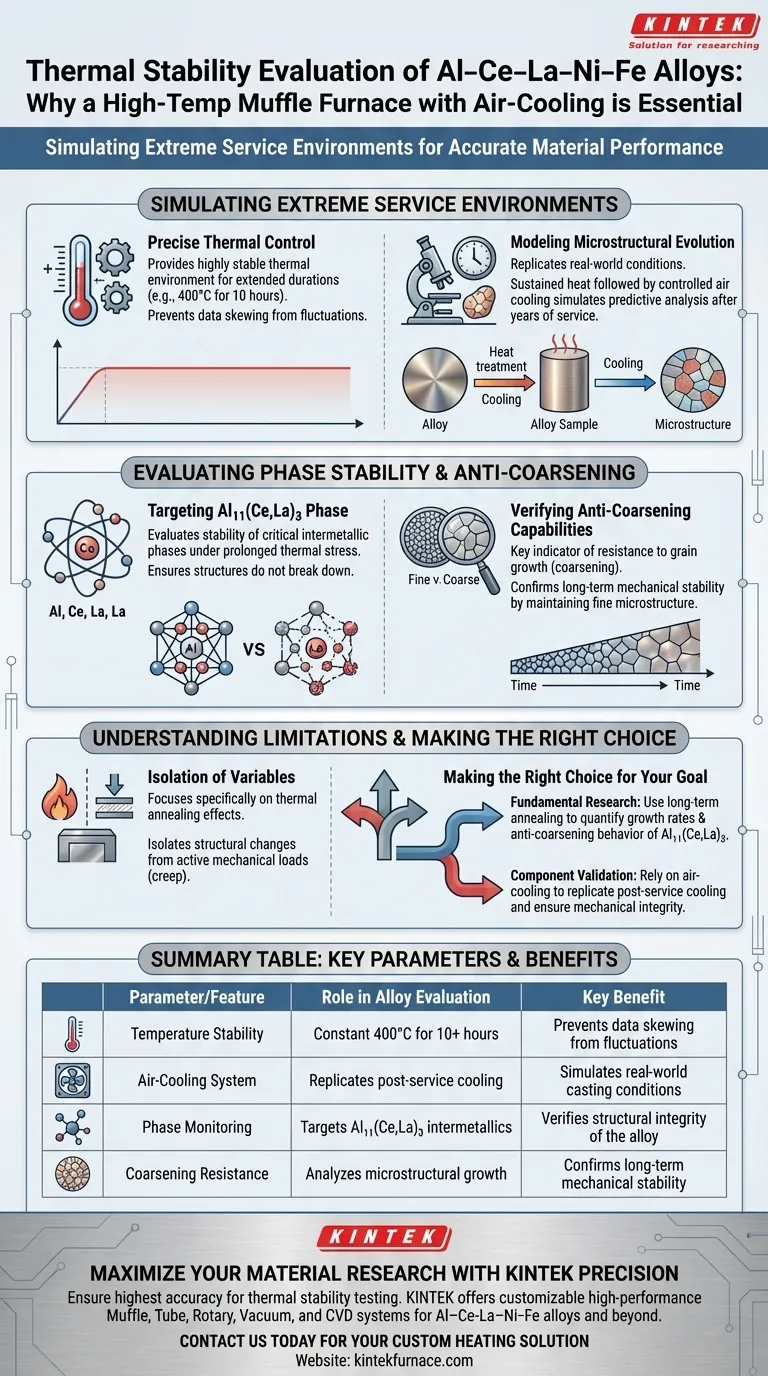
A high-temperature muffle furnace combined with an air-cooling system is indispensable for accurately evaluating the thermal stability of Al–Ce–La–Ni–Fe alloys. This equipment provides the precise control necessary to perform long-term annealing treatments—such as holding at 400°C for 10 hours—which are required to simulate the extreme thermal environments these materials will encounter in service.
By maintaining a stable thermal environment and utilizing controlled air cooling, this process isolates the variables necessary to verify the anti-coarsening capabilities of key alloy phases. It serves as the primary method for linking microstructural evolution to long-term mechanical stability.

Simulating Extreme Service Environments
Precise Thermal Control
The primary function of the muffle furnace is to provide a highly stable thermal environment over extended durations.
Fluctuations in temperature can skew data regarding material degradation. This stability ensures that the annealing process, specifically at parameters like 400°C for 10 hours, is consistent and reproducible.
Modeling Microstructural Evolution
The goal of this thermal treatment is to replicate the conditions a casting faces during real-world operation.
By subjecting the alloy to sustained heat followed by air cooling, researchers can simulate the microstructural evolution of the material. This allows for a predictive analysis of how the alloy will behave after years of service in high-temperature applications.
Evaluating Phase Stability
Targeting the Al11(Ce,La)3 Phase
The evaluation focuses heavily on specific intermetallic phases within the alloy, particularly Al11(Ce,La)3.
These phases are critical to the alloy's performance. The furnace test determines if these structures remain stable or break down when exposed to prolonged thermal stress.
Verifying Anti-Coarsening Capabilities
A key indicator of stability is the alloy's resistance to "coarsening," where fine microstructures grow larger and lose effectiveness.
This equipment allows engineers to verify the anti-coarsening capabilities of the phases. Proving that the microstructure resists coarsening is essential for confirming the material's mechanical stability.
Understanding the Limitations
Isolation of Variables
It is important to recognize that this method focuses specifically on thermal annealing.
While it effectively simulates microstructural changes due to heat, it typically isolates these effects from active mechanical loads (creep) during the heating cycle. It verifies the stability of the material's structure, rather than its immediate response to physical stress while hot.
Making the Right Choice for Your Goal
To effectively utilize this equipment for your specific objectives:
- If your primary focus is fundamental research: Use the long-term annealing capability to quantify the specific growth rates and anti-coarsening behavior of the Al11(Ce,La)3 phase.
- If your primary focus is component validation: Rely on the air-cooling cycle to replicate post-service cooling rates to ensure the casting retains its mechanical integrity after thermal exposure.
Reliable performance data begins with the precise simulation of your material's worst-case thermal environment.
Summary Table:
| Parameter/Feature | Role in Alloy Evaluation | Key Benefit |
|---|---|---|
| Temperature Stability | Constant 400°C for 10+ hours | Prevents data skewing from fluctuations |
| Air-Cooling System | Replicates post-service cooling | Simulates real-world casting conditions |
| Phase Monitoring | Targets Al11(Ce,La)3 intermetallics | Verifies structural integrity of the alloy |
| Coarsening Resistance | Analyzes microstructural growth | Confirms long-term mechanical stability |
Maximize Your Material Research with KINTEK Precision
Ensure the highest level of accuracy for your thermal stability testing. Backed by expert R&D and manufacturing, KINTEK offers high-performance Muffle, Tube, Rotary, Vacuum, and CVD systems—all fully customizable to meet your specific research parameters for Al–Ce–La–Ni–Fe alloys and beyond.
Our advanced lab high-temp furnaces provide the stable environments and controlled cooling necessary to verify anti-coarsening capabilities and microstructural evolution. Contact us today to find your custom heating solution.
Visual Guide
References
- Benjamin E. MacDonald, Diran Apelian. High-Pressure Die Casting of Al–Ce–La–Ni–Fe Alloys. DOI: 10.1007/s40962-023-01252-x
This article is also based on technical information from Kintek Furnace Knowledge Base .
Related Products
- 1700℃ High Temperature Muffle Oven Furnace for Laboratory
- 1800℃ High Temperature Muffle Oven Furnace for Laboratory
- 1200℃ Muffle Oven Furnace for Laboratory
- 1400℃ Muffle Oven Furnace for Laboratory
- Laboratory Muffle Oven Furnace with Bottom Lifting
People Also Ask
- What is the primary function of a high-temperature laboratory muffle furnace in chemical synthesis? Achieve Precision.
- How does a high-temperature laboratory muffle furnace affect material properties? Transform Anodic Oxide Films Fast
- What role does a muffle furnace play in BCZY712 electrolyte powder production? Achieve Perfect Phase Purity
- What role does a muffle furnace play in sintering photocathodes? Enhance Electrode Conductivity & Catalytic Activity
- How does the two-stage sintering process contribute to the synthesis of MeCuFeO3 perovskite? Optimize crystal purity.



















