
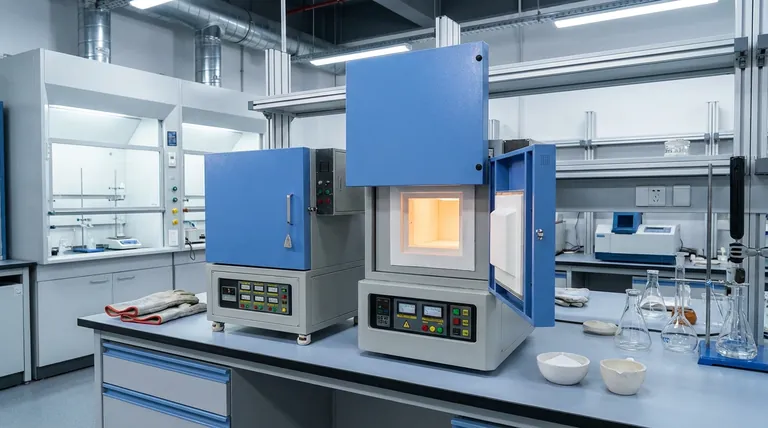
A high-temperature box-type resistance furnace, often called a muffle furnace, is strictly required to perform calcination. This critical thermal processing step removes organic impurities, specifically surfactants like Cetyltrimethylammonium bromide (CTAB), that remain after hydrothermal synthesis. Furthermore, the furnace environment is essential for refining the material's internal structure, ensuring the SnO2/ZnO composite achieves the necessary crystallinity for high-performance applications.
The furnace acts as the final transformative tool, converting a chemically impure intermediate into a stable, high-purity photocatalyst by burning off residues and locking in the crystal lattice.
Achieving Chemical Purity
Eliminating Synthesis Residues
During the earlier hydrothermal synthesis stages, surfactants such as CTAB are often used as templates or stabilizing agents.
These organic compounds adhere to the material and must be completely removed to prevent interference with the composite's surface properties.
The Role of High-Temperature Calcination
The muffle furnace provides a controlled, high-temperature environment designed to burn off these organic contaminants.
By exposing the intermediate products to sustained heat, the furnace ensures that only the inorganic Tin Dioxide and Zinc Oxide components remain.
Ensuring Surface Cleanliness
Removing these impurities is not merely cosmetic; it exposes the active sites of the nanoparticles.
This chemical purity is a prerequisite for the material to function effectively as a photocatalyst in its final application.
Enhancing Structural Integrity
Improving Crystallinity
Beyond cleaning the material, the thermal energy provided by the furnace drives the rearrangement of atoms within the nanoparticles.
This process improves the crystallinity of the SnO2/ZnO binary composite, correcting defects in the atomic structure.
Solidifying Structural Stability
The heat treatment ensures the nanoparticles are structurally robust and mechanically strong.
Without this stabilization, the material would likely suffer from poor durability and inconsistent performance during use.
Optimizing for Photocatalysis
The primary reference indicates that this structural refinement is directly linked to the material's end-use performance.
High crystallinity and structural stability are vital for ensuring the efficiency of the final photocatalyst product.
Understanding the Process Constraints
The Necessity of Precision
While high heat is necessary, the application of that heat must be uniform and controlled.
Box-type resistance furnaces are specifically selected because they offer a stable heating environment, minimizing temperature gradients that could cause uneven processing.
The Risk of Incomplete Processing
If this calcination step is skipped or performed at insufficient temperatures, organic residues will remain trapped.
This results in a composite with low chemical purity and a weak internal structure, rendering it unsuitable for advanced catalytic tasks.
Making the Right Choice for Your Goal
To maximize the quality of your SnO2/ZnO composites, align your furnace parameters with your specific performance targets.
- If your primary focus is Chemical Purity: Ensure the calcination temperature and duration are sufficient to fully degrade and volatilize the CTAB surfactants.
- If your primary focus is Mechanical Stability: Prioritize a heating profile that promotes optimal crystallization to enhance the structural strength of the nanoparticles.
The muffle furnace is not just a heating device; it is the gatekeeper between a raw synthesis product and a functional, high-performance material.
Summary Table:
| Feature | Impact on SnO2/ZnO Binary Composites |
|---|---|
| Organic Removal | Eliminates CTAB surfactants to ensure high chemical purity. |
| Structural Stability | Enhances crystallinity and corrects atomic structure defects. |
| Active Site Exposure | Cleans nanoparticle surfaces to optimize photocatalytic efficiency. |
| Thermal Precision | Provides uniform heating to prevent uneven material processing. |
Elevate Your Composite Synthesis with KINTEK Precision
Maximize the performance of your SnO2/ZnO binary composites with KINTEK’s advanced thermal solutions. Backed by expert R&D and world-class manufacturing, we provide high-precision Muffle, Tube, Rotary, Vacuum, and CVD systems designed to meet the rigorous demands of material science.
Whether you need to eliminate surfactants like CTAB or optimize nanoparticle crystallinity, our fully customizable lab high-temperature furnaces ensure the structural integrity and chemical purity your research demands.
Ready to refine your synthesis process? Contact KINTEK today to discover how our expert heating technology can transform your laboratory results.
References
- Pengfei Chen, Lihan Deng. Synergistic Enhancement of Carrier Migration by SnO2/ZnO@GO Heterojunction for Rapid Degradation of RhB. DOI: 10.3390/molecules29040854
This article is also based on technical information from Kintek Furnace Knowledge Base .
Related Products
- 1700℃ High Temperature Muffle Oven Furnace for Laboratory
- 1800℃ High Temperature Muffle Oven Furnace for Laboratory
- 1400℃ Muffle Oven Furnace for Laboratory
- 1200℃ Muffle Oven Furnace for Laboratory
- High Temperature Muffle Oven Furnace for Laboratory Debinding and Pre Sintering
People Also Ask
- What is the primary function of a high-temperature laboratory muffle furnace in chemical synthesis? Achieve Precision.
- How does a high-temperature laboratory muffle furnace affect material properties? Transform Anodic Oxide Films Fast
- What role does a muffle furnace play in BCZY712 electrolyte powder production? Achieve Perfect Phase Purity
- How does a muffle furnace impact Ni/MgAl2O4 catalysts? Optimize Stability and Catalytic Performance
- What role does a muffle furnace play in sintering photocathodes? Enhance Electrode Conductivity & Catalytic Activity



















