
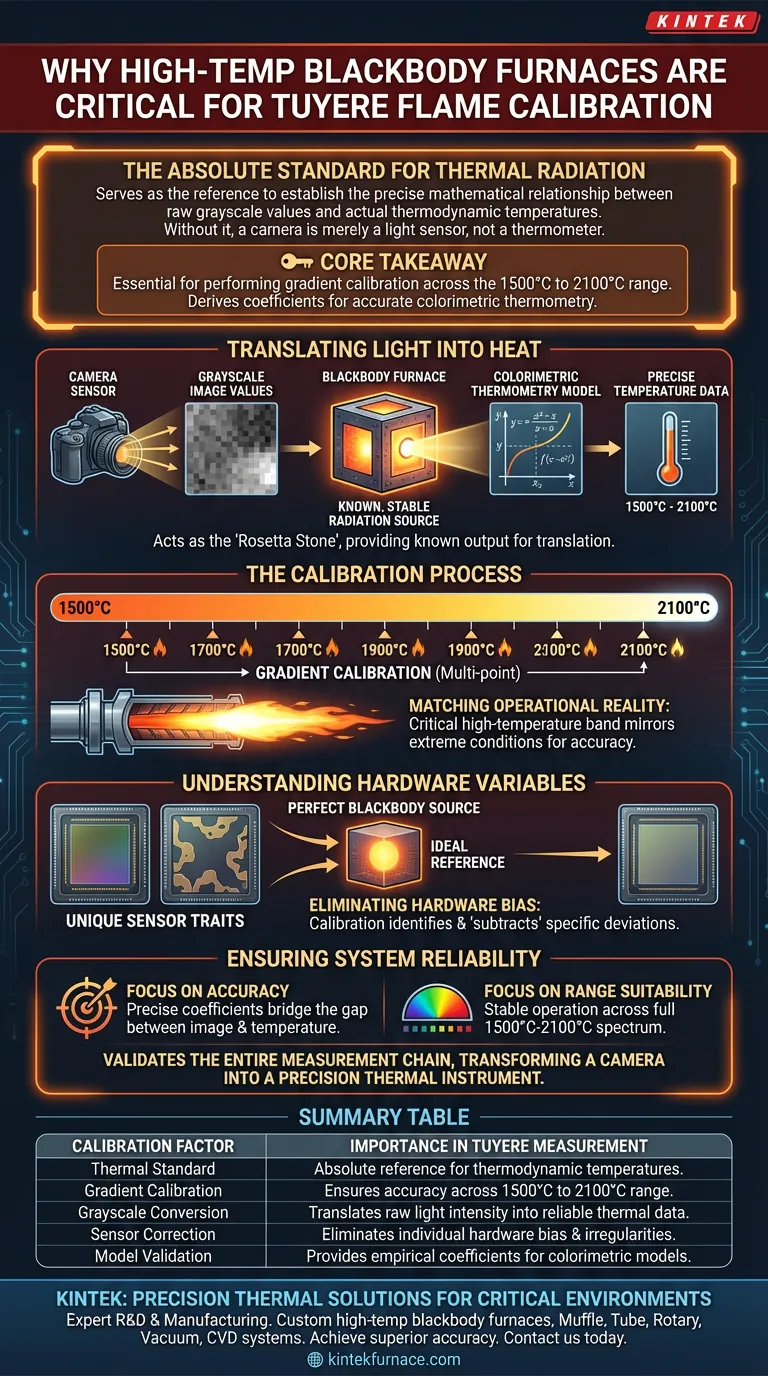
A high-temperature blackbody furnace is indispensable because it serves as the absolute standard for thermal radiation. It is required to establish the precise mathematical relationship between the raw grayscale values captured by your imaging equipment and the actual thermodynamic temperatures of the flame. Without this reference, a camera is merely a light sensor, not a thermometer.
Core Takeaway A blackbody furnace provides a known, stable radiation source essential for performing gradient calibration across the 1500°C to 2100°C range. This process derives the specific calibration coefficients needed to correct for camera sensor irregularities, ensuring the colorimetric thermometry model yields accurate data in the field.

The Gap Between Imaging and Measurement
Translating Light into Heat
A camera sensor does not inherently measure temperature; it captures light intensity, resulting in grayscale image values. To turn this visual data into thermal data, you need a translation layer. The blackbody furnace acts as the "Rosetta Stone" for this translation, providing a known temperature output that corresponds to a specific light intensity.
The Role of Colorimetric Models
The system uses a colorimetric thermometry model to calculate temperature. This mathematical model relies on specific coefficients to function correctly. These coefficients cannot be guessed; they must be empirically derived by observing a standard source—the blackbody furnace—at various known temperatures.
The Calibration Process
Gradient Calibration
Calibration is not a one-point check. It requires gradient calibration, which involves testing at multiple set points across the specific operating range of the tuyere.
Matching Operational Reality
The furnace allows for calibration specifically within the 1500°C to 2100°C range. Calibrating within this high-temperature band is critical because it mirrors the actual extreme conditions of a blast furnace tuyere, ensuring linearity and accuracy where it matters most.
Understanding Hardware Variables
Correcting Sensor Unique Traits
No two camera sensors are identical. Every device has unique photosensitive characteristics that can introduce errors into the measurement.
Eliminating Hardware Bias
By calibrating against a perfect blackbody source, you can identify exactly how a specific camera's sensor deviates from the ideal. The resulting calibration coefficients effectively "subtract" these hardware-specific errors from the final calculation.
Ensuring System Reliability
If your primary focus is Accuracy:
Prioritize generating precise calibration coefficients to bridge the gap between image grayscale and thermodynamic temperature.
If your primary focus is Range Suitability:
Ensure the blackbody furnace is capable of stable operation across the full 1500°C to 2100°C spectrum to match the tuyere environment.
Ultimately, the blackbody furnace validates the entire measurement chain, transforming a standard camera into a precision thermal instrument.
Summary Table:
| Calibration Factor | Importance in Tuyere Measurement |
|---|---|
| Thermal Standard | Serves as the absolute reference for thermodynamic temperatures. |
| Gradient Calibration | Ensures accuracy across the specific 1500°C to 2100°C range. |
| Grayscale Conversion | Translates raw image light intensity into reliable thermal data. |
| Sensor Correction | Eliminates individual hardware bias and photosensitive irregularities. |
| Model Validation | Provides empirical coefficients for colorimetric thermometry models. |
Precision Thermal Solutions for Critical Environments
Don't let measurement inaccuracies compromise your blast furnace operations. KINTEK provides the industry-leading high-temperature calibration solutions needed to transform raw data into actionable intelligence.
Backed by expert R&D and manufacturing, KINTEK offers a comprehensive range of Muffle, Tube, Rotary, Vacuum, and CVD systems, along with specialized high-temperature blackbody furnaces customizable for your unique laboratory and industrial needs.
Ready to achieve superior accuracy? Contact KINTEK today to consult with our experts on the perfect high-temperature furnace solution for your application.
Visual Guide
References
- Haoyu Cai, Dongdong Zhou. Study of Tuyere Combustion Flame Temperature in Vanadium and Titanium Blast Furnaces by Machine Vision and Colorimetric Thermometry. DOI: 10.3390/met14050499
This article is also based on technical information from Kintek Furnace Knowledge Base .
Related Products
- 1700℃ High Temperature Muffle Oven Furnace for Laboratory
- 1700℃ High Temperature Laboratory Tube Furnace with Alumina Tube
- 1800℃ High Temperature Muffle Oven Furnace for Laboratory
- 1400℃ High Temperature Laboratory Tube Furnace with Alumina Tube
- High Temperature Muffle Oven Furnace for Laboratory Debinding and Pre Sintering
People Also Ask
- What is the primary function of a high-temperature laboratory muffle furnace in chemical synthesis? Achieve Precision.
- How does a high-temperature laboratory muffle furnace affect material properties? Transform Anodic Oxide Films Fast
- What role does a muffle furnace play in BCZY712 electrolyte powder production? Achieve Perfect Phase Purity
- What role does a muffle furnace play in sintering photocathodes? Enhance Electrode Conductivity & Catalytic Activity
- How does the two-stage sintering process contribute to the synthesis of MeCuFeO3 perovskite? Optimize crystal purity.



















