
The precision of temperature control in a box-type muffle furnace is the primary determinant of microstructural homogeneity in thermoelectric alloy ingots. It directly regulates the thermodynamic environment, ensuring that elemental components diffuse thoroughly within the liquid phase. Without strict adherence to specific heating rates and holding times, the alloy cannot form the uniform solid solution required for high-quality performance.
Core Takeaway Thermoelectric efficiency relies heavily on material consistency. Precise temperature control eliminates component segregation during synthesis, enabling the formation of a homogeneous solid solution that defines the alloy's final quality.
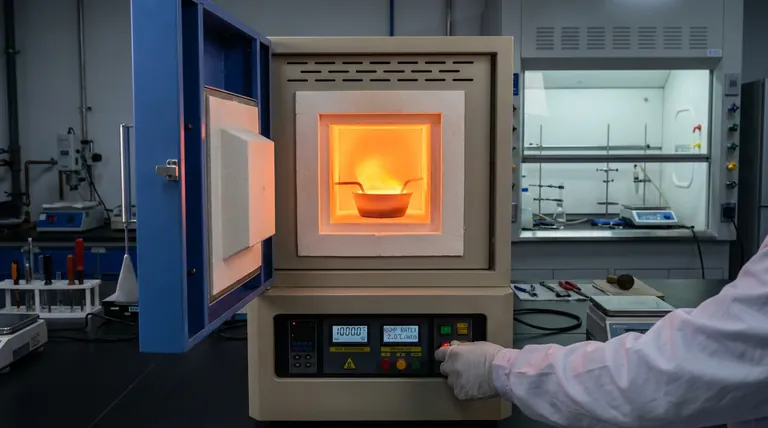
The Role of the Thermodynamic Environment
Establishing the Temperature Baseline
To synthesize high-quality thermoelectric alloys, the furnace must provide a stable thermodynamic environment capable of reaching high temperatures, often up to 1000 °C.
This high thermal baseline is necessary to transition the various elemental components into a liquid phase.
Controlling the Heating Rate
Precision control allows for a slow, specific heating rate, such as 2 °C per minute.
This gradual increase is not arbitrary; it prevents thermal shock and ensures that the material heats evenly throughout its volume.
Achieving Microstructural Homogeneity
Facilitating Elemental Diffusion
The core objective of precise temperature regulation is to ensure sufficient diffusion of elements while the alloy is in the liquid phase.
When the temperature is controlled accurately, the different components mix thoroughly rather than clustering together.
The Importance of Holding Time
Maintaing the target temperature for an extended period, such as 10 hours, is critical for the synthesis process.
This duration allows the diffusion process to complete, stabilizing the internal structure of the material.
Eliminating Component Segregation
The combination of precise heating rates and extended holding times works to eliminate component segregation.
By preventing elements from separating, the furnace facilitates the formation of a uniform solid solution, resulting in an ingot with a homogeneous microstructure.
Common Pitfalls to Avoid
The Risk of Rapid Heating
If the temperature control lacks precision and heats the material too quickly, elemental components may not have time to diffuse properly.
This often leads to a heterogeneous structure where different parts of the ingot exhibit different physical properties.
Consequences of Temperature Fluctuations
Inability to hold a stable temperature for the required duration (e.g., the full 10 hours) can interrupt the formation of the solid solution.
This results in an incomplete synthesis, where segregation remains within the ingot, severely degrading the quality of the final thermoelectric alloy.
Making the Right Choice for Your Goal
To maximize the quality of your thermoelectric alloy ingots, consider the following based on your specific objectives:
- If your primary focus is Structural Uniformity: Prioritize a furnace that guarantees a stable holding temperature for long durations to eliminate segregation.
- If your primary focus is Process Repeatability: Ensure your equipment can strictly maintain a specific heating rate (e.g., 2 °C/min) to replicate the diffusion environment in every batch.
Precise thermal regulation is not just a feature; it is the fundamental requirement for transforming raw elements into a high-performance solid solution.
Summary Table:
| Process Parameter | Impact on Alloy Quality | Critical Goal |
|---|---|---|
| Heating Rate (e.g., 2°C/min) | Prevents thermal shock; ensures even volume heating | Process Repeatability |
| Temperature Stability | Facilitates thorough elemental diffusion in liquid phase | Component Uniformity |
| Holding Time (e.g., 10 hrs) | Stabilizes internal structure; forms solid solution | Eliminating Segregation |
| Thermal Baseline (up to 1000°C) | Transitions elements into a consistent liquid phase | Microstructural Homogeneity |
Elevate Your Material Synthesis with KINTEK Precision
Don't let temperature fluctuations compromise the integrity of your thermoelectric alloys. At KINTEK, we specialize in providing high-performance thermal solutions designed for the most demanding research and production environments.
Backed by expert R&D and world-class manufacturing, we offer Muffle, Tube, Rotary, Vacuum, and CVD systems—all of which are fully customizable to meet your unique temperature precision and holding time requirements. Whether you are aiming for perfect microstructural homogeneity or strict process repeatability, our lab high-temp furnaces provide the stable thermodynamic environment your materials deserve.
Ready to achieve superior alloy quality? Contact our technical experts today to discuss your custom furnace needs!
References
- Tao Guo, Lingling Ren. Study on the Effect of Sn, In, and Se Co-Doping on the Thermoelectric Properties of GeTe. DOI: 10.3390/ma17030551
This article is also based on technical information from Kintek Furnace Knowledge Base .
Related Products
- Laboratory Muffle Oven Furnace with Bottom Lifting
- High Temperature Muffle Oven Furnace for Laboratory Debinding and Pre Sintering
- 1200℃ Muffle Oven Furnace for Laboratory
- 1400℃ Muffle Oven Furnace for Laboratory
- 1700℃ High Temperature Muffle Oven Furnace for Laboratory
People Also Ask
- Why is a high-temperature laboratory muffle furnace essential for the alkali fusion process in zeolite synthesis?
- Why is a high-temperature muffle furnace required for FeOx-MOx/TiO2? Engineering High-Performance Nanocomposites
- What function does a muffle furnace perform in Ba0.75Ca0.25TiO3 calcination? Ensure Phase Purity & Synthesis
- What is the importance of the calcination process? Master High-Purity Calcium Phosphate Nanopowder Production
- What are the primary functions of a high-temperature laboratory muffle furnace in the preparation of biosorbent materials?



















