
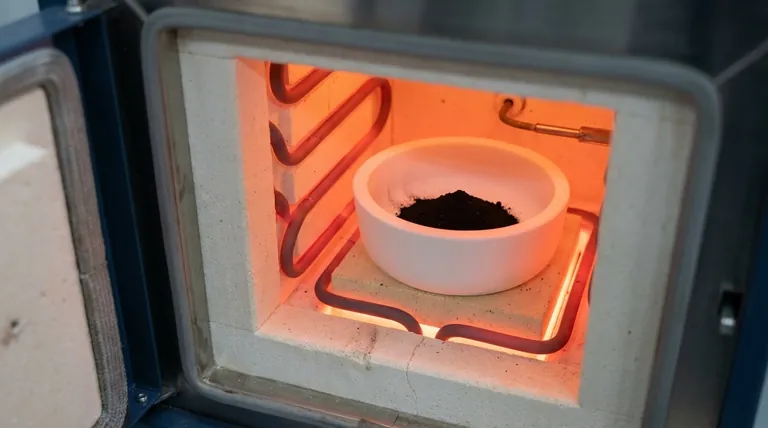
High-purity Alumina crucibles are required because they provide the necessary chemical stability and high-temperature resistance to protect Molybdenum Disulfide samples. During annealing processes that reach up to 900 °C, the crucible remains inert, preventing the container material from reacting with the sample or introducing metallic impurities.
The use of high-purity Alumina is critical for experimental validity. It ensures that any measured physical properties result strictly from the material's intrinsic defects rather than external contamination from the container.
The Critical Role of Chemical Stability
Withstanding Extreme Heat
The annealing process for Molybdenum Disulfide often involves temperatures reaching as high as 900 °C.
At these extremes, many standard laboratory containers would degrade or soften. High-purity Alumina retains its structural integrity, providing a safe environment for the thermal treatment.
Preventing Material Leaching
The primary function of the crucible is to act as a non-reactive barrier.
Because high-purity Alumina is chemically inert, it prevents reactions between the container walls and the Molybdenum Disulfide powder. This is vital to stop metallic impurities from the crucible explicitly leaching into the sample during heating.
Preserving Experimental Validity
Isolating Intrinsic Properties
Scientific analysis of annealed Molybdenum Disulfide often focuses on subtle characteristics, such as magnetic properties.
Researchers need to confirm that these properties originate from intrinsic defect generation within the material itself.
Eliminating False Positives
If a reactive crucible were used, impurities could enter the sample and display their own magnetic behaviors.
By using high-purity Alumina, researchers eliminate this variable. This guarantees that the experimental results reflect the true nature of the Molybdenum Disulfide, rather than the characteristics of a contaminated mixture.
Understanding the Risks of Alternative Materials
The Danger of Contamination
Using a crucible with lower purity or lower thermal resistance introduces a high risk of "phantom" results.
If the container reacts even slightly, it introduces foreign elements into the powder. This renders the data regarding intrinsic defects unusable, as it becomes impossible to distinguish between the sample's properties and the contaminants' properties.
Ensuring Accuracy in Your Analysis
If your primary focus is determining intrinsic magnetic properties:
- You must use high-purity Alumina to ensure the observed magnetism is not a result of metallic impurities leaching from the container.
If your primary focus is high-temperature safety:
- Reliance on Alumina is necessary to maintain containment integrity at annealing temperatures up to 900 °C.
Select the crucible material that guarantees the sample remains chemically isolated throughout the entire thermal process.
Summary Table:
| Feature | High-Purity Alumina Crucible Benefit |
|---|---|
| Thermal Resistance | Maintains structural integrity up to 900°C and above |
| Chemical Inertness | Prevents reactions between container walls and MoS2 samples |
| Purity Control | Eliminates metallic impurity leaching for accurate defect analysis |
| Experimental Validity | Ensures measured properties (e.g., magnetism) are intrinsic |
Elevate Your Materials Research with KINTEK
Don't let impurities compromise your experimental results. KINTEK provides high-purity Alumina crucibles and precision thermal equipment designed for the most demanding scientific applications. Backed by expert R&D and manufacturing, KINTEK offers Muffle, Tube, Rotary, Vacuum, and CVD systems, all fully customizable to meet your unique lab requirements.
Ready to ensure the integrity of your next annealing process?
Contact us today to find the perfect high-temperature solution for your lab!
References
- Chang-Soo Park, Deuk Young Kim. Strong Room-Temperature Ferromagnetism of MoS2 Compound Produced by Defect Generation. DOI: 10.3390/nano14040334
This article is also based on technical information from Kintek Furnace Knowledge Base .
Related Products
- 1400℃ High Temperature Laboratory Tube Furnace with Alumina Tube
- 1700℃ High Temperature Laboratory Tube Furnace with Alumina Tube
- Magnesium Extraction and Purification Condensing Tube Furnace
People Also Ask
- How does zone-melting in tube furnaces synthesize bismuth micro-wires? Master Single-Crystal Thermoelectric Growth
- How are high-temperature laboratory tube furnaces applied in long-term vacuum homogenization heat treatments for intermetallic samples?
- How are high-temp tube furnaces used to measure diffusion coefficients per Fick's law? Master Precision Annealing
- How do high-temperature laboratory tube furnaces ensure environmental stability? Precision Thermal Reduction Tips
- How are high-temperature tube furnaces applied in testing ceramic-supported alloy membranes? Insights


