
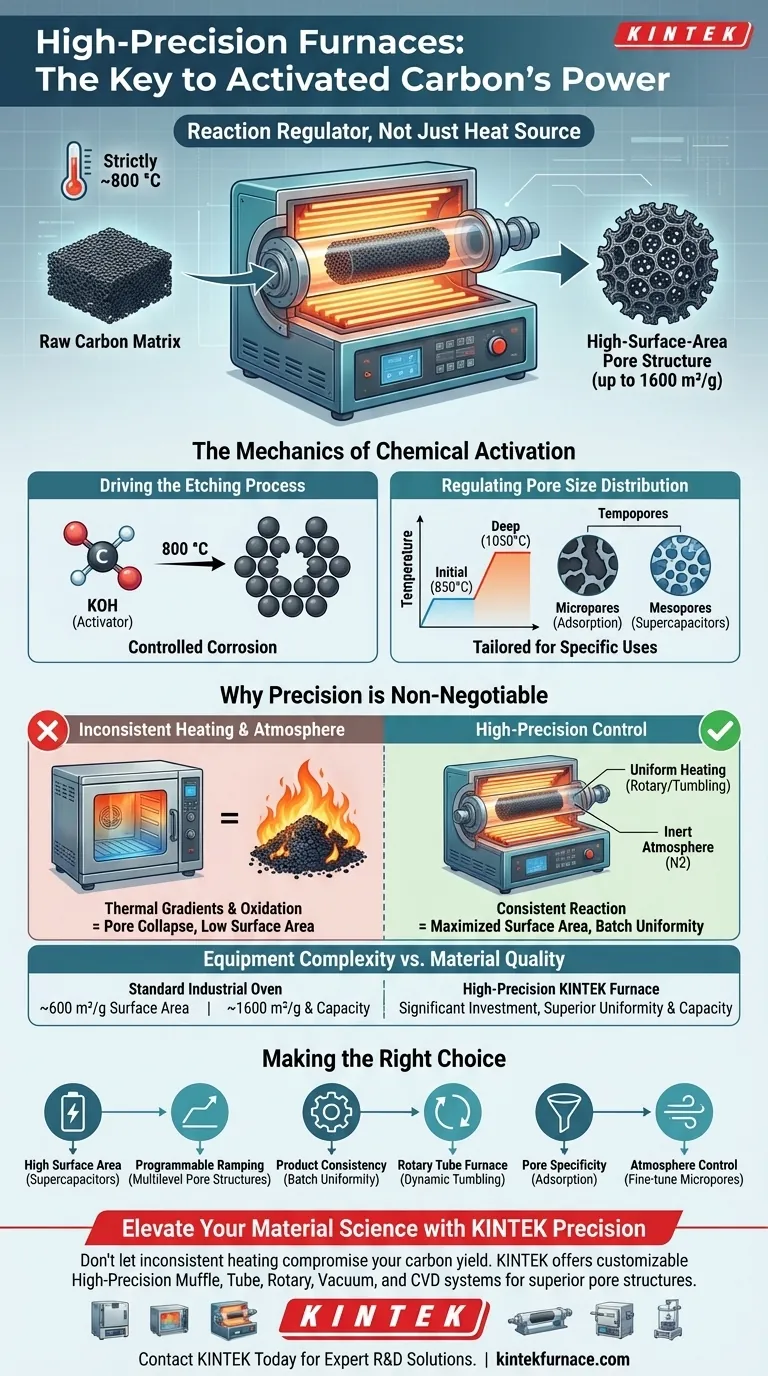
Precise thermal control is the primary determinant of success in chemical activation. A high-precision high-temperature furnace is required to strictly maintain the ~800 °C environment needed to drive the reaction between activators (such as KOH) and the carbon matrix, ensuring the creation of a high-surface-area pore structure without destroying the material.
Core Takeaway The furnace functions as a reaction regulator, not just a heat source. By enforcing accurate heating rates and constant temperatures, it controls exactly how aggressive chemical agents etch the carbon skeleton, which is the mechanism that defines the material's final micropore volume and performance capabilities.
The Mechanics of Chemical Activation
Driving the Etching Process
Chemical activation is effectively a controlled corrosion of the carbon material. At high temperatures (typically around 800 °C), activators like Potassium Hydroxide (KOH) act as powerful etching agents. The furnace provides the necessary thermal energy for these agents to attack the carbon skeleton, expanding micropore and mesopore structures to significantly increase the total surface area.
Regulating Pore Size Distribution
The specific thermal profile determines the geometry of the pores. Programmable temperature control is essential to execute segmented heating strategies—for example, stabilizing at 850 °C for initial activation before ramping to 1050 °C for deep activation. This precision allows you to dictate the ratio of micropores to mesopores, tailoring the material for specific uses like supercapacitors or mercury adsorption.
Why Precision is Non-Negotiable
Eliminating Temperature Gradients
Inconsistent heating results in a heterogeneous product where some particles are over-activated and others are under-reacted. Advanced equipment, such as rotary tube furnaces, combines precise heating with mechanical tumbling to ensure dynamic mixing. This eliminates thermal gradients within the chamber, ensuring every particle undergoes the same chemical reaction and results in consistent physical properties.
Managing the Reaction Atmosphere
At activation temperatures, the carbon matrix is highly vulnerable to uncontrolled oxidation (burning away). High-precision furnaces feature reliable atmosphere control systems to maintain an inert environment, typically using Nitrogen (N2). This isolates the chemical activation process, allowing the creation of structural defects and active sites without incinerating the carbon yield.
Understanding the Risks and Trade-offs
The Danger of Thermal Overshoot
Temperature control must be exact because the line between activation and destruction is thin. If the furnace permits local overheating, it can cause pore structures to collapse or sinter, drastically reducing the specific surface area. Conversely, insufficient heat fails to initiate the etching required to open efficient transport channels for electrolyte ions.
Equipment Complexity vs. Material Quality
High-precision furnaces represent a significant capital investment compared to standard industrial ovens. However, this equipment is necessary to achieve high-performance metrics, such as increasing specific surface area from ~600 m²/g to nearly 1600 m²/g. For advanced applications, the cost of the furnace is justified by the superior uniformity and capacity of the final activated carbon.
Making the Right Choice for Your Goal
Selecting the correct thermal processing strategy depends on the desired properties of your activated carbon.
- If your primary focus is High Surface Area (Supercapacitors): Prioritize a furnace with programmable ramp rates to carefully control the etching of multilevel pore structures.
- If your primary focus is Product Consistency (Batch Uniformity): Prioritize a rotary tube furnace to ensure dynamic tumbling and eliminate thermal dead spots.
- If your primary focus is Pore Specificity (Adsorption): Prioritize atmosphere control to fine-tune the creation of micropores without uncontrolled oxidation.
Ultimately, the precision of your furnace is the limiting factor in transforming raw carbonized material into a high-value functional product.
Summary Table:
| Key Feature | Role in Chemical Activation | Benefit to Final Product |
|---|---|---|
| Precise Temp Control | Drives etching between activator (KOH) and carbon | Maximized specific surface area (up to 1600 m²/g) |
| Atmosphere Control | Maintains inert environment (N2) | Prevents carbon oxidation and material loss |
| Uniform Heating | Eliminates thermal gradients/hot spots | Ensures batch consistency and prevents pore collapse |
| Programmable Ramping | Executes segmented heating strategies | Tailors micropore to mesopore distribution ratios |
Elevate Your Material Science with KINTEK Precision
Don't let inconsistent heating compromise your carbon yield. At KINTEK, we understand that the furnace is the heart of your chemical activation process. Backed by expert R&D and manufacturing, we offer high-precision Muffle, Tube, Rotary, Vacuum, and CVD systems—all fully customizable to meet the rigorous demands of your lab.
Whether you are developing supercapacitors or high-performance adsorbents, our equipment provides the exact thermal and atmosphere control needed to achieve superior pore structures.
Ready to optimize your activation process? Contact us today to discuss your unique needs with our technical specialists.
Visual Guide
References
- João Ferreira, J. C. R. E. Oliveira. High‐Capacity Hybrid Electrode for Seawater Batteries with Bio‐Waste Electrocatalyst. DOI: 10.1002/ente.202501038
This article is also based on technical information from Kintek Furnace Knowledge Base .
Related Products
- Electric Rotary Kiln Small Rotary Furnace for Activated Carbon Regeneration
- 1700℃ Controlled Inert Nitrogen Atmosphere Furnace
- 1200℃ Muffle Oven Furnace for Laboratory
- Laboratory Muffle Oven Furnace with Bottom Lifting
- 1400℃ High Temperature Laboratory Tube Furnace with Alumina Tube
People Also Ask
- What are the main applications of a rotary kiln electric furnace? Achieve Uniform Heat Treatment for Powders
- What are the key components of a rotary kiln electric furnace? Unlock Efficient Thermal Processing
- What is the significance of the refractory lining in a rotary kiln electric furnace? Unlock Efficiency and Longevity
- What advantages do electric rotary kilns offer over fuel-based kilns? Boost Efficiency and Purity in Your Process
- What materials can be processed in an electric rotary kiln? Versatile Solutions for Advanced Materials



















