
Reliable sintering of Titanium-Aluminum (TiAl) alloys depends entirely on atmosphere control. A diffusion pump is required to rapidly achieve a high vacuum level, specifically 1.6 x 10^-2 Pa, to completely strip away residual air that would otherwise react with the metals. Once this vacuum is established, a high-purity argon system acts as a stabilizing medium, protecting the alloy from evaporation and ensuring uniform heat distribution.
The synergy between the diffusion pump and argon gas solves two distinct problems: the vacuum eliminates oxidative contaminants, while the argon pressure prevents the loss of volatile active metals during high heat.
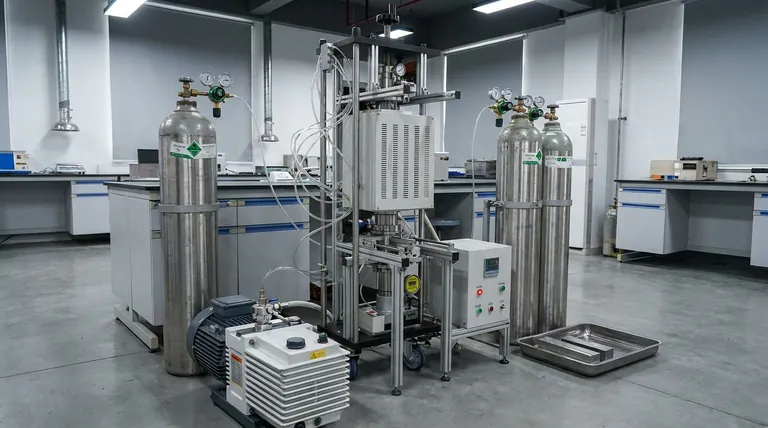
The Critical Role of the Diffusion Pump
Achieving Deep Vacuum Rapidly
Titanium and aluminum are highly reactive elements that readily bond with oxygen and nitrogen found in residual air.
To prevent this, a standard mechanical pump is insufficient; a diffusion pump is necessary to rapidly evacuate the chamber to high vacuum levels ($1.6 \times 10^{-2}$ Pa).
Preventing Chemical Contamination
The primary function of this deep vacuum is the thorough removal of atmospheric gases.
By eliminating these gases before the heat increases, the system prevents the formation of brittle oxides and nitrides that would compromise the alloy's structural integrity.
The Function of High-Purity Argon
Inhibiting Metal Volatilization
Once the vacuum has cleaned the environment, the temperature is raised for sintering.
At these high temperatures, active metals like aluminum are prone to volatilization (evaporating away).
Introducing high-purity argon creates a protective pressure barrier that inhibits this evaporation, preserving the correct chemical composition of the alloy.
Enhancing Thermal Conductivity
A vacuum is an excellent thermal insulator, which can lead to uneven heating during the sintering phase.
Argon gas serves as a heat conduction medium, bridging the gap between the heating elements and the workpiece.
This ensures the temperature is distributed uniformly across the alloy, preventing internal stresses or incomplete sintering.
Understanding the Process Sensitivities
The Risk of Inadequate Vacuum
If the diffusion pump fails to reach the required $1.6 \times 10^{-2}$ Pa threshold, trace amounts of oxygen will remain.
Even microscopic levels of oxidation can render a TiAl alloy brittle and unusable for high-stress applications.
The Necessity of Gas Purity
The argon introduced must be of high purity; standard industrial argon may contain moisture or trace gases.
Using low-grade argon negates the benefits of the vacuum stage by re-introducing contaminants into the chamber during the critical heating phase.
Optimizing Your Sintering Strategy
To ensure high-performance results in TiAl alloy production, consider the following operational priorities:
- If your primary focus is material purity: Prioritize the maintenance of the diffusion pump to consistently reach and hold the $1.6 \times 10^{-2}$ Pa vacuum baseline.
- If your primary focus is compositional stability: Monitor the argon flow and pressure carefully to prevent the volatilization of aluminum components at peak temperatures.
- If your primary focus is thermal uniformity: Ensure the argon introduction is calibrated to act as an effective thermal bridge without introducing turbulence or impurities.
Mastering the transition from high vacuum to protective atmosphere is the key to producing defect-free TiAl components.
Summary Table:
| Component | Primary Function | Benefit to TiAl Alloy |
|---|---|---|
| Diffusion Pump | Achieves high vacuum (1.6 x 10^-2 Pa) | Removes oxygen/nitrogen to prevent brittleness |
| High-Purity Argon | Creates protective pressure barrier | Inhibits metal volatilization & preserves composition |
| Gas Medium | Enhances thermal conductivity | Ensures uniform heat distribution & reduces stress |
Elevate Your TiAl Sintering Precision with KINTEK
Don't let oxidation or volatilization compromise your material integrity. KINTEK provides industry-leading thermal solutions backed by expert R&D and world-class manufacturing. Whether you require Vacuum, CVD, Muffle, or Tube systems, our lab high-temp furnaces are fully customizable to meet the rigorous $1.6 \times 10^{-2}$ Pa demands of your specific application.
Ready to optimize your lab's performance? Contact our experts today to discuss how our specialized furnace systems can ensure defect-free sintering for your next project.
References
- Jiawei Zhu, Maohua Li. The Effect of Stearic Acid on Microstructure and Properties of (Ti2AlC + Al2O3)p/TiAl Composites. DOI: 10.3390/met14040392
This article is also based on technical information from Kintek Furnace Knowledge Base .
Related Products
- Vacuum Dental Porcelain Sintering Furnace for Dental Laboratories
- Dental Porcelain Zirconia Sintering Ceramic Vacuum Press Furnace
- Vacuum Heat Treat Sintering Furnace Molybdenum Wire Vacuum Sintering Furnace
- Vacuum Heat Treat Sintering Furnace with Pressure for Vacuum Sintering
- Small Vacuum Heat Treat and Tungsten Wire Sintering Furnace
People Also Ask
- What is the purpose of dental sintering furnaces? Transform Zirconia into Durable, High-Quality Dental Restorations
- How does a dental vacuum porcelain furnace maintain restoration quality? Precision Sintering for Superior Esthetics
- What is the role of dental sintering furnaces in dental restorations? Transform Zirconia into Durable, Aesthetic Teeth
- What economic benefits does using a dental sintering furnace offer? Boost Profits with Faster, Automated Dental Lab Workflows
- How does a dental sintering furnace save time compared to traditional ceramic processing? Streamline Your Lab's Workflow











