The fundamental distinction is one of cleanliness and control. Organic processing additives are preferred because they can be completely and cleanly removed from the ceramic green body through controlled thermal decomposition, or pyrolysis, during a pre-sintering debinding step. Inorganic additives, conversely, cannot be burned out and leave behind permanent, often detrimental, chemical residues that compromise the final material's properties.
The core problem isn't just about shaping powder into a form; it's about engineering a transient state. You must build a temporary structure that vanishes without a trace. Organic additives are the only viable tool for this task because their carbon-based chemistry allows for complete burnout, whereas inorganic additives permanently contaminate the ceramic, altering its sintering behavior and degrading its ultimate performance in the high-temperature furnace.
The Unforgiving Nature of the Ceramic Process
Before a ceramic enters a furnace, its fate is largely sealed. This fundamental principle is why the choice of temporary additives is so critical.
Green Body Flaws Become Permanent Defects
Flaws introduced during the forming stage cannot be healed by sintering. Density gradients, agglomerates, and micro-cracks in the green body lead to uneven shrinkage during firing.
This non-uniform shrinkage is a primary cause of warpage, cracking, and dimensional distortion in the final component. The high temperatures of the sintering furnace amplify these inconsistencies rather than fix them.
The Mandate for Uniform Particle Packing
The goal of green body processing is to achieve a perfectly homogeneous packing of ceramic particles. This uniformity ensures predictable, linear shrinkage during sintering and allows the component to reach full theoretical density.
Organic additive systems are precisely engineered to achieve this. A dispersant prevents particle agglomeration, while the binder and plasticizer system lubricates the particles, allowing them to rearrange into a dense, uniform packing during the shaping process.
The Critical Role of Complete Binder Burnout
The transition from a shaped green body to a dense ceramic part hinges on the debinding stage. This is where the preference for organic chemistry becomes absolute.
The Clean Decomposition of Organic Additives
The primary reference highlights that organic additives—polymers, dispersants, and plasticizers—undergo thermal decomposition. When heated in a controlled atmosphere, they break down into gaseous byproducts that are swept from the furnace.
This pyrolytic process leaves behind virtually no residual contamination. The result is a chemically clean body of ceramic particles ready to densify. This complete removal is essential for preventing internal defects caused by trapped decomposition gases.
The Permanent Contamination of Inorganic Additives
Inorganic additives, such as silicates or phosphates, cannot be removed by heat. They remain in the ceramic body as a permanent, alien phase.
At high sintering temperatures, these residues can melt to form an unintended glassy phase at the particle boundaries. This liquid phase fundamentally alters sintering kinetics, often accelerating uncontrolled grain growth and degrading the material's high-temperature mechanical properties, electrical resistivity, and thermal conductivity.
Designing an Effective Organic Binder System
An organic additive is not a single substance but a carefully orchestrated system. Each component plays a specific role that contributes to the final part's quality.
The Multiple Components of an Additive Package
For a process like alumina extrusion, a complete system is required to transform the inert powder into an extrudable paste. This includes an aqueous solvent, a polyelectrolyte dispersant for particle separation, a polymer binder for green strength, a plasticizer to control flexibility, and a lubricant to aid in forming.
Each component must be chemically compatible with the others. For instance, the binder should not be so polar that it displaces the dispersant from the particle surfaces, as this would cause the slip to flocculate.
Matching Additive Properties to the Forming Method
The rheology demanded by the binder-solvent system must match the shaping process.
- Tape Casting: Requires a low-viscosity slip with high solids loading, which shears thin during casting and gels rapidly upon drying.
- Extrusion: Requires a plastic mass with a high yield stress that can be forced through a die and retain its shape, demanding a binder with high molecular weight and a plasticizer to lower its glass transition temperature ($T_g$).
Understanding the Trade-offs
The path of pyrolysis is not without its own significant challenges. The complete removal of organic additives is a delicate and critical process.
The Danger of Uncontrolled Pyrolysis
The burnout process itself is a leading cause of failure. If a binder decomposes too rapidly or generates a high volume of gases in a short time, the internal vapor pressure can cause the green body to blister, crack, or completely disintegrate.
A slow, meticulously controlled heating rate during the debinding phase is essential. This is especially challenging for thick-section parts, where the diffusion path for decomposition gases is long, dramatically increasing processing time and risk.
The Challenge of Oxidizing vs. Inert Atmospheres
The burnout behavior is heavily dependent on the furnace atmosphere. In an oxidizing atmosphere (air), organics burn cleanly but can leave carbon residue if oxygen is depleted inside the part. In a non-oxidizing atmosphere like nitrogen, the polymer decomposes into fragments that can leave significant carbon char.
For non-oxide ceramics like silicon nitride, debinding in an inert atmosphere is a major technical hurdle. The binder system and its removal cycle must be carefully designed to prevent residual carbon, which would later react with the ceramic powder and degrade its properties.
Making the Right Choice for Your Goal
Selecting a non-contaminating additive system is a foundational requirement. The specific chemistry and process must then be tailored to your production goals and property targets.
- If your primary focus is achieving the highest mechanical strength and reliability: Prioritize a dispersant and colloidal processing method that yields the most homogeneous green packing possible. Uniform green density is the single greatest predictor of a flaw-free, high-strength final part.
- If your primary focus is minimizing processing time and cost: You must balance the decomposition rate of the binder with the risk of defects. A faster-burning binder chemistry and a thicker part may require an unacceptably slow heating cycle to prevent cracking, potentially negating the cost savings.
- If your primary focus is manufacturing thick or complex-shaped parts: Your most critical selection is not just the binder chemistry but the design of a multi-stage, slow-debinding process using a non-polar organic solvent system. This minimizes internal stress gradients and provides a safe escape path for decomposition gases.
A high-performance ceramic structure is created not just in the final, high-temperature fire, but in the invisible, meticulously engineered polymer network that must vanish completely to bring it to life.
Summary Table:
| Feature / Aspect | Organic Additives | Inorganic Additives |
|---|---|---|
| Removal Mechanism | Clean pyrolysis (debinding into gas) | Cannot be thermally burned out |
| Residue & Purity | Leaves virtually zero residue | Leaves permanent glassy/foreign impurities |
| Green Body Packing | Tailors rheology for uniform density | Causes inclusions and density gradients |
| Final Properties | Maximizes mechanical strength & density | Induces distortion, grain growth, & defects |
Achieve flawless debinding and optimal sintering results with KINTEK. Specializing in high-performance laboratory equipment and consumables, KINTEK provides a comprehensive range of customizable high-temperature furnaces—including muffle, tube, rotary, vacuum, CVD, atmosphere, dental, and induction melting furnaces—engineered to meet your exact advanced ceramic processing needs. Contact us today to elevate your laboratory's material performance!
Related Products
- High Temperature Muffle Oven Furnace for Laboratory Debinding and Pre Sintering
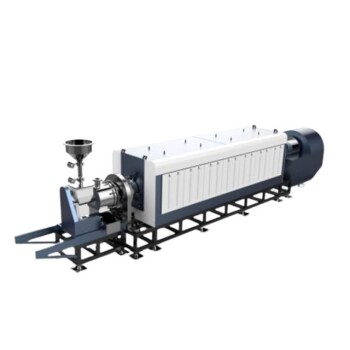
- Electric Rotary Kiln Small Rotary Furnace for Activated Carbon Regeneration
- Vacuum Dental Porcelain Sintering Furnace for Dental Laboratories
- Vertical Laboratory Quartz Tube Furnace Tubular Furnace
- Multi Heating Zones CVD Tube Furnace Machine for Chemical Vapor Deposition Equipment
People Also Ask
- What thermal phenomena occur during polymer binder burnout in ceramic green bodies? Lab Furnace Guide
- Why is controlled heat treatment in a muffle furnace necessary for calcined clay? Achieve Optimal Pozzolanic Activity
- What role does a high-temperature muffle furnace play in STFO synthesis? Achieve Pure Perovskite Results
- How does a high-temperature muffle furnace facilitate the formation of LaNbxAl1−xO3+δ perovskite structures? Key Roles
- What role does a high-temperature muffle furnace play in the multi-stage synthesis of Li0.5MnFe1.5O4? Key to Pure Spinel