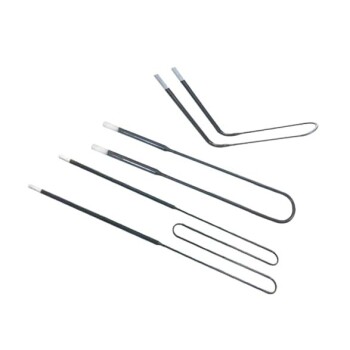
Laboratory resistance heaters and silver paint form the critical thermal management system necessary for high-quality Pulsed Laser Deposition (PLD). While the heater generates the stable, high-temperature environment required for Barium Titanate (BaTiO3) crystallization, the silver paint acts as a conductive interface, ensuring that this heat is transferred efficiently and uniformly to the substrate to prevent structural failure.
Core Takeaway Achieving high-quality Barium Titanate thin films is impossible without precise thermal control. Resistance heaters provide the necessary energy for growth kinetics, but it is the silver paint that guarantees uniform heat conduction, eliminating the thermal gradients that lead to stress cracking and defects.
The Role of Thermal Energy in PLD
The Necessity of Resistance Heaters
Growing complex oxides like Barium Titanate requires a high-energy environment. Laboratory resistance heaters are the primary source of this energy, creating a stable, high-temperature zone within the vacuum chamber.
This heat is not merely for reaching a setpoint; it drives the fundamental growth kinetics of the film. Without a consistent and adequate heat source, the adatoms (atoms depositing on the surface) lacks the mobility to arrange themselves into the correct crystal lattice.
The Problem of Heat Transfer in Vacuum
In a vacuum environment, heat cannot travel through convection (air). It must travel through radiation or conduction.
Because the substrate and the heater block are both rigid solids, placing one on top of the other results in imperfect microscopic contact. This leads to inefficient heat transfer and "cold spots" on the substrate where the film will fail to grow correctly.
The Critical Function of Silver Paint
Ensuring Excellent Thermal Contact
Silver paint is applied to the back of single-crystal substrates to solve the conduction problem. It acts as a liquid interface that fills the microscopic gaps between the heater block and the substrate.
By creating a continuous physical link, the silver paint ensures excellent thermal contact. This allows the thermal energy from the resistance heater to flow directly into the substrate without significant loss or resistance.
Preventing Thermal Gradients
One of the greatest dangers during PLD growth is the formation of thermal gradients—differences in temperature across the surface of the substrate.
If the substrate is heated unevenly, different parts of the film will grow at different rates. Silver paint ensures uniform heat conduction, keeping the entire substrate at the same temperature.
Reducing Structural Defects
Uniform heating is directly linked to the structural integrity of the Barium Titanate film.
By maintaining thermal consistency, you significantly reduce structural defects within the crystal lattice. Furthermore, uniform heating prevents stress cracking, which occurs when thermal expansion is uneven across the substrate surface.
Understanding the Operational Trade-offs
Application Consistency
While silver paint is essential, its application introduces a variable. If the paint is applied too thick or too thin, it can alter the thermal conductivity or the physical position of the substrate relative to the laser plume.
Contamination Risks
Silver paint contains volatile organic binders that allow it to be spread as a liquid. As the heater ramps up, these binders must burn off (outgas).
If the heater is ramped too quickly, or if the vacuum pumping speed is insufficient, these outgassing agents can contaminate the vacuum environment, potentially affecting the purity of the BaTiO3 film.
Removal Challenges
After the deposition is complete, the silver paint residue effectively glues the substrate to the heater block. Removing the sample requires care to avoid mechanical stress that could crack the newly grown film or the substrate itself.
Making the Right Choice for Your Goal
To ensure the success of your Barium Titanate thin film growth, consider the following recommendations:
- If your primary focus is Film Homogeneity: Ensure the silver paint is applied in a thin, even layer to guarantee that the entire substrate receives the exact same thermal energy.
- If your primary focus is Structural Integrity: Verify that your resistance heater is calibrated to maintain stability, as fluctuations combined with poor thermal contact will lead to immediate stress cracking.
By treating the heater and the silver paint as a unified thermal system, you ensure the thermodynamic conditions necessary for flawless crystal growth.
Summary Table:
| Component | Primary Function | Impact on BaTiO3 Film |
|---|---|---|
| Resistance Heater | Provides energy for growth kinetics | Drives adatom mobility and crystal lattice formation |
| Silver Paint | Creates a conductive thermal interface | Ensures uniform heat distribution and prevents stress cracking |
| Vacuum Environment | Eliminates convective interference | Requires conduction/radiation for energy transfer |
| Thermal Contact | Fills microscopic surface gaps | Eliminates "cold spots" and localized growth failure |
Optimize Your Thin Film Deposition Today
Precise thermal management is the difference between a flawed crystal and a high-performance thin film. KINTEK provides the advanced heating solutions required for rigorous PLD processes. Backed by expert R&D and manufacturing, we offer Muffle, Tube, Rotary, Vacuum, and CVD systems, along with other lab high-temperature furnaces—all fully customizable to meet your unique research needs.
Don't let thermal gradients compromise your BaTiO3 growth. Contact KINTEK today to discover how our high-precision equipment can enhance your laboratory’s efficiency and output.
References
- Yizhe Jiang, Lane W. Martin. Effect of fabrication processes on BaTiO3 capacitor properties. DOI: 10.1063/5.0203014
This article is also based on technical information from Kintek Furnace Knowledge Base .
Related Products
- Molybdenum Disilicide MoSi2 Thermal Heating Elements for Electric Furnace
- Electric Rotary Kiln Continuous Working Small Rotary Furnace Kiln for Pyrolysis Plant Heating
- Silicon Carbide SiC Thermal Heating Elements for Electric Furnace
People Also Ask
- What are the typical application temperatures for molybdenum disilicide (MoSi2) heating elements? Master High-Temp Performance
- What is the primary use of molybdenum disilicide? Ideal for High-Temp Heating Elements
- What are the characteristics of molybdenum disilicide heating elements? Unlock High-Temp Performance
- What are the properties of molybdenum disilicide (MoSi2) that make it suitable for high-temperature applications? Discover Its High-Temp Resilience
- What are the applications of molybdenum disilicide heating elements? Achieve Extreme Heat Stability for Industrial Processes