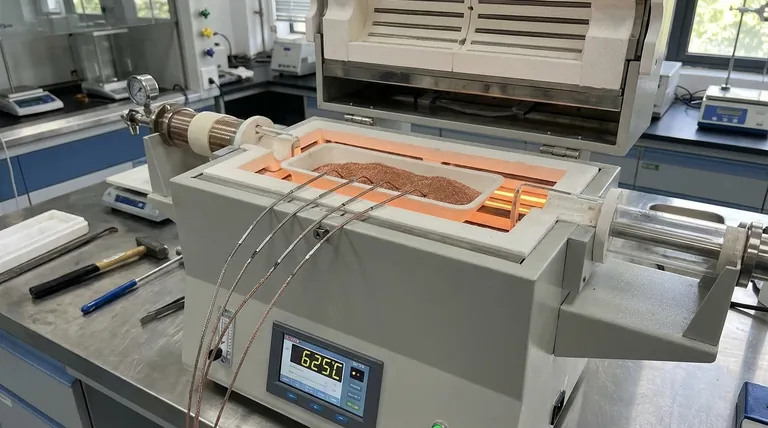
High-precision thermocouples function as the authoritative control mechanism within the furnace during the pre-treatment of copper powder. Specifically, instruments like K-type thermocouples provide real-time feedback on the actual internal temperature, ensuring the annealing process strictly adheres to the pre-set heating curve. Without this continuous monitoring, the precise thermal environment required for chemical and physical transformation cannot be maintained.
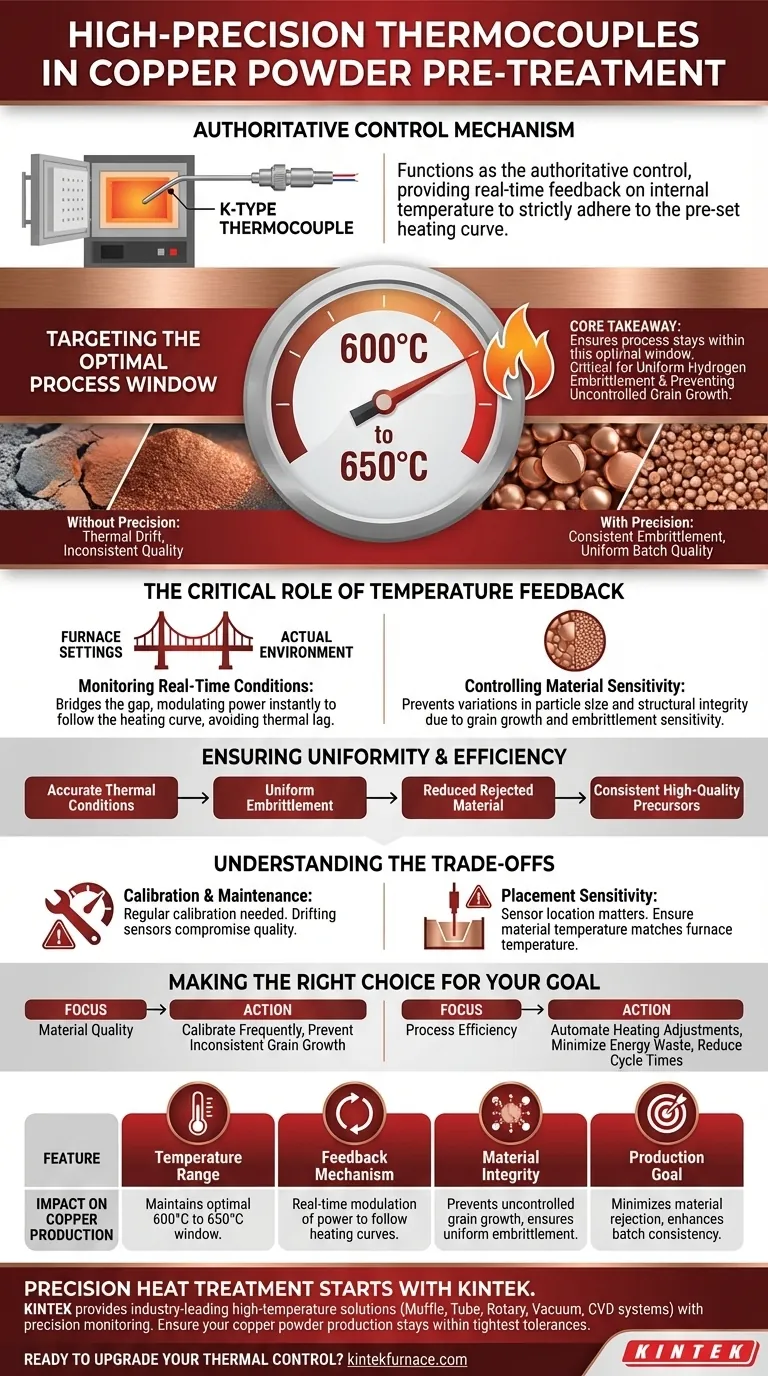
Core Takeaway The primary role of these sensors is to guarantee the process stays within the optimal 600°C to 650°C window. This precision is critical because slight deviations in temperature directly impact the uniformity of hydrogen embrittlement and can lead to uncontrolled copper grain growth.
The Critical Role of Temperature Feedback
Monitoring Real-Time Conditions
The fundamental function of the thermocouple is to bridge the gap between the furnace's settings and the actual internal environment.
Heating elements may fluctuate, but high-precision thermocouples provide real-time feedback.
This data allows the system to modulate power instantly, ensuring the annealing process strictly follows the designated heating curve rather than drifting due to thermal lag or load variations.
Controlling Material Sensitivity
Copper powder production is chemically delicate during the pre-treatment stage.
Both copper grain growth and the degree of hydrogen embrittlement are highly sensitive to temperature changes.
If the monitoring is inaccurate, the physical properties of the final powder will vary, leading to inconsistencies in particle size and structural integrity.
Targeting the Optimal Process Window
The 600°C to 650°C Threshold
The primary reference identifies a specific temperature window that dictates success: 600°C to 650°C.
This is the optimal range for hydrogen embrittlement.
High-precision thermocouples are the only reliable way to ensure the material reaches and sustains this specific temperature without overshooting, which could alter the grain structure detrimental to the powder's quality.
Ensuring Uniformity and Efficiency
Beyond mere temperature tracking, these sensors are vital for production efficiency.
By maintaining accurate thermal conditions, manufacturers ensure uniform embrittlement across the entire batch.
This reduces the rate of rejected material and ensures the pre-treatment phase yields consistent, high-quality copper precursors ready for crushing or further processing.
Understanding the Trade-offs
Calibration and Maintenance
While high-precision thermocouples like K-types are robust, their accuracy is not absolute forever.
They require regular calibration to ensure the feedback loop remains valid.
A drifting sensor can report that the furnace is in the optimal 600–650°C range when it is actually outside of it, quietly compromising the batch quality.
Placement Sensitivity
The feedback provided is only as good as the sensor's location.
A thermocouple measures temperature at a specific point, which may differ from the center of the copper load.
Operators must understand that "furnace temperature" and "material temperature" can diverge, necessitating careful sensor placement or soak times to ensure the copper actually reaches the target state.
Making the Right Choice for Your Goal
To maximize the effectiveness of high-precision thermocouples in your production line:
- If your primary focus is Material Quality: Calibrate sensors frequently to ensure the furnace strictly maintains the 600°C to 650°C window, preventing inconsistent grain growth.
- If your primary focus is Process Efficiency: Utilize the real-time feedback data to automate heating adjustments, minimizing energy waste and reducing cycle times.
Precise temperature monitoring is the difference between processing copper and truly engineering its microstructure.
Summary Table:
| Feature | Impact on Copper Powder Production |
|---|---|
| Temperature Range | Maintains optimal 600°C to 650°C window |
| Feedback Mechanism | Real-time modulation of power to follow heating curves |
| Material Integrity | Prevents uncontrolled grain growth and ensures uniform embrittlement |
| Production Goal | Minimizes material rejection and enhances batch consistency |
Precision Heat Treatment Starts with KINTEK
Don't let thermal drift compromise your material integrity. KINTEK provides industry-leading high-temperature solutions, including Muffle, Tube, Rotary, Vacuum, and CVD systems, all designed with precision monitoring to meet your specific lab or industrial requirements. Backed by expert R&D and manufacturing, our systems ensure your copper powder production or advanced material research stays within the tightest tolerances.
Ready to upgrade your thermal control? Contact our experts today to discuss your custom furnace needs.
Visual Guide
References
- Falah Mustafa Al-Saraireh. The Effect of Annealing Conditions on Copper's Brittleness and Powder Production Efficiency. DOI: 10.21062/mft.2025.035
This article is also based on technical information from Kintek Furnace Knowledge Base .
Related Products
- Multi Zone Laboratory Quartz Tube Furnace Tubular Furnace
- Multi Heating Zones CVD Tube Furnace Machine for Chemical Vapor Deposition Equipment
- High Temperature Muffle Oven Furnace for Laboratory Debinding and Pre Sintering
- Vertical Laboratory Quartz Tube Furnace Tubular Furnace
- 1200℃ Split Tube Furnace Laboratory Quartz Tube Furnace with Quartz Tube
People Also Ask
- What environmental protection applications utilize multi zone tube furnaces? Unlock Precision in Waste Treatment and Green Tech
- What temperature-related capabilities make multi zone tube furnaces valuable for research? Unlock Precision Thermal Control
- What role do multi zone tube furnaces play in new energy research? Unlock Precise Thermal Control for Innovation
- Why are multi zone tube furnaces particularly useful for nanomaterial research? Unlock Precise Thermal Control for Advanced Synthesis
- What are the main applications of multi zone tube furnaces in university laboratories? Unlock Precision in Material Science and Energy Research