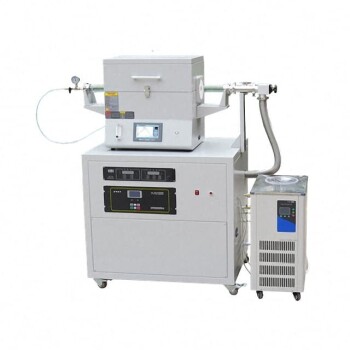
Nitrogen partial pressure and processing temperature are the non-negotiable thermodynamic and kinetic pillars. Without a sufficiently high nitrogen chemical potential, the driving force for phase segregation vanishes; without enough atomic mobility, the self‑organized nanocomposite never forms. This article dissects every control parameter that must be managed inside a Chemical Vapor Deposition (CVD) reactor to synthesize superhard nanocomposite thin films, mapping surface-level gas and temperature settings to the deep‑seated physical mechanisms that deliver hardness exceeding 80–100 GPa.
The central insight: A superhard nanocomposite like nc‑TmN/a‑Si₃N₄ emerges only when thermodynamics and kinetics are simultaneously satisfied. You must provide a high nitrogen activity to make the two phases thermodynamically immiscible, and maintain a temperature high enough (around 550 °C) to let atoms diffuse and organize into 3–4 nm crystallites sheathed by an amorphous monolayer‑thick tissue. Every other CVD control—pressure, flow rates, substrate temperature uniformity—ultimately serves to preserve these two master conditions.
Mapping the Surface Need to the Deep Physical Requirement
What the Operator Controls vs. What the Film Needs
When a process engineer asks about “thermodynamic and kinetic process parameters,” they are really asking: Which knobs do I turn to force the film into a specific nanostructure? The knobs on CVD equipment are temperature, pressure, gas flow rates, and plasma power (if applicable). The film, however, responds to chemical potentials, diffusion lengths, and reaction rates.
The primary reference makes this explicit:
- Thermodynamic driver → nitrogen activity, set by the partial pressure of nitrogen‑bearing precursors.
- Kinetic enabler → atomic diffusion rate, set by processing temperature.
Your job is to translate the equipment’s control variables into these physical quantities. Getting it wrong means the film will either remain a single‑phase solid solution (no nanocrystals) or coarsen into large grains that lose the quantum‑confinement‑like hardening mechanism.
Thermodynamic Control: Creating the Driving Force for Phase Separation
Why Nitrogen Partial Pressure Rules Everything
Superhard nanocomposites of the family nc‑TmN/a‑Si₃N₄ (Tm = Ti, W, V, etc.) depend on thermodynamic immiscibility between the stoichiometric transition metal nitride and silicon nitride. This immiscibility is not automatic; it is an equilibrium condition that only exists when the chemical activity of nitrogen is high enough.
In a CVD environment, nitrogen activity is practically determined by the partial pressure of reactive nitrogen species—ammonia (NH₃), nitrogen gas (N₂) activated by plasma, or nitrogen‑containing metal‑organic precursors. If that partial pressure is too low, the system may not contain enough nitrogen to drive the reaction
x Tm + y Si + (z N) → TmN + Si₃N₄
to completion, and you’ll get substoichiometric phases that freely mix, preventing spinodal decomposition.
The “Spinodal Decomposition Window” and How Gas Ratios Define It
Phase separation via spinodal decomposition occurs spontaneously when the free energy curve of the mixed system has a negative curvature. In practice, this means you must operate inside a composition–temperature window where a single‑phase mixture is unstable against composition fluctuations.
Key control action: Set the precursor flow rates (e.g., TiCl₄, SiCl₄, NH₃ or SiH₄, N₂) to deliver an excess of the nitriding agent relative to the metal atoms. The primary reference highlights that the stoichiometry of the deposited film is highly dependent on the partial pressure and flow rates of reactant gases. Therefore, precise mass‑flow controllers and pressure regulation are not just ancillary; they are the hands that shape the thermodynamic driving force.
Kinetic Control: Enabling the Self‑Organization Without Over‑Coarsening
The Temperature Sweet Spot at 550 °C
The primary reference pinpoints ~550 °C or higher as the kinetic enabler. At this temperature, metal and silicon atoms have enough surface and bulk diffusivity to cluster into distinct 3–4 nm crystallites within the timescale of a typical deposition (minutes to hours). Below this temperature, diffusion is too sluggish; you may deposit an amorphous or glassy film that never phase‑separates, resulting in poor hardness.
Why “Higher” Must Still Be Bounded
While the primary reference says “typically around 550 °C or higher,” it doesn’t give a free pass to ramp up the heater. At temperatures much above 600–650 °C (depending on the system), diffusion becomes so fast that nanocrystals coarsen. The monolayer‑thick Si₃N₄ tissue that prevents grain boundary sliding can break down, and you lose the interfacial strengthening. The hardness then plummets from superhard (>80 GPa) down to ordinary hard coating values.
Therefore, the kinetic control is a Goldilocks condition: hot enough to complete spinodal decomposition, but cool enough to freeze the structure at the optimal 3–4 nm length scale.
The Supporting Cast: Pressure, Flow, and Uniformity
Total Reactor Pressure as a Kinetic and Thermodynamic Modulator
Total chamber pressure influences both gas‑phase reactions and surface diffusion. Lower pressure lengthens the mean free path, which can improve film uniformity on complex geometries (as noted in CVI processes for SiC). However, it also reduces the concentration of reactants at the surface. For superhard nanocomposite CVD, intermediate pressures (often a few Torr to tens of Torr) are common to strike a balance between precursor transport and surface mobility.
Gas Flow Rates and Stoichiometry Precision
The primary reference emphasizes that stoichiometry “often deviates from ideal chemical formulas” and is highly dependent on flow rates. In a multi‑component system like Ti‑Si‑N, small drifts in the Ti:Si ratio can shift the volume fraction of the amorphous matrix, altering the residual stress state and the final hardness. Mass‑flow controllers must be calibrated and stable within 1% of setpoint to keep the delivery ratio constant.
Substrate Temperature Uniformity: The Unseen Killer of Reproducibility
A substrate holder with a thermal gradient of even 20 °C across a wafer can create a spatial variation in film hardness. One region gets the perfect 3–4 nm crystallites; another remains under‑decomposed or over‑coarsened. Active temperature control (resistive heaters, thermocouple feedback) and wafer rotation are not luxuries but necessities for meeting the <5 °C uniformity often needed for research‑grade nanocomposite films.
Understanding the Trade‑offs and Common Pitfalls
The Temperature‑Pressure‑Hardness Triangle
Every CVD process exists in a multi‑dimensional parameter space where improving one property often sacrifices another. For superhard nanocomposite films, the most painful trade‑offs are:
- High temperature accelerates diffusion → faster spinodal completion, but risk of grain growth and loss of hardness.
- High nitrogen partial pressure ensures phase segregation → but can slow down deposition rate if it dilutes metal precursors or shifts into a mass‑transport‑limited regime.
- Lower total pressure improves film uniformity → but may reduce the gas‑phase concentration of reactant species, requiring longer deposition times and raising thermal budget.
The art is to hold temperature exactly at the threshold where spinodal decomposition is just completed at the end of the deposition run, without any soak time that would allow Ostwald ripening. This often means lower temperatures (500–550 °C) for longer depositions or higher temperatures for shorter ones, with the latter requiring acute process monitoring.
Overlooking the Amorphous Matrix Stoichiometry
A hidden failure mode is to fixate on nanocrystal size but ignore the Si₃N₄ tissue. If the Si:N ratio in the amorphous phase is off‑stoichiometric (e.g., silicon‑rich SiNₓ), the interfacial energy changes, and the tissue may crystallize at lower temperatures or fail to wet the nitride grains. This undermines the “glue” that gives the nanocomposite its load‑invariant superhardness. Calibrating the precursor flows to yield exactly stoichiometric Si₃N₄—not just any silicon‑containing phase—is a control imperative.
Equipment Limitations: The Gap Between Knob and Reality
CVD equipment often has a dead‑band or drift in its pressure control valves and mass‑flow controllers. A pressure setpoint of 5 Torr with a ±0.5 Torr oscillation can be enough to perturb the gas residence time and local stoichiometry. Before trusting a recipe, you must characterize your system’s dynamic stability. Similarly, cold‑wall reactors can create parasitic gas‑phase nucleation that consumes precursor before it reaches the substrate, effectively changing the input stoichiometry you so carefully dialed in.
Making the Right Choice for Your Process Goal
Your specific CVD application—whether it’s coating cutting tools, MEMS devices, or industrial components—will dictate which parameter you lock first. Here’s how to prioritize:
- If your primary focus is achieving the maximum superhardness plateau (>80 GPa): Lock the nitrogen partial pressure at a sufficiently high level to guarantee thermodynamic immiscibility, then reduce the deposition temperature until kinetic suppression just stops the transformation. Use this temperature as your ceiling.
- If your primary focus is coating complex 3D parts uniformly: Begin with a lower total pressure to enhance gas diffusion and surface coverage, then adjust the precursor flow ratio to re‑establish the correct nitrogen activity at that new residence time.
- If your primary focus is throughput and deposition speed: Start with higher temperatures (but still below the coarsening threshold for your material) to shorten the spinodal completion time, and use in‑situ monitoring (e.g., optical pyrometry, residual gas analysis) to ensure you’re not drifting into a grain‑growth regime.
You now hold a clear map connecting the equipment’s dials to the fundamental forces that sculpt a superhard nanocomposite. Turn those dials with the confidence that you are not just altering gas flows and heater setpoints—you are orchestrating a self‑assembly phenomenon at the atomic scale.
Summary Table:
| Parameter | Equipment Control | Physical Mechanism | Optimal Condition | Risk of Deviation |
|---|---|---|---|---|
| Nitrogen Activity | Gas Flow Rates (NH₃/N₂ MFCs) | Drives thermodynamic phase segregation | High partial pressure ratio | Single-phase solid solution; no phase separation |
| Processing Temperature | Heater Setpoint & Feedback | Enables atomic diffusion & self-organization | ~550 °C (Goldilocks zone) | <500°C: Sluggish diffusion; >650°C: Grain coarsening |
| Total Reactor Pressure | Vacuum Valve & Pressure Controller | Controls gas residence time & transport | Intermediate (Torr level) | Poor film uniformity or reduced precursor transport |
| Matrix Stoichiometry | MFC Precision (<1% drift) | Forms stable, monolayer-thick tissue | Exact stoichiometric Si₃N₄ | Tissue crystallization; loss of superhardness |
Maximize Your CVD Thin Film Precision with KINTEK
Achieving the exact thermodynamic and kinetic conditions for superhard nanocomposites requires uncompromising thermal uniformity and precision gas control. KINTEK specializes in advanced laboratory equipment and customizable high-temperature furnace systems—including specialized CVD systems, vacuum, tube, atmosphere, and muffle furnaces tailored to your strict research and production specifications.
Whether you are synthesizing next-generation hard coatings or optimizing complex material synthesis, KINTEK provides reliable, high-precision equipment to help you hit your performance targets every time.
👉 Contact KINTEK today to discuss your custom furnace requirement
Related Products
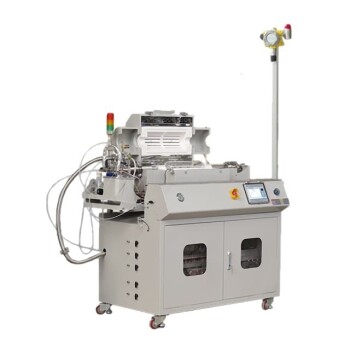
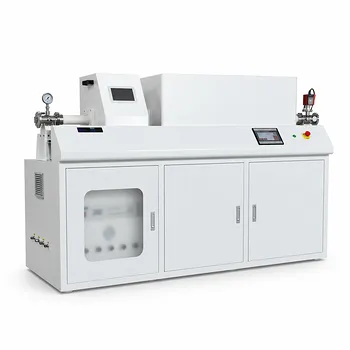
- Custom Made Versatile CVD Tube Furnace Chemical Vapor Deposition CVD Equipment Machine
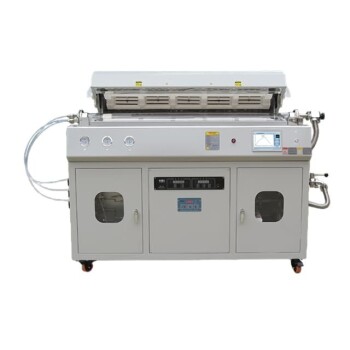
- Multi Heating Zones CVD Tube Furnace Machine for Chemical Vapor Deposition Equipment
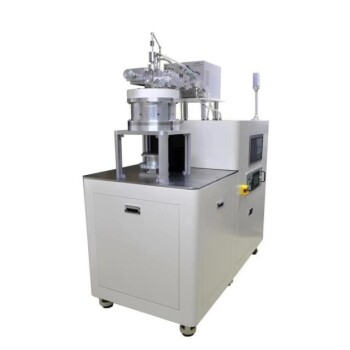
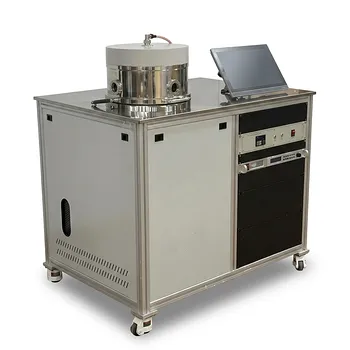
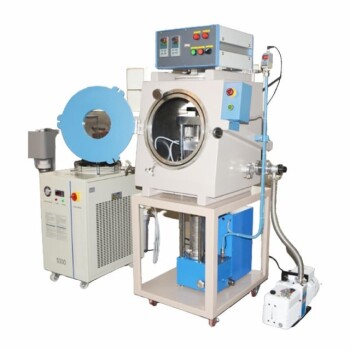
- HFCVD Machine System Equipment for Drawing Die Nano Diamond Coating
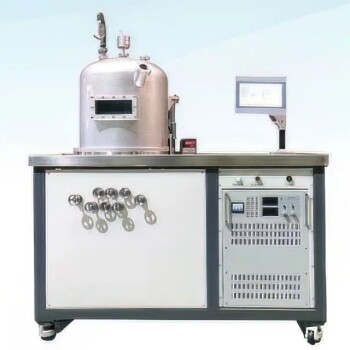
- MPCVD Machine System Reactor Bell-jar Resonator for Lab and Diamond Growth
- 915MHz MPCVD Diamond Machine Microwave Plasma Chemical Vapor Deposition System Reactor
People Also Ask
- Why are CVD tube furnace sintering systems indispensable for 2D material research and production? Unlock Atomic-Scale Precision
- What is a CVD tube furnace and what is its primary function? Discover Precision Thin-Film Deposition
- Which industries and research fields benefit from CVD tube furnace sintering systems for 2D materials? Unlock Next-Gen Tech Innovations
- How does CVD tube furnace sintering enhance graphene growth? Achieve Superior Crystallinity and High Electron Mobility
- What temperature range do standard CVD tube furnaces operate at? Unlock Precision for Your Material Deposition