
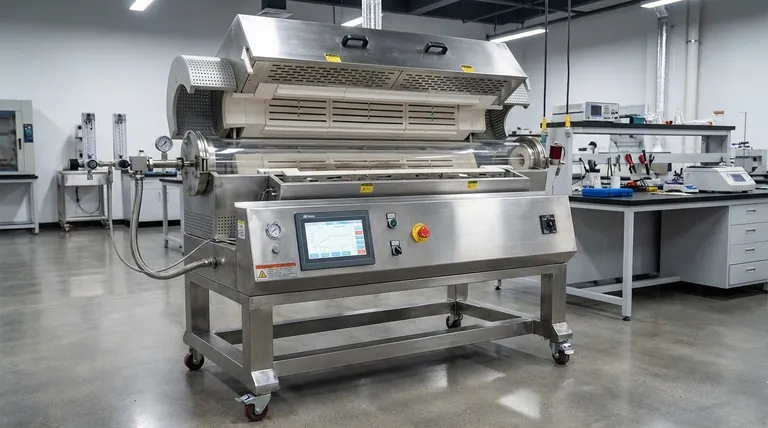
To enhance the performance of a rotary tube furnace, you should focus on features that improve control over the material's movement, thermal profile, and processing atmosphere. Key supplementary features include multi-zone heating, adjustable rotation speed and tilt control, integrated material feeders, and comprehensive atmosphere control packages. These elements move a furnace from a simple heater to a precision processing instrument.
While individual features like multi-zone heating or tilt control offer specific benefits, true performance enhancement comes from a holistic system design. The goal is to precisely manage heat transfer, material residence time, and atmospheric integrity to achieve your desired outcome efficiently and consistently.
Mastering the Thermal Profile
The primary function of any furnace is heat application. Advanced features transform this from a brute-force action into a precise, controllable process variable.
The Power of Multi-Zone Heating
A basic furnace may have a single heating zone, which offers limited control. A furnace equipped with multiple, independently controlled thermal zones along the tube's length is vastly superior.
This allows you to create a specific temperature profile. For example, you can design a process with a pre-heating zone, a central high-temperature reaction zone, and a controlled cool-down zone, all within the same continuous operation.
Indirect Firing for Precision and Purity
Most high-performance rotary tube furnaces use an indirect-fired design. The heating elements warm the outside of the process tube rather than being exposed directly to the material.
This design prevents contamination of the process material and atmosphere. More importantly, it allows for extremely uniform heat transfer and precise temperature control, which is critical for sensitive materials and reactions.
Controlling Material Dynamics
How material moves through the furnace is just as important as the temperature it experiences. This is controlled by managing rotation, angle, and mixing.
Adjustable Rotation Speed
The speed at which the tube rotates directly influences the mixing of the material bed.
Higher rotation speeds increase tumbling and agitation, promoting better heat and mass transfer. Slower speeds can reduce particle degradation for delicate materials or increase exposure time for specific reactions.
Variable Tilt Control
The angle, or tilt, of the furnace tube is the primary control for material residence time—the duration the material spends inside the furnace.
A steeper angle results in faster throughput and shorter residence time. A shallower angle slows the material's travel, increasing the processing time. Adjustability is key for process optimization.
Advanced Mixing Technologies
To further enhance uniformity and reduce processing time, some furnaces incorporate internal lifters or baffles.
These mixing technologies continuously fold the material bed over on itself. This ensures that particles from the center of the bed are constantly brought to the surface for direct exposure to the heat and process atmosphere, dramatically improving efficiency.
Ensuring Atmospheric Integrity
For many modern processes, controlling the gaseous environment within the furnace is a requirement for success.
Inert Gas and Atmosphere Packages
Many chemical and thermal processes, such as sintering or calcination, must occur in a specific atmosphere to prevent oxidation or facilitate a reaction.
A dedicated atmosphere control package provides the sealed flanges, gas inlet and outlet ports, and flow control systems needed to reliably purge oxygen and maintain a positive pressure of an inert gas like nitrogen or argon.
Off-Gas Treatment and Handling
Processes that release volatile compounds or hazardous byproducts require an integrated gas treatment system. This can include afterburners, scrubbers, or filtration systems to ensure the furnace exhaust is safe and environmentally compliant.
Understanding the Trade-offs
Adding features introduces complexity and cost. A successful design is not about including every option, but about choosing the right ones.
The Cost of Complexity
Every adjustable feature adds a parameter that must be managed. More advanced systems require a higher initial investment and can have more complex maintenance requirements. It is critical to only specify features that address a tangible process need.
The Necessity of System-Level Control
A furnace with multi-zone heating, variable speed, and gas control is ineffective without a central brain. A modern Process Control System (PLC) is essential to orchestrate these variables. This enables repeatable, automated recipes and ensures all components work in unison.
Feeders and Discharge as a Critical Link
A high-performance furnace is only as good as its material handling. Inconsistent feeding leads to inconsistent results. For continuous processing, an automated feeder synchronized with the furnace controls is not an optional accessory but a core system component.
Making the Right Choice for Your Goal
The ideal set of features depends entirely on your primary process objective.
- If your primary focus is maximizing throughput: Prioritize adjustable tilt control and an automated, high-capacity feeder system to precisely manage residence time and material flow.
- If your primary focus is product uniformity: Invest in multi-zone heating, advanced mixing technologies (lifters), and precise rotation speed control to ensure every particle has the same thermal experience.
- If your primary focus is executing complex reactions: A system with multiple, independently controlled heating zones and a sophisticated atmosphere control package is non-negotiable.
- If your primary focus is research and development: Choose a flexible system with wide-ranging, easily adjustable controls for tilt, rotation, and temperature to explore a broad processing window.
Ultimately, the most performant furnace is not the one with the most features, but the one whose features are deliberately chosen to master your specific process requirements.
Summary Table:
| Feature | Key Benefit | Ideal For |
|---|---|---|
| Multi-Zone Heating | Precise temperature profiles | Complex reactions, product uniformity |
| Adjustable Rotation Speed | Controlled mixing and particle integrity | Delicate materials, specific reactions |
| Variable Tilt Control | Manage material residence time | Throughput optimization |
| Atmosphere Control Packages | Prevent oxidation, enable specific reactions | Sintering, calcination in inert gases |
| Integrated Material Feeders | Consistent material flow | Continuous processing, automation |
Ready to optimize your rotary tube furnace performance? At KINTEK, we leverage exceptional R&D and in-house manufacturing to provide advanced high-temperature furnace solutions tailored to your needs. Our product line includes Muffle, Tube, Rotary Furnaces, Vacuum & Atmosphere Furnaces, and CVD/PECVD Systems, all backed by strong deep customization capabilities to precisely meet your unique experimental requirements. Whether you're focused on throughput, uniformity, or complex reactions, our experts can help you select and customize the right features for superior results. Contact us today to discuss how we can enhance your laboratory's efficiency and achieve your process goals!
Visual Guide

Related Products
- Vacuum Sealed Continuous Working Rotary Tube Furnace Rotating Tube Furnace
- Laboratory Vacuum Tilt Rotary Tube Furnace Rotating Tube Furnace
- Split Multi Heating Zone Rotary Tube Furnace Rotating Tube Furnace
- Inclined Rotary Plasma Enhanced Chemical Deposition PECVD Tube Furnace Machine
- Inclined Rotary Plasma Enhanced Chemical Deposition PECVD Tube Furnace Machine
People Also Ask
- What is the purpose of rotary tube furnaces? Achieve Uniform Heat Treatment for Powders and Granules
- What are the key advantages of using a rotary tube furnace? Achieve Dynamic, Uniform Heating for Powders
- How does the amount of material processed vary between batch and continuous rotary tube furnaces? Scale Your Production Efficiently
- What are the advantages of rotary tube furnaces in fuel compatibility? Boost Efficiency and Cut Costs
- What is the temperature range of some rotary tube furnaces? Achieve Uniform Heating Up to 1200°C



















