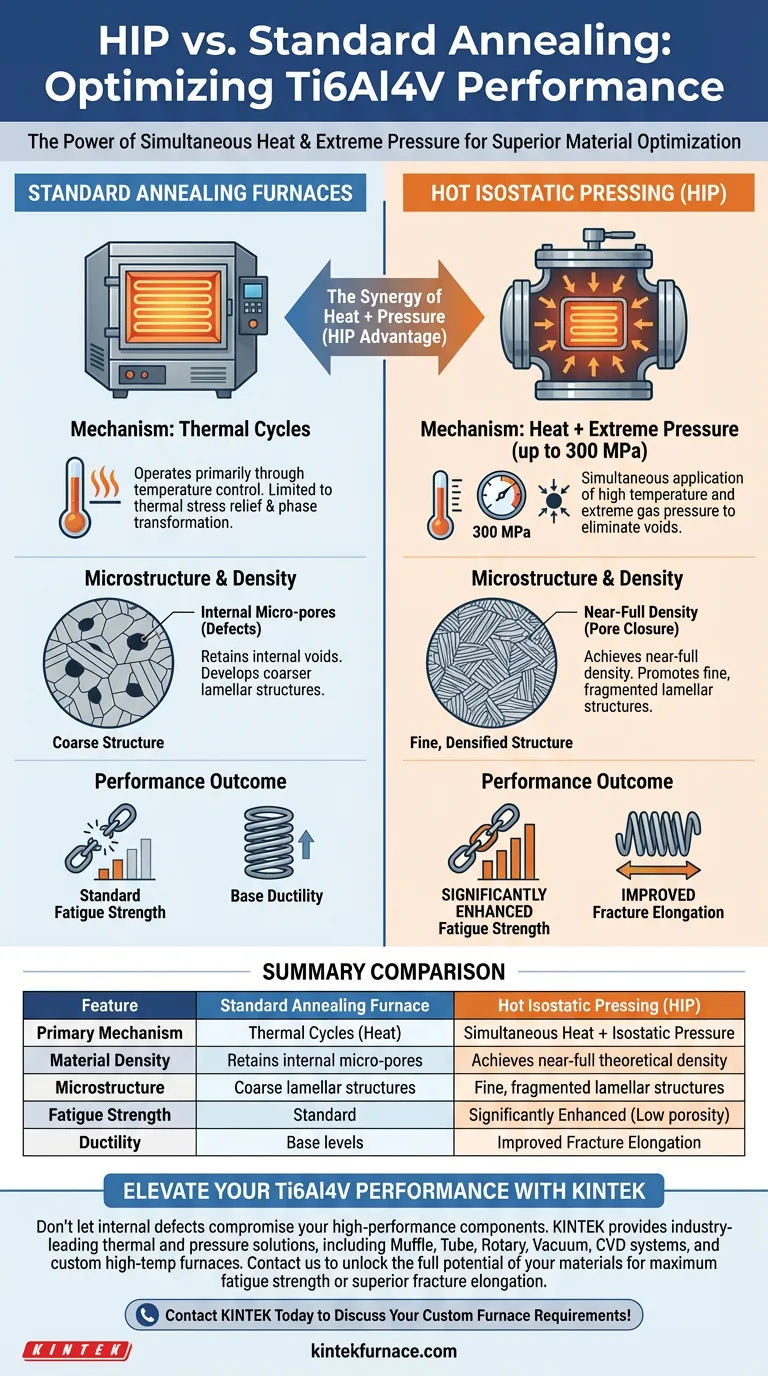
Hot Isostatic Pressing (HIP) provides a distinct advantage over standard annealing by subjecting Ti6Al4V components to simultaneous high temperature and extreme gas pressure (up to 300 MPa). Unlike standard furnaces which rely solely on thermal cycles, this combination actively eliminates internal voids to achieve near-full density and superior mechanical resilience.
The core differentiator is the synergistic application of heat and pressure. While standard furnaces treat the material thermally, HIP utilizes pressure to physically close residual micro-pores, resulting in fine, fragmented lamellar structures that standard annealing cannot produce.
The Mechanism of Densification
Simultaneous Heat and Pressure
Standard annealing furnaces operate primarily through temperature control. In contrast, HIP equipment introduces a critical second variable: extreme gas pressure reaching levels such as 300 MPa.
Elimination of Internal Defects
This intense pressure works in concert with high temperatures to collapse internal voids. The process effectively closes residual micro-pores and defects within the Ti6Al4V material, creating a level of material solidity that thermal treatment alone cannot achieve.
Achieving Near-Full Density
The primary physical result of this process is the achievement of near-full density. By physically forcing material into void spaces, the structural integrity of the component is maximized at a microscopic level.
Microstructural Transformation
Fine, Fragmented Lamellar Structures
The impact of HIP extends beyond simple density to the crystalline structure of the alloy. The process promotes the formation of a fine, fragmented lamellar microstructure.
Superiority Over Standard Furnace Output
Parts processed in standard furnaces typically develop coarser structures. The refined microstructure generated by HIP is a direct contributor to the enhanced performance characteristics of the final part.
Measurable Performance Gains
Enhanced Fatigue Strength
The reduction of porosity and the refinement of the microstructure directly improve the material's resistance to cyclic loading. HIP-treated parts exhibit significantly higher fatigue strength compared to their furnace-annealed counterparts.
Improved Fracture Elongation
In addition to strength, the material's ductility is positively affected. The specific microstructural changes allow for greater fracture elongation, meaning the material can withstand more deformation before failing.
Understanding the Comparison
The Limits of Standard Annealing
It is critical to understand that standard annealing furnaces are limited to thermal stress relief and phase transformation. Without the element of isostatic pressure, they cannot actively close existing porosity or densify the material.
The Necessity of Synergy
The benefits of HIP are not derived from heat or pressure in isolation, but from their synergistic effect. It is this combination that unlocks the specific mechanical properties required for high-performance applications.
Making the Right Choice for Your Goal
To determine if HIP is the correct optimization route for your Ti6Al4V components, consider your specific mechanical requirements.
- If your primary focus is maximizing cyclic durability: HIP is essential because it closes the micro-pores that typically serve as crack initiation sites, significantly boosting fatigue strength.
- If your primary focus is material ductility: HIP provides the necessary microstructural refinement to improve fracture elongation, allowing for greater deformation before failure.
By integrating extreme pressure with thermal processing, HIP transforms Ti6Al4V from a standard alloy into a fully densified, high-performance material.
Summary Table:
| Feature | Standard Annealing Furnace | Hot Isostatic Pressing (HIP) |
|---|---|---|
| Primary Mechanism | Thermal Cycles (Heat) | Simultaneous Heat + Isostatic Pressure |
| Material Density | Retains internal micro-pores | Achieves near-full theoretical density |
| Microstructure | Coarse lamellar structures | Fine, fragmented lamellar structures |
| Fatigue Strength | Standard | Significantly Enhanced (Low porosity) |
| Ductility | Base levels | Improved Fracture Elongation |
Elevate Your Ti6Al4V Performance with KINTEK
Don't let internal defects compromise your high-performance components. KINTEK provides industry-leading thermal and pressure solutions designed to unlock the full potential of your materials. Backed by expert R&D and precision manufacturing, we offer a comprehensive range of Muffle, Tube, Rotary, Vacuum, and CVD systems, along with customizable high-temp furnaces tailored to your unique metallurgy needs.
Whether you require maximum fatigue strength or superior fracture elongation, our team is ready to help you optimize your process. Contact KINTEK today to discuss your custom furnace requirements!
Visual Guide
References
- Anna Antolak‐Dudka, Justyna Łukasiewicz. Comparison of the Microstructural, Mechanical and Corrosion Resistance Properties of Ti6Al4V Samples Manufactured by LENS and Subjected to Various Heat Treatments. DOI: 10.3390/ma17051166
This article is also based on technical information from Kintek Furnace Knowledge Base .
Related Products
- Vacuum Hot Press Furnace Machine for Lamination and Heating
- Vacuum Hot Press Furnace Machine Heated Vacuum Press Tube Furnace
- Vacuum Hot Press Furnace Machine Heated Vacuum Press
- High Pressure Laboratory Vacuum Tube Furnace
- 2200 ℃ Tungsten Vacuum Heat Treat and Sintering Furnace
People Also Ask
- What are the primary components of a vacuum hot press furnace? Master the Core Systems for Precise Material Processing
- What safety features are incorporated in vacuum hot press furnaces? Ensure Operator and Equipment Protection
- What are the benefits of the vacuum environment system in a vacuum hot press furnace? Unlock High-Density Sintering
- What industries benefit from the use of vacuum hot press furnaces? Unlock High-Performance Materials for Your Industry
- What control features does a vacuum hot press furnace offer? Precision Control for Advanced Materials Processing