
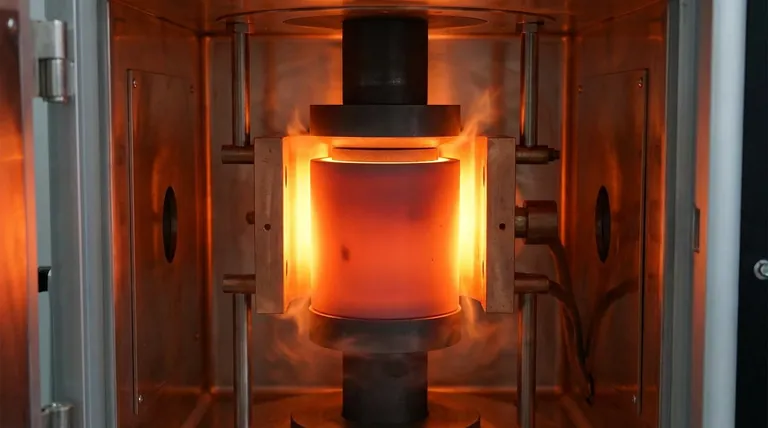
High-purity graphite molds function as the central processing vessel during the Spark Plasma Sintering (SPS) of TiC-reinforced SiC composites. They perform three simultaneous and critical roles: they act as a geometric container for the powder, a resistive heating element that generates thermal energy, and a mechanical piston that transmits uniform pressure to the sample.
Core Takeaway The graphite mold facilitates the "thermal-mechanical coupling" required to densify refractory composites. By serving simultaneously as the heat source and the pressure transmission medium, it enables rapid heating and full densification at temperatures up to 2000°C while maintaining dimensional stability.
The Functional Roles of the Mold
Acting as a Resistive Heating Element
In conventional sintering, heat is applied externally. In SPS, the graphite mold itself generates the heat.
The mold possesses high electrical conductivity. When the SPS machine passes a pulsed direct current (DC) through the mold, it acts as a resistor.
This process converts electrical energy directly into Joule heat. Because the heat is generated immediately adjacent to and within the sample, the temperature rises rapidly and efficiently.
Transmitting Mechanical Pressure
The mold is not a static container; it is an active mechanical component. It serves as the medium to transmit axial pressure to the TiC-SiC powder mixture.
This pressure typically reaches limits around 50 to 60 MPa for standard high-strength graphite.
Applying this pressure during heating is critical. It forces particles together, promotes atomic diffusion, and assists in the breakdown of agglomerates, leading to higher density in the final composite.
Ensuring Geometric Containment
At the macroscopic level, the mold defines the shape and dimensions of the final product.
It acts as a rigid containment vessel that holds the loose powder mixture in place. This ensures the material creates a coherent solid rather than flowing outward under the applied load.
Why Graphite is Critical for TiC-SiC Composites
Thermal Stability at Extreme Temperatures
Sintering silicon carbide (SiC) based composites requires extreme heat to achieve full density.
High-purity graphite maintains its structural strength and integrity at temperatures between 1800°C and 2000°C.
While other mold materials might soften, deform, or melt at these temperatures, graphite remains stable, ensuring the composite retains its intended geometry.
Uniform Energy Distribution
Achieving a uniform microstructure in a composite reinforced with Titanium Carbide (TiC) requires even heating.
The graphite mold absorbs the pulsed current and distributes the resulting thermal energy uniformly across the sample.
This prevents "hot spots" that could lead to uneven grain growth or residual stresses within the ceramic matrix.
Understanding the Trade-offs
Pressure Limitations
While graphite is strong at high temperatures, it has mechanical limits compared to metals used in low-temperature processing.
Standard high-purity graphite molds generally withstand pressures up to 60 MPa. Exceeding this limit to force higher density risks fracturing the mold during the process.
Chemical Interactions
Graphite is chemically active at elevated temperatures.
While beneficial for conductivity, there is a potential for surface interactions between the carbon in the mold and the constituent powders if not properly managed with barrier foils or specific processing atmospheres.
Making the Right Choice for Your Goal
To maximize the effectiveness of high-purity graphite molds in your SPS process, consider the following processing targets:
- If your primary focus is Rapid Densification: Utilize the mold's high conductivity to increase heating rates, enabling fast thermo-mechanical coupling that suppresses grain coarsening.
- If your primary focus is Geometric Precision: Operate within the safe pressure limits (typically under 60 MPa) to prevent mold deformation, relying on the high-temperature dwell time (1800°C+) to achieve final density.
Success in SPS relies on balancing the thermal energy generated by the mold with the mechanical pressure it can safely transmit.
Summary Table:
| Role | Functional Mechanism | Impact on TiC-SiC Composites |
|---|---|---|
| Resistive Heating | Converts pulsed DC into Joule heat | Enables rapid heating and efficient densification at 2000°C |
| Pressure Transmission | Transmits 50-60 MPa of axial pressure | Promotes atomic diffusion and eliminates porosity |
| Geometric Containment | Defines shape and holds loose powders | Ensures dimensional stability and prevents material flow |
| Thermal Stability | Maintains strength at extreme temperatures | Prevents mold deformation during high-temp ceramic sintering |
Optimize Your Advanced Material Sintering with KINTEK
Achieving full densification in refractory composites like TiC-SiC requires more than just high temperatures—it demands precision-engineered equipment. Backed by expert R&D and manufacturing, KINTEK offers state-of-the-art Muffle, Tube, Rotary, Vacuum, and CVD systems, alongside customizable high-temperature lab furnaces designed to meet your unique processing needs.
Whether you are refining Spark Plasma Sintering parameters or scaling up production, our team is ready to help you achieve superior grain control and material performance.
Contact KINTEK today to find your custom heating solution!
References
- Advancing Technology and Addressing Toxicity: The Dual Impacts of Rare Earth Elements on Materials and the Environment. DOI: 10.37933/nipes/7.2.2025.19
This article is also based on technical information from Kintek Furnace Knowledge Base .
Related Products
People Also Ask
- How does the heating mechanism of Spark Plasma Sintering (SPS) function? Enhance TiC/SiC Composite Fabrication
- Why is it necessary to maintain a high vacuum environment during the SPS of SiC? Key to High-Density Ceramics
- What are the technical advantages of using an SPS sintering furnace? Elevate Al2O3-TiC Material Performance
- What are the steps in the discharge plasma sintering process? Master Fast, High-Density Material Consolidation
- What are the advantages of spark plasma sintering (SPS) over traditional forging? Precision Microstructural Control

